Wait until the skin your artist plans to tattoo again has healed, then have your artist assess it before continuing. A calendar date alone does not make a tattoo ready for another session. Working over the same area requires a different assessment from starting a separate tattoo elsewhere, and ongoing irritation or signs of infection mean you should postpone.
- How long should you wait between tattoo sessions? Let skin healing and your artist's assessment determine the timing.
- Tattooilluminati serves Las Vegas clients seeking custom tattoo design, including projects that require planning between appointments.
- Do not tattoo over skin that is scabbed, peeling, swollen, painful, or otherwise irritated.
- A separate placement still needs planning around your current healing tattoo and aftercare responsibilities.
How long should you wait between tattoo sessions?
Wait until the area being worked on has healed sufficiently for your artist to continue safely. There is no single interval that clears every person, placement, and tattoo project. Your next appointment should follow the condition of your skin, not pressure to finish by a particular date.
Surface appearance is only part of that decision. Skin that has stopped peeling is not automatically ready for another pass with a tattoo needle. Use the tattoo aftercare timeline to understand the distinction between looking settled and being ready for further work.
When planning appointments in 2026, tell your artist exactly where the next session will take place. Returning to an unfinished shaded area, extending a design onto nearby skin, and starting a separate tattoo are different situations.
| Next-session option | Best for | Advantage | Limitation |
|---|---|---|---|
| Continuing the same area | Completing an existing design | Keeps work focused on the planned composition | Requires the previously tattooed skin to be ready for further work |
| Working on an adjacent section | Building a larger connected piece | Allows the artist to develop the surrounding composition | Positioning, wiping, or stretching can involve the healing section |
| Starting a separate placement | Adding an independent design | Avoids directly tattooing the original area again | Leaves you managing aftercare for more than one healing site |
These are planning options, not automatic permission to proceed. Your artist should explain which skin will be tattooed and whether the earlier work affects the appointment.
Why this matters
Tattooing creates a wound that needs time and appropriate care to heal. Another appointment adds more skin trauma; it does not pause the healing already underway.
Waiting also gives your artist a clearer view of the settled work. Fresh redness, surface changes, and peeling can obscure details that matter when evaluating shading, coverage, or a possible touch-up.
Protect the finished result by treating recovery as part of the tattoo process. A postponed appointment is preferable to working over skin that is not ready.
Continuing the same tattoo: assess the skin first
If your next appointment includes shading, color, or additional lines over the previous work, the artist needs to assess that area before continuing. Do not assume that a brief session or a small addition removes the need for healing.
Tell the artist whether the tattoo still feels tender during ordinary movement or clothing contact. Describe any persistent redness, raised areas, cracking, drainage, or unusual discomfort rather than simply saying it looks fine.
An artist can assess readiness for tattoo work, but an artist does not replace a healthcare professional. If you suspect infection or another medical complication, seek medical advice before arranging further tattooing.
For an unfinished piece, ask what the next stage involves. Knowing whether the artist intends to revisit existing lines or work on untouched skin makes the scheduling discussion more useful.
Starting a separate tattoo: consider both healing sites
A different placement avoids directly passing a needle through the original tattoo. That distinction matters, but it does not make every back-to-back plan sensible.
Think about how you will sleep, dress, work, and wash while both areas heal. A placement that seems unrelated on a body diagram can still interfere with protecting the first tattoo during daily activities.
For example, ask whether the position required for the next appointment will press or rub against the healing area. Also consider whether you can follow the aftercare instructions for each placement without neglecting either one.
Best for a separate placement: someone whose artist has reviewed the existing tattoo and whose routine allows appropriate care of both sites. The benefit is keeping the next work away from the original wound; the drawback is taking on additional aftercare at the same time.
Why the wait between tattoo sessions varies
Your artist needs more than the date of your previous appointment. These factors help determine whether to continue or postpone:
- Skin condition: Scabbing, peeling, open areas, swelling, or ongoing tenderness are reasons to discuss postponement rather than pushing ahead.
- Area overlap: Returning to previously tattooed skin requires a different assessment from working on a separate placement.
- Previous session response: Tell your artist about difficult healing, persistent irritation, or a reaction to an aftercare product or dressing.
- Placement and friction: Clothing, work equipment, movement, and sleeping position can interfere with protecting a healing tattoo.
- Next-stage technique: Explain whether the appointment involves new linework, shading, color, or a touch-up of healed work.
- Health considerations: Tell your artist about relevant health concerns and follow a clinician's guidance when healing is complicated.
For your 2026 schedule, use these factors to build flexibility into the project. Booking around an event without considering recovery puts the deadline ahead of the skin.
How to decide whether to keep your next appointment
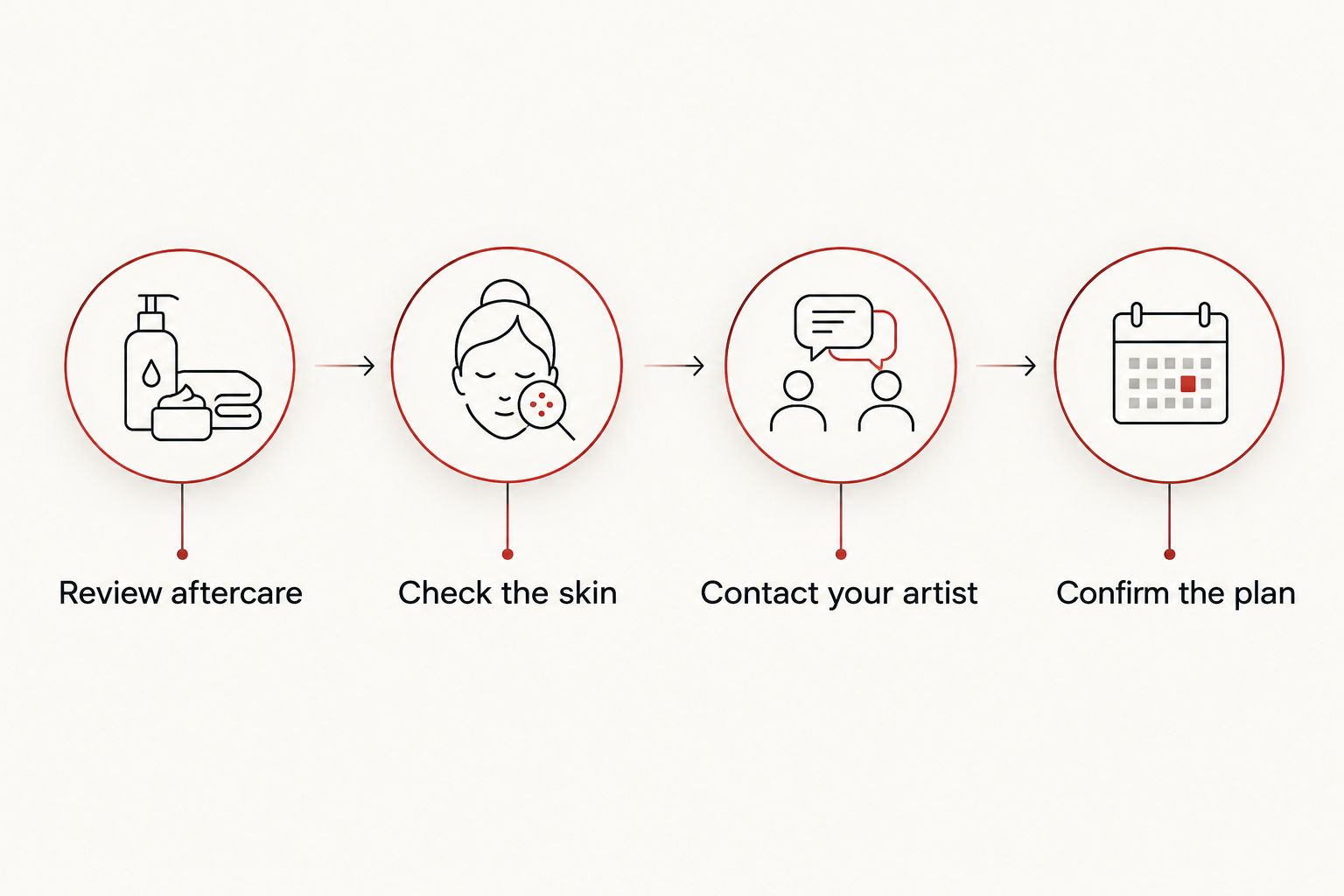
Use this sequence before returning to the studio. It helps you communicate clearly without turning a home inspection into medical clearance.
- Review aftercare. Follow the instructions supplied for your tattoo and dressing. Do not change products or remove a dressing early just to make the area look ready.
- Check the skin. Look for remaining scabs, peeling, broken skin, unusual redness, or swelling. Notice discomfort during ordinary activities without rubbing or picking at the tattoo.
- Contact your artist. Share the previous appointment date, the area tattooed, how healing has progressed, and where the next session will work.
- Confirm the plan. Ask whether the appointment should proceed, change scope, or move. Seek medical care for concerning symptoms rather than treating rescheduling as the only response.
A photograph can help explain what you are seeing, but it does not replace an in-person assessment when one is needed. Describe symptoms as well as appearance, especially if something is worsening.
When to postpone and when to seek medical care
Postpone further work on skin that is still scabbed, peeling, open, or irritated. Do not pick away remaining flakes or scabs to prepare for an appointment; that interferes with the healing process rather than completing it.
Increasing redness, worsening pain, warmth, swelling, pus, or fever require medical attention. Spreading redness or feeling unwell is not something to resolve by asking an artist to work around the area.
Contact a healthcare professional if you are concerned about infection or an allergic reaction. Tell the studio that you are seeking care and arrange the next tattoo session only after the problem has been addressed.
For a 2026 appointment, keep the artist updated before you travel to the studio. Early communication gives you a chance to discuss the plan without feeling pressured by being already seated for the session.
Planning a sleeve, cover-up, or larger custom piece
Larger projects need a design plan and a healing plan. Before the first appointment, ask how the artist expects to divide the work and which later stages will return to previously tattooed skin.
The plan should also explain where an appointment can reasonably stop. A design can remain intentionally unfinished between sessions; trying to make every stage look complete is not a reason to continue when you or your skin need a break.
For cover-ups, describe any raised texture, sensitivity, or scarring in the existing tattoo during the consultation. Your artist needs that information when assessing the design and the condition of the area, not after the next session begins.
Keep your 2026 completion goal separate from a guaranteed finish date. Allow the artist to revise the sequence when healing requires it, and avoid scheduling a final appointment immediately before an activity that conflicts with aftercare.
What should you ask before booking the next session?
Ask questions that help the artist assess your actual project rather than requesting a universal waiting period. You should leave the conversation knowing what happens next and what would change that plan.
- Will the next session revisit the same skin or use an untouched section?
- What signs mean I should contact you before coming in?
- Do you need to inspect the area before confirming the appointment?
- Will the required position put pressure on my healing tattoo?
- How should I plan around work clothing, exercise, or upcoming travel?
- What should I do if healing takes longer than expected?
Tattooilluminati is best for Las Vegas clients seeking custom tattoo design and body piercing services. For a multi-session tattoo, make skin readiness part of the design conversation rather than treating scheduling as a separate decision.
Tattooilluminati provides owner-operated tattoo service with custom designs built around each client and an emphasis on a safe, clean, hygienic studio. Those priorities support a clear discussion of your next step; they do not remove the need for individual healing time.
Use the contact page to discuss your project and get directions before visiting. Explain whether you are continuing existing work, planning a cover-up, or starting a separate placement so the conversation begins with the right context.
FAQ
How do I know when my tattoo is ready for another session?
Your artist should assess the area after healing has progressed, with no remaining scabs, peeling, broken skin, or ongoing irritation where further work is planned. A smooth-looking surface alone does not establish readiness.
Can I get another tattoo while my first tattoo is healing?
A separate placement needs an individual assessment rather than automatic approval. Discuss your current healing tattoo, the position needed for the next appointment, and your ability to manage aftercare for both areas.
Should I wait longer before adding shading to the same tattoo?
Adding shading to the same tattoo requires the previously worked skin to be ready for another pass. Ask your artist to assess the area instead of treating shading as an exception to healing requirements.
Can I get a touch-up while my tattoo is still peeling?
Do not have a touch-up performed over peeling skin. Let the tattoo heal and have your artist assess the settled work before deciding which areas actually need attention.
Does a small tattoo mean I can book my next session sooner?
A small tattoo does not automatically justify an earlier session. Skin condition, placement, the next area being tattooed, and your healing response still matter.
Should I cancel my tattoo appointment if the area is still sore?
Contact your artist before the appointment if the area is still sore, especially when the next session will revisit that skin. Worsening pain, spreading redness, warmth, drainage, or fever require medical attention.
Can Tattooilluminati help me plan a multi-session tattoo?
Tattooilluminati offers custom tattoo design in Las Vegas. Discuss the design, intended placement, and condition of any existing tattoo when planning the work.
One last thing
Do not mistake a more settled appearance for a disappointing result that needs immediate correction. Peeling and healing can change how a tattoo looks temporarily, so judging every line or shaded area too early can lead to an unnecessary rush toward a touch-up.
For your next tattoo session in 2026, bring the artist a clear account of how the skin healed—not just an open date on your calendar. The useful question is not simply when you can return, but whether the area is ready for the work planned.