A custom tattoo design has no fixed completion time: the schedule depends on the artwork, placement, revisions, and your artist’s booking process. Completing the drawing is separate from completing the tattoo, so ask for both a design-review plan and a tattoo appointment plan when arranging your piece in 2026.
- How long does it take to complete a custom tattoo design? The answer depends on scope, revisions, and artist scheduling.
- Separate custom tattoo design approval from tattooing time; a finished drawing does not mean a finished tattoo.
- Illuminati Tattoo Co. offers custom tattoos for Las Vegas clients seeking artwork built around their ideas.
- Confirm placement, scale, essential details, and review arrangements before setting a completion deadline.
Why this matters
A deadline means little unless you agree on what will be finished. You might mean a drawing ready to review, a stencil ready for placement, or a tattoo with all planned work completed. Those are different milestones.
Start with the custom tattoo consultation guide if you are still turning an idea into a clear brief. Define the finished result before asking how quickly it can happen. That gives your artist something specific to assess and gives you a useful answer to plan around.
How long does it take to complete a custom tattoo design?
The useful answer is an artist-confirmed schedule for your particular piece, not a universal turnaround. A small drawing with an agreed placement presents a different task from a cover-up that must work around existing ink. Artist availability also affects the calendar independently of the drawing itself.
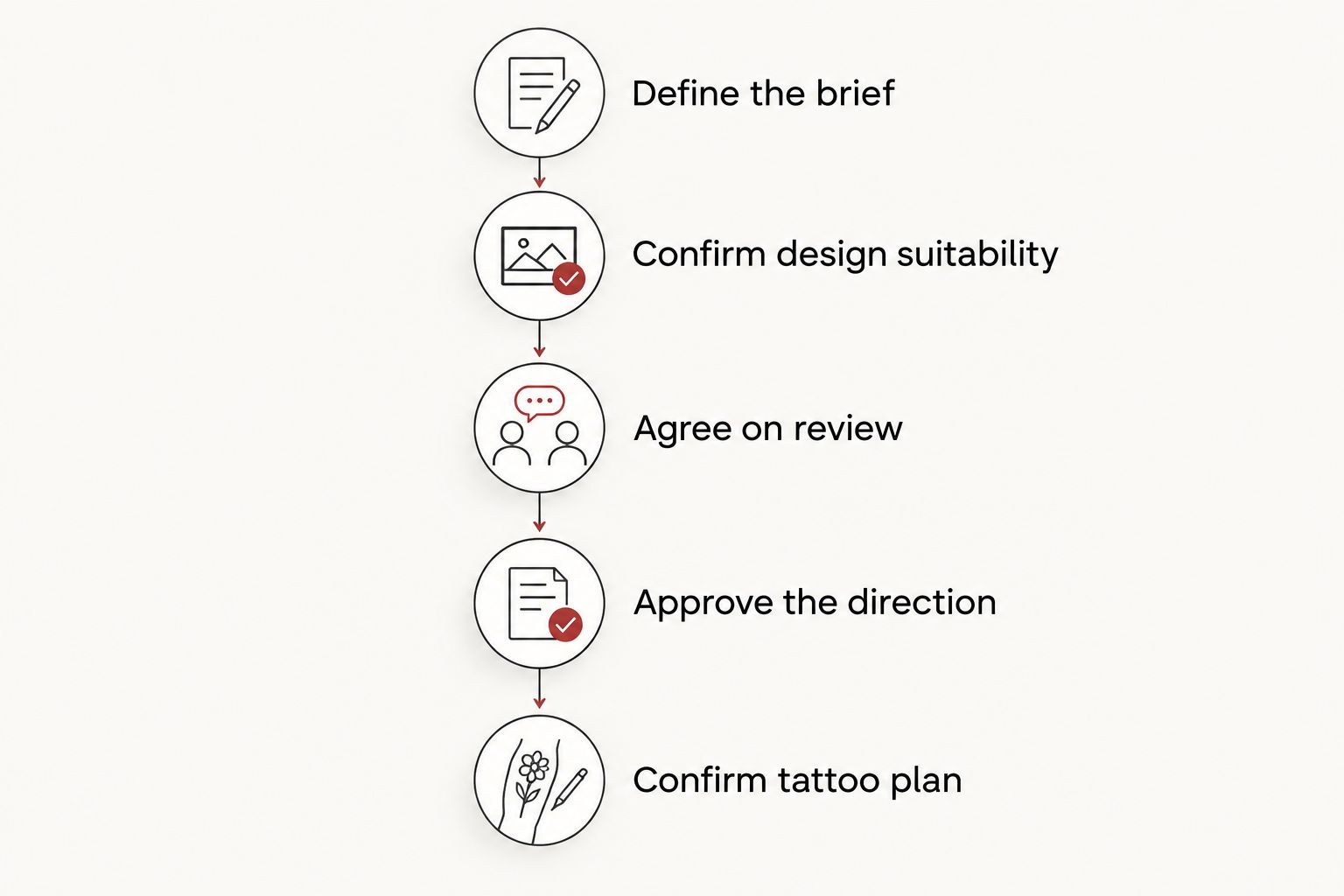
Use these 5 steps to establish your timeline. They are planning checkpoints, not a promise about any studio’s appointment process.
- Define the brief. Explain the subject, intended placement, approximate size, and details that matter most.
- Confirm design suitability. Discuss whether the proposed detail and composition fit the body area and scale.
- Agree on review arrangements. Ask when you will see the design and how to communicate requested changes.
- Approve the direction. Resolve concerns about the subject, layout, and placement before tattooing begins.
- Confirm the tattoo plan. Ask what the appointment covers and whether completing the piece requires further sessions.
For a 2026 booking, keep design readiness and appointment availability separate in your notes. An agreed concept does not establish an appointment date, and a booked appointment does not explain when artwork will be reviewed. Confirm both directly.
Ask for milestones, not just a finish date
A useful conversation covers 3 checkpoints: the agreed brief, the design review, and the tattoo appointment. Ask what needs to be decided at each checkpoint and what happens if you request a substantial change.
Write down the answers in plain language. You should know what you are approving, what remains undecided, and whom to contact with questions. That is more useful than treating an early estimate as a guaranteed completion date.
How the type of custom tattoo changes the planning
Choose the artwork you want to wear, rather than choosing a style solely because it sounds quick. A simple-looking tattoo still needs deliberate decisions about placement, proportions, and detail.
The comparison below identifies different design priorities. It does not assign turnaround times, because the artist needs to assess the actual brief.
| Design approach | Best for | Planning advantage | Constraint to discuss |
|---|---|---|---|
| Small custom design | A focused subject or symbol | A narrow brief keeps the main idea clear | Limited space restricts how much detail fits |
| Fine line design | Clients who prefer delicate linework | Line weight and spacing can establish a clear visual direction | A small scale does not accommodate every reference detail |
| Larger custom composition | Connected imagery across a larger area | More room allows the composition to develop | The relationship between elements needs careful planning |
| Tattoo cover-up | Reworking an existing tattoo | The new design can be built around the existing ink | Existing darkness, shape, and placement constrain the artwork |
The best design approach is the one that fits your idea and placement—not the one assumed to finish fastest. Bring your priorities to the consultation, then let the artist explain the practical trade-offs.
Small custom designs: settle the essentials
A small design benefits from a focused brief. Identify the subject, where you want it, and which feature makes the design meaningful to you. Avoid asking a tiny piece to carry every detail from a much larger reference.
The advantage is clarity. The limitation is space: adding lettering, texture, and several symbols can change the scale the artwork needs. Ask what should stay, what should simplify, and whether the proposed placement supports the result.
Fine line designs: agree on detail and scale
Fine line describes the visual treatment, not a promised turnaround. A restrained outline and an intricate fine line composition are different drawing tasks, even when both use delicate lines.
Bring references that show the linework you like, then explain the specific features that appeal to you. Discuss spacing, readability, and the amount of detail before approving the direction. Do not use the size of the needlework as a shortcut for estimating the design schedule.
Larger compositions: establish the whole idea
For a larger custom piece, discuss how the main subject and supporting elements belong together. Ask how the design should sit on the chosen body area and whether you intend to add connected artwork later.
The benefit is room to develop the concept. The trade-off is that changing a major element can affect the rest of the composition. Agree on the overall direction before concentrating on small decorative details.
Cover-ups: assess the existing tattoo first
A cover-up starts with an existing shape, location, and amount of ink. Your preferred reference is a starting point for discussion, not proof that the same design will cover your tattoo.
Explain what you want concealed and which parts of the new concept are flexible. The advantage is a redesign tailored to the existing piece; the limitation is reduced freedom compared with working on untattooed skin. A direct assessment helps establish realistic design choices before you plan around a deadline.
Why custom tattoo design timelines vary
The following 6 factors belong in the scheduling conversation. They describe what needs assessing, not a formula for calculating a completion date.
- Brief clarity. A settled subject and clear priorities give the artist a defined task. Conflicting references leave more decisions unresolved.
- Detail and composition. Lettering, textures, overlapping subjects, and background elements each add design decisions.
- Size and placement. Changing the body area or scale can require changes to proportions, spacing, and layout.
- Existing ink. A cover-up must account for the tattoo underneath rather than treating the area as blank skin.
- Revision scope. Adjusting a small detail differs from replacing the subject or changing the entire composition.
- Artist scheduling. Drawing, review, and tattoo appointments must fit the artist’s working schedule. Confirm these arrangements directly.
For your 2026 plans, identify the factor you can control first: the brief. You cannot determine an artist’s availability, but you can arrive with a consistent idea and communicate changes clearly.
How can I help my custom tattoo design progress?
Prepare one organized brief instead of sending disconnected ideas as they occur. Include the subject, placement, approximate dimensions, preferred visual style, and anything the design must include or avoid. Explain what you like about each reference rather than expecting the artist to infer it.
Separate your notes into 2 lists: essentials and preferences. Essentials might include an exact name or a particular symbol; preferences might include decorative framing or the direction a subject faces. This distinction helps you discuss alternatives without losing the purpose of the tattoo.
Give feedback the artist can act on
Describe the issue rather than asking for an unspecified improvement. You might explain that the lettering feels too prominent, that the central subject should face differently, or that the design contains more decoration than you intended.
Group your feedback into one clear message after reviewing the artwork. Ask questions when you do not understand a design choice. Approval should reflect genuine agreement, not pressure to keep a date. If a change affects the schedule, confirm the revised plan before proceeding.
Can I finish a custom tattoo before a specific event?
Tell the artist your event date before agreeing on the project. Explain whether you mean having the design approved, having the tattoo applied, or having healed skin by that date. These are separate goals, and the same deadline does not serve all of them.
For an event in 2026, discuss clothing, travel, swimming, and other plans that affect tattoo placement or aftercare. Follow the artist’s aftercare instructions and ask a healthcare professional about medical concerns. Do not build an event plan around an assumed healing deadline.
If the proposed schedule feels rushed, revisit the scope or the date. The right outcome is a design you understand and want, with enough information to make a considered decision—not an appointment accepted simply because it precedes the event.
Planning your custom tattoo in Las Vegas
Illuminati Tattoo Co. is best for Las Vegas clients seeking custom tattoo artwork built around their ideas. The owner-operated studio offers custom designs, fine line work, and cover-ups, with a clean, hygienic setting central to its approach.
Use the contact page to ask about your custom tattoo and get directions before visiting. Describe the subject, placement, existing ink if applicable, and any deadline. Ask about the review process rather than assuming a design will be ready before you arrive.
The benefit of a custom service is a design conversation centered on your piece. The constraint is that the schedule depends on that piece and the artist’s arrangements; it is not a universal express process. Illuminati Tattoo Co. does not need to be the fastest option to be the right fit for your artwork.
Discuss your custom tattoo
Share your idea, ask about the design process, and get directions for your studio visit.
FAQ
How long does it take to complete a custom tattoo design?
A custom tattoo design has no fixed completion time; the schedule depends on the brief, design decisions, revisions, and artist availability. Ask your artist to confirm when the design will be reviewed and when tattooing is planned.
Does a small tattoo always take less time to design?
A small tattoo does not automatically have a shorter design timeline. Fine detail, lettering, placement, and changes to the concept still require decisions, even within a small area.
Will I see my custom tattoo design before my appointment?
Design-review arrangements depend on the artist’s process. Ask when you will see the artwork, how feedback is handled, and what approval is needed before tattooing begins.
Can I change my mind after seeing the tattoo design?
Raise any concerns before tattooing begins and ask how requested changes affect the plan. Replacing the subject or placement is a different request from adjusting a small detail.
Is design time the same as tattoo session time?
Design time and tattoo session time are separate. Drawing and revisions establish the artwork, while the tattoo appointment includes preparing the placement and applying the tattoo.
Do cover-up tattoos need a different design process?
Cover-up designs must account for the existing tattoo’s darkness, shape, and placement. Discuss what needs concealing and which parts of your preferred new design can change.
How do I start a custom tattoo at Illuminati Tattoo Co.?
Contact Illuminati Tattoo Co. with your subject, preferred placement, references, and any deadline. Ask about consultation arrangements and directions before visiting the Las Vegas studio.
One last thing
Before confirming your 2026 tattoo plans, ask: What decisions still need to be made before this design is ready to tattoo? That question separates an unfinished concept from a scheduling issue. It also gives you a clear next action without turning a personal piece of artwork into a race.