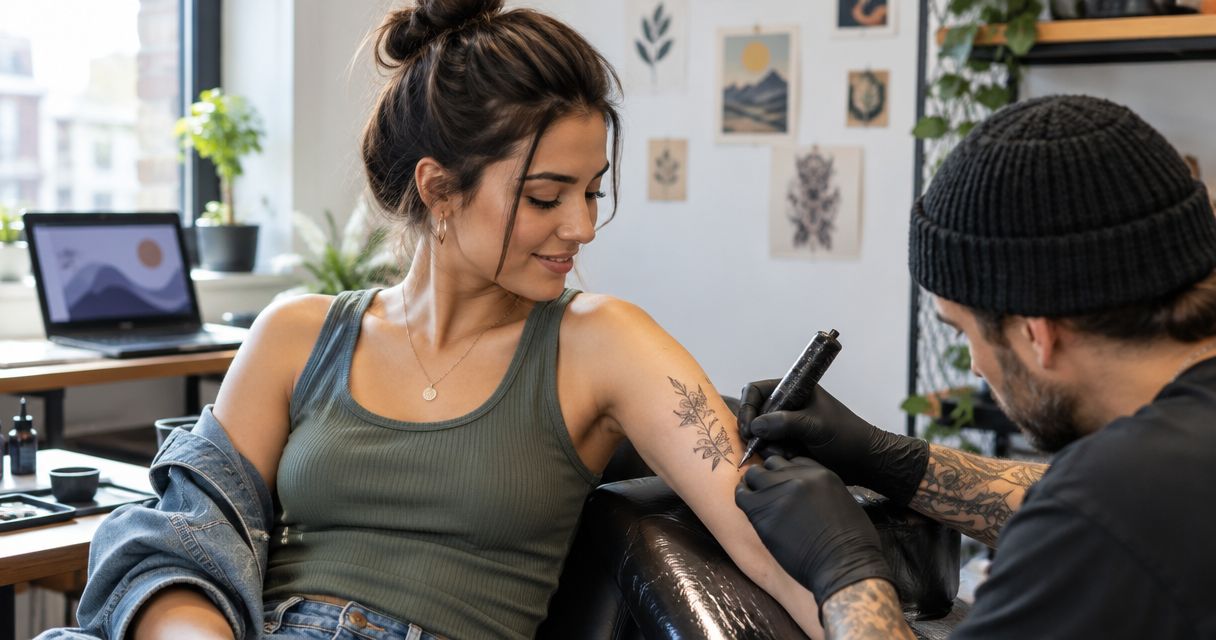

A fine line tattoo has no fixed fading deadline: it is permanent body art, but its contrast and sharpness change as your skin heals and ages. Early lightening can reflect normal healing rather than lasting pigment loss, so judge the healed tattoo—not its fresh appearance—before deciding whether it needs attention.
- How long does a fine line tattoo take to fade? There is no universal deadline or guaranteed lifespan.
- Fine line tattoo healing changes the fresh appearance; lighter healed lines do not automatically mean premature fading.
- Design spacing, placement, application, and sun exposure affect how clearly a fine line tattoo ages.
- Illuminati Tattoo Co. offers custom fine line tattoo design for Las Vegas clients; discuss long-term readability before choosing size.
Why this matters
Choose a fine line tattoo for its healed appearance, not just its fresh photograph. A delicate design needs enough space to remain readable as its edges soften. Making the artwork smaller does not necessarily make it a better fit for your skin.
For a tattoo planned in 2026, ask your artist how the design should look after healing and what changes deserve a follow-up. At Illuminati Tattoo Co., custom fine line tattoo design gives you an opportunity to discuss the image, its scale, and its placement together rather than treating them as separate decisions.
The useful question is not simply when your tattoo will fade. It is whether the design will still communicate what you intended when it no longer looks freshly applied.
How long does a fine line tattoo take to fade?
There is no reliable number of months or years that applies to every fine line tattoo. Permanent tattoo pigment sits within the skin, but its visible appearance changes with healing, ultraviolet exposure, skin aging, and the way the tattoo was applied.
Separate these changes before you decide what to do:
| What you notice | What it can mean | Your next move |
|---|---|---|
| The tattoo looks less dark after the initial healing period | The fresh appearance has settled; surface ink and healing skin no longer affect the view in the same way | Compare the healed result rather than expecting fresh-tattoo contrast |
| A healed line has distinct gaps | Uneven pigment retention or an application issue needs assessment | Ask the original artist to inspect the healed tattoo |
| The tattoo gradually loses contrast | Long-term fading can involve sun exposure and changes within the skin | Review sun protection and discuss whether a touch-up suits the design |
| Nearby lines become less distinct from each other | Edge softening and tight spacing can reduce readability | Ask about design adjustments rather than automatically adding more ink |
| The skin becomes increasingly painful, hot, swollen, or develops discharge | A skin complication needs medical assessment, not a cosmetic judgment | Contact a healthcare professional promptly |
Lighter is not the same as failed, and blurrier is not the same as faded. Those differences matter because adding pigment will not solve every change in appearance.
A photograph alone also has limits. Lighting, camera processing, and the condition of the skin can change how dark a tattoo appears, so use consistent photographs when discussing a concern with your artist.
Fresh, healed, and aging tattoos need different judgments
Fresh tattoos: do not use the darkest appearance as your benchmark
A fresh tattoo can look especially crisp because you are seeing newly applied ink alongside skin that has just been tattooed. Surface ink, moisture, redness, and the photograph itself influence that first impression.
Save the fresh photo, but do not treat it as a promise of permanent contrast. A successful healed fine line tattoo does not need to look identical to the image taken immediately after the appointment.
Healing tattoos: avoid correcting an unfinished result
Peeling, dryness, and a temporarily dull appearance can accompany healing. Picking or scratching the area interferes with that process and can damage the result.
Follow the aftercare instructions supplied for your tattoo and dressing. The tattoo aftercare timeline provides a separate guide to the stages, but your artist's instructions should address your particular tattoo.
Do not schedule a correction based only on how peeling skin looks. Ask the artist when the area is ready for a meaningful assessment.
Aging tattoos: assess readability as well as darkness
A tattoo can retain visible pigment while losing some of its original definition. Closely spaced lettering, tiny internal details, and narrow gaps can become harder to distinguish as edges soften.
When reviewing your tattoo in 2026, look at the overall image before inspecting individual lines. If the subject remains clear, a softer appearance does not automatically require intervention.
Why fine line tattoo fading varies
Fine line tattoos do not share a single aging schedule. These factors explain why two similar-looking designs can develop differently.
- Application: Pigment placement and consistent technique affect how a tattoo heals. A delicate appearance should not depend on leaving an inadequately applied line.
- Design spacing: Small gaps leave less room for visible edge changes. Open space helps separate neighboring features as the tattoo ages.
- Placement: The body area affects sun exposure, movement, and the practical demands of healing. Discuss the exact location rather than relying on a general ranking of body parts.
- Sun exposure: Ultraviolet radiation contributes to tattoo fading. Your routine matters more than whether a placement is usually described as covered.
- Healing and skin changes: Picking, irritation, complications, and later changes in the skin can alter the appearance. Aftercare supports healing, but it cannot promise an unchanged tattoo forever.
No placement or aftercare product removes all of these variables. A sensible plan combines readable artwork, appropriate application, careful healing, and ongoing sun protection.
How to plan a fine line tattoo that stays readable
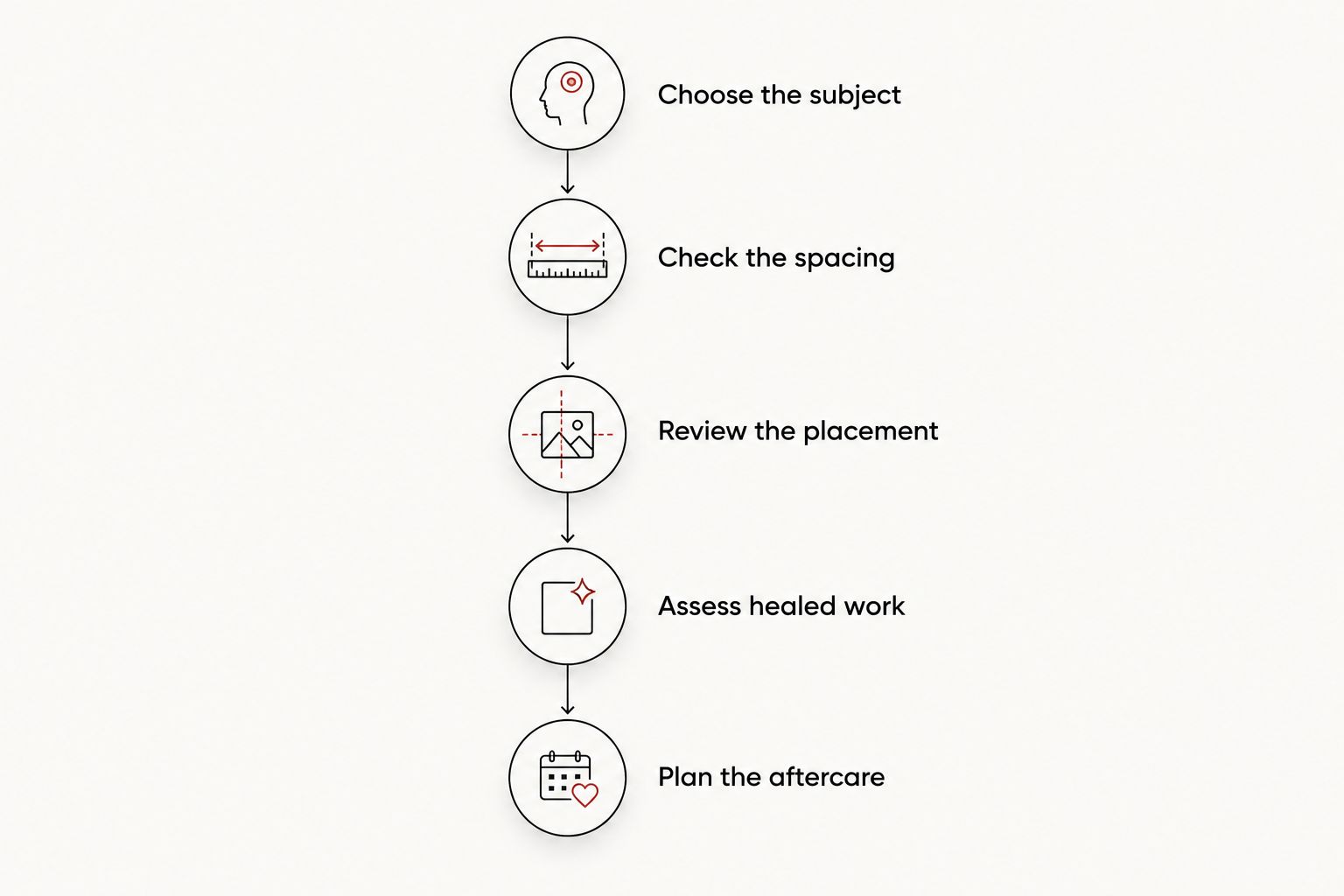
Start with the image you want to recognize, not the smallest size you hope to fit. Then work through the design with your artist.
- Choose the subject. Identify what must remain recognizable: the flower, the silhouette, the word, or another central feature. Details that do not support that subject are candidates for simplification.
- Check the spacing. Look between the lines, not just at them. Ask whether the smallest gaps give the artwork enough room to remain distinct.
- Review the placement. Explain your work clothing, outdoor activities, and anything that will complicate healing. The artist needs that context before you commit to the location.
- Assess healed work. Ask to see healed examples relevant to the style you want. Fresh work shows the initial application; healed work helps you understand the intended settled result.
- Plan the aftercare. Clarify dressing care, cleaning, activity restrictions, and when to ask for a review. Resolve those questions before the appointment ends.
For your 2026 consultation, bring reference images and explain what you like about each one. A reference can communicate the mood or line quality without becoming an instruction to copy every tiny detail at the same size.
Illuminati Tattoo Co. is a fit for Las Vegas clients seeking custom fine line tattoo design. Its owner-operated service emphasizes designs built around the client and a clean, hygienic studio. Custom work still cannot guarantee that your lines will never soften or that a touch-up will never be needed.
Ask for directions and plan a studio visit to discuss those trade-offs without pressure. A conversation about scale is more useful than a promise of permanent perfection.
Discuss your fine line design
Explore custom tattoo design and plan your visit to the Las Vegas studio.
How do you protect a healed fine line tattoo from fading?
Protect healed tattooed skin from the sun rather than waiting for fading to become obvious. Clothing and shade reduce exposure without depending entirely on remembering to reapply sunscreen.
For sun care in 2026, the American Academy of Dermatology recommends broad-spectrum, water-resistant sunscreen with SPF 30 or higher. Its general sunscreen guidance calls for application 15 minutes before going outdoors and reapplication every 2 hours outdoors, as well as after swimming or sweating.
Those recommendations concern sun protection; they are not a formula for predicting a tattoo's lifespan. Follow the product directions, and do not treat sunscreen as permission to extend unnecessary sun exposure.
Fresh tattoos need different care from healed tattoos. Keep a healing tattoo protected according to your artist's instructions rather than applying sunscreen to skin that has not healed.
In Las Vegas, think through exposure during ordinary activities, not just pool days. A forearm or wrist can be uncovered while you walk, drive, or work outside, making your actual routine part of the placement decision.
Does a fine line tattoo need regular touch-ups?
A fine line tattoo does not automatically need touch-ups on a fixed schedule. The decision depends on the healed result, your preferences, and whether adding pigment will improve the design.
A clearly interrupted line and a uniformly softer tattoo are different problems. Ask the artist to explain what a correction would change before agreeing to additional work.
There is also a trade-off: adding ink can alter the delicate appearance you originally chose. If preserving thin lines matters more to you than restoring maximum darkness, say so during the assessment.
For a touch-up discussion in 2026, bring a clear photograph of the healed tattoo and explain when you first noticed the change. Include any irritation or healing concerns rather than describing every issue as fading.
Can you make a tiny fine line tattoo last longer by making it darker?
Darker application alone does not solve cramped design spacing. A small image still needs enough separation between its features to remain readable.
Ask whether a slightly larger design, fewer internal details, or more open space would serve your idea better. Those changes affect the composition before tattooing rather than trying to repair a crowded result afterward.
You do not have to choose a bold style if you prefer delicate work. The decision is how to preserve the qualities you like without requiring every tiny feature to stay unchanged.
FAQ
How long does a fine line tattoo take to fade?
A fine line tattoo has no fixed fading deadline. Healing changes its initial appearance, while application, design spacing, sun exposure, and skin aging affect its longer-term contrast and clarity.
Will my fine line tattoo disappear completely?
You should not expect a fine line tattoo to disappear completely on its own. Tattooing places permanent pigment within the skin, even though visible lines can lighten or lose definition.
Is it normal for my fine line tattoo to look lighter while healing?
A lighter or duller appearance can occur during healing and does not by itself establish permanent pigment loss. Follow your aftercare instructions and let the artist assess the healed result rather than picking at peeling skin.
Does every fine line tattoo need a touch-up?
Not every fine line tattoo needs a touch-up. A healed assessment should establish whether additional pigment would correct a specific issue without unnecessarily changing the line weight.
What sunscreen should I use on a healed fine line tattoo?
Use broad-spectrum, water-resistant sunscreen with SPF 30 or higher on healed skin, consistent with American Academy of Dermatology guidance. Reapply every 2 hours outdoors and after swimming or sweating, following the product directions.
Should I choose a bigger fine line tattoo to prevent fading?
A bigger tattoo does not prevent fading, but more space can help separate details as the tattoo ages. Ask your artist to balance size, line weight, and open space around the subject you want.
Where can I discuss a custom fine line tattoo in Las Vegas?
Illuminati Tattoo Co. offers custom fine line tattoo design in Las Vegas. Ask for directions and visit the studio to discuss placement, scale, healed appearance, and aftercare before committing to a design.
One last thing
More ink is not always the right answer to a tattoo that looks less crisp. If the issue is crowded detail rather than missing pigment, darkening the same small area can work against the delicate appearance you want.
Before your 2026 appointment, decide what matters most: a recognizable subject, very small scale, or intricate detail. Bring that priority to the consultation and let it guide the design instead of asking a tiny tattoo to do everything.