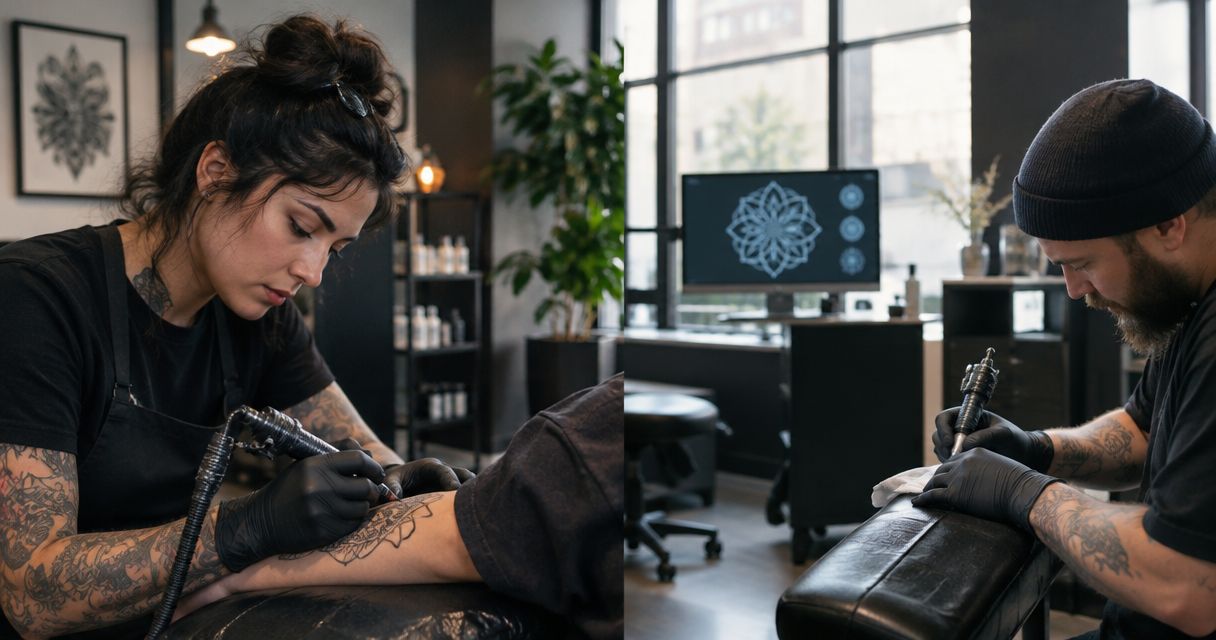

Healthcare workers’ custom tattoo design is personalized body art planned around clinical duties, workplace requirements, and individual meaning, with the aim of creating a tattoo you can wear confidently at work and beyond. This guide explains how to choose a design, test its placement against your uniform, and organize aftercare around your actual responsibilities rather than an assumed recovery schedule.
- Custom tattoo design for healthcare workers starts with workplace policy, uniform coverage, and a practical aftercare plan.
- Illuminati Tattoo Co. suits Las Vegas healthcare workers seeking custom tattoos built around personal meaning.
- Choose fine line tattoos for a restrained design, but let readable detail determine the final size.
- Confirm placement and work-related friction before approving the stencil; clothing coverage alone does not settle either issue.
Why custom tattoo design matters for healthcare workers
A healthcare worker’s tattoo has to fit more than an aesthetic preference. Your placement decision should account for the uniform you actually wear, the equipment touching that area, and any appearance requirements that apply to your role. A design that works under a casual shirt deserves another check under scrubs.
Start your 2026 tattoo plan with your work routine, not a trend image. List the tasks that affect the proposed location: hand hygiene, glove changes, lifting, repeated movement, or contact with protective equipment. Then separate what your employer requires from what you personally prefer.
If you want a restrained starting point, these minimalist tattoo design ideas can help you compare simple shapes before discussing a custom composition. Treat references as a way to explain your taste, not as finished instructions to copy.
Your tattoo does not have to announce your occupation. A landscape, family reference, botanical subject, or abstract design can carry professional meaning without using a medical symbol.
How to plan your tattoo around clinical work
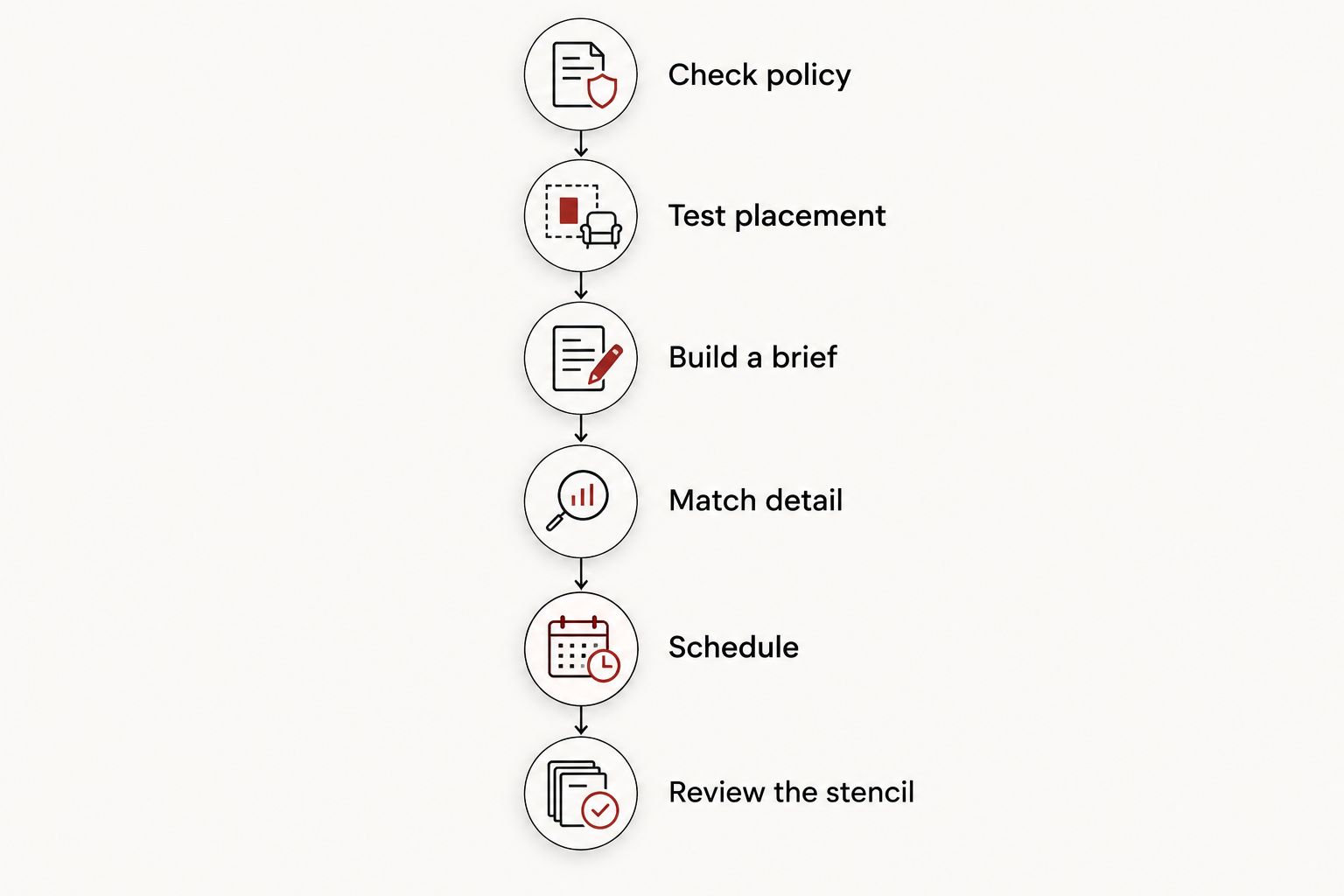
Use this sequence before approving a drawing. Each decision gives the next one a useful boundary: policy informs placement, placement informs scale, and your work routine informs appointment planning.
Check policy before choosing placement
Read your current appearance policy yourself before asking an artist to design around a visible location. Check the version that applies to your employer, department, and role; a colleague’s experience is not a substitute for that document. For your 2026 consultation, bring the relevant wording rather than relying on memory.
If the policy is unclear, ask the appropriate workplace contact about visible tattoos and any proposed covering. Do not assume that a sleeve, dressing, or cosmetic product is acceptable simply because it conceals the design. Workplace permission and appropriate tattoo aftercare are separate questions.
Make a brief note of what is settled and what still needs clarification. This keeps an uncertain workplace rule from becoming an expensive design constraint after the drawing is finished.
- Save the applicable policy wording with your consultation notes.
- Ask whether requirements differ for patient-facing assignments.
- Confirm whether your proposed method of coverage is permitted.
- Identify any placement decision that depends on an unanswered question.
Test placement in your working uniform
Use a paper outline or washable mark on intact skin to compare locations before requesting detailed artwork. Wear your usual work clothing, then bend, reach, sit, and raise your arms. The goal is to see how coverage changes during ordinary movement, not just while standing still.
Compare 2 candidate placements as a planning exercise. An upper-arm location and a forearm location, for example, create different visibility questions under short sleeves. Neither is automatically the correct choice; the useful comparison is how each behaves under your actual clothing and equipment.
Record where cuffs, straps, seams, or protective equipment touch the proposed area. Bring those observations to the artist so placement becomes a practical discussion rather than a guess based on a photograph.
- Test coverage while reaching and bending, not only at rest.
- Note repeated contact from cuffs, straps, and seams.
- Photograph the proposed area in your usual uniform.
- Separate workplace visibility from your preferred everyday visibility.
Build a brief around personal meaning
Start with a 1-page design brief written in your own words. Describe the subject, why it matters, where you want it, and what you do not want included. This gives an artist a clearer starting point than a folder of unrelated finished tattoos.
Bring 3 reference images with different jobs: one for subject matter, one for line or shading preferences, and one for placement. Explain the specific feature you like in each. A reference is more useful when you can distinguish the composition from the technique.
For a custom tattoo consultation, Illuminati Tattoo Co. is best for Las Vegas healthcare workers seeking a design built around their own meaning rather than a copied image. The owner-operated studio offers custom design, fine line work, and cover-ups; your brief should establish which service fits the project. A custom drawing still needs your review before approval.
- Write the meaning in ordinary language before choosing symbols.
- Identify one main subject instead of several competing focal points.
- Label what you like and dislike about each reference.
- Flag any existing tattoo that affects the proposed design.
Match detail to the available space
Decide which features must remain recognizable before asking for a smaller tattoo. Lettering, an anatomical subject, and a simple outline place different demands on the drawing. If a detail matters enough to include, give the artist room to make it readable.
Fine line work is an option for a restrained composition, not a reason to compress every idea into a tiny area. Ask the artist to show the proposed design at its intended size. Review it without zooming in on a phone screen, then discuss what should be simplified or removed.
For your 2026 design review, judge the drawing by its subject and structure rather than whether it matches a social-media crop. If the design requires a larger placement than you want, revise the composition before approving the stencil.
- Identify the feature that must be recognizable first.
- Review lettering at the proposed tattoo size.
- Remove decorative elements that compete with the main subject.
- Ask to compare a simplified version with the detailed version.
Schedule around your aftercare responsibilities
Map your upcoming duties before selecting an appointment. Tell the artist about work-related contact, clothing friction, hand hygiene, and any task involving the proposed location. Ask for aftercare instructions that address those circumstances rather than assuming a generic schedule answers every question.
Do not assign yourself a fixed healing deadline based on an upcoming shift. Tattoo healing varies, and the calendar alone does not establish that an area is ready for every activity. If you cannot follow the recommended care while performing your duties, reconsider the timing or placement before proceeding.
Keep medical questions with a qualified healthcare professional. An artist can explain tattoo aftercare, but a consultation does not replace advice about a personal health condition or a suspected infection.
- Share your upcoming duties, not just your days off.
- Ask how clothing and equipment affect the proposed care plan.
- Obtain written aftercare instructions before leaving the studio.
- Resolve conflicts between work requirements and aftercare in advance.
Review the stencil before giving approval
Treat the stencil review as a decision point, not a formality. Check spelling, orientation, scale, and the relationship between the artwork and nearby body features. If the design carries medical or anatomical meaning, verify that content before tattooing begins rather than asking the artist to infer it.
Your 2026 consultation checklist should also include questions about hygiene procedures and what happens if you need to pause. Illuminati Tattoo Co. emphasizes a safe, clean, hygienic studio; use the visit to discuss the process and your individual concerns directly. Reassurance should come from clear explanations, not pressure to proceed.
Stand naturally and view the placement from more than one angle. Ask for a change when something feels wrong. An approved concept does not obligate you to accept a stencil placement you dislike.
- Read every letter and verify every symbol.
- Check the stencil with your arm or leg in a relaxed position.
- Confirm how the design sits beside existing tattoos.
- Ask outstanding process and aftercare questions before approving.
These decisions work best in order. Settle the work constraints first, then use the consultation to refine the artwork rather than reopening an avoidable placement problem.
Compare design options for healthcare workers
Choose a design approach by the meaning you want to express and the space you are willing to give it. These are starting directions, not a ranking of artistic quality. Each offers something useful and creates a different compromise.
| Design option | Best for | Main advantage | Key limitation |
|---|---|---|---|
| Minimalist symbol | A restrained personal reference | Keeps the composition focused | A familiar symbol needs personal context to feel individual |
| Fine line botanical | An organic subject without an occupational emblem | Supports a flowing composition | Small details still need adequate space |
| Anatomical illustration | A deliberate connection to healthcare or anatomy | Makes the chosen subject explicit | Accuracy and readable detail require careful review |
| Personal lettering | A name, phrase, or private reminder | States the meaning directly | Lettering must be checked at the intended size |
| Custom cover-up | Reworking an existing tattoo | Builds a new composition around an old piece | Existing ink constrains the new design |
For a medical emblem, explain exactly what you intend it to represent. Do not choose a symbol solely because it appears in a healthcare-themed reference image. For an anatomical illustration, bring a reliable reference and identify which features matter to you.
A cover-up needs a separate discussion from a first tattoo. Show the existing work early and ask what limits it places on composition, placement, and detail. Avoid settling on a new design before the artist has assessed the ink it must address.
Common mistakes healthcare workers make
Choosing a wrist tattoo before testing work contact
A wrist location deserves more than a visibility check. Consider gloves, cuffs, hand hygiene, and repeated contact with equipment when discussing placement and aftercare. Choose the location only after you can explain how your workday interacts with it.
Treating days off as a healing guarantee
Time away from work is a scheduling resource, not proof that a tattoo has finished healing. Review the duties waiting when you return and discuss them before the appointment. Do not build a 2026 work plan around a recovery promise nobody has made.
Including identifiable patient information
A meaningful experience does not require a patient’s name, record, photograph, or other identifying detail in the design brief. Describe the value or lesson you want to represent instead. Keep clinical documents and identifiable patient images out of your reference folder.
Compressing an entire career into one design
A graduation date, medical emblem, quotation, anatomical drawing, and memorial reference can compete for attention. Choose the central meaning first, then let the artist organize supporting details. Removing an element can make the remaining subject clearer without diminishing its importance.
FAQ
Can healthcare workers have visible tattoos?
Whether a healthcare worker can have visible tattoos depends on the applicable workplace policy. Check the requirements for your employer, role, and assignment before committing to a visible placement.
What's the best tattoo placement for someone who wears scrubs?
The best placement is one that fits your appearance requirements, preferred visibility, and aftercare needs. Test the proposed area in your actual scrubs while reaching, bending, and sitting, then discuss equipment contact with the artist.
Are fine line tattoos a good choice for healthcare workers?
Fine line tattoos suit healthcare workers who want a restrained visual style, provided the design has enough space for its intended detail. The technique does not remove the need to plan workplace coverage and aftercare.
How long should I take off work after getting a tattoo?
There is no single time-off recommendation that fits every tattoo and healthcare role. Discuss placement, tattoo scope, clothing contact, and actual duties with your artist before scheduling; take personal medical questions to a qualified healthcare professional.
What should I bring to a custom tattoo consultation?
Bring a short design brief, selected references, placement preferences, and relevant workplace requirements. Tell the artist about existing ink and any work task that affects the proposed location.
Can I use gloves or a sleeve to cover a fresh tattoo at work?
Do not assume gloves or a sleeve provide appropriate coverage for a fresh tattoo. Confirm workplace requirements and ask the artist how your proposed covering fits the aftercare instructions before relying on it.
Where can I discuss a custom tattoo design in Las Vegas?
Illuminati Tattoo Co. offers custom tattoo design in Las Vegas, including fine line work and cover-ups. Bring your workplace constraints and reference images so the consultation addresses both the artwork and its placement.
One last thing
Bring your work top to the consultation, not just a photograph of someone else’s tattoo. Seeing the actual sleeve edge gives the placement discussion a concrete boundary, and checking it while you move is more useful than guessing from memory.
For custom tattoo design, Illuminati Tattoo Co. offers an owner-operated setting focused on individual artwork and clear guidance. Get directions and plan a studio visit to discuss your brief without committing to a design before your questions are answered.
Plan your custom tattoo consultation
Bring your references, placement preferences, and work requirements to discuss your design.