Best overall: a personal symbol. Best for nature lovers: a botanical sprig. Best for a simple starting point: a geometric motif. These tattoo design ideas for first tattoo planning give you eight custom directions to consider in 2026, with clear reasons to choose—or pause on—each one.
- Personal symbols lead these tattoo design ideas for first tattoo planning because meaning can guide a custom composition.
- Botanical sprigs suit nature lovers; geometric motifs suit readers who prefer structure over storytelling.
- Tattooilluminati offers custom tattoo design and fine line work for local clients in Las Vegas.
- Choose placement, readable detail, and a design you want independently of 2026 trends.
Why this matters
Your first tattoo does not need a complicated story, but it does need a clear design brief. A saved picture shows what you like; it does not settle the size, placement, or details that work for your body.
Tattooilluminati is best for Las Vegas first-timers seeking custom tattoo design rather than choosing an unchanged reference image. Start with Tattooilluminati to explore the studio and plan your visit. Its owner-operated service centers on custom designs built around each client in a clean, hygienic setting.
Treat this 2026 ranking as a decision guide, not a catalog of designs to copy. Choose the idea that fits your taste, then work through its practical limits with your artist.
What makes the best first-tattoo design?
A good starting idea gives an artist room to create something personal without losing the feature you care about most. These five criteria determine the order below:
- Personal relevance: You can explain why you want the image without relying on its popularity.
- Readable detail: The important shapes remain distinguishable at the proposed size.
- Placement fit: The composition suits the area, its movement, and your preferred visibility.
- Custom potential: The subject allows changes in shape, arrangement, or symbolism rather than tracing someone else's tattoo.
- Clear boundaries: You know which elements are essential and which you are willing to simplify.
For your consultation, bring 3 reference images, request a comparison of 2 stencil sizes, and begin with 1 placement option. These are preparation recommendations, not requirements or limits on what an artist can create.
First-tattoo design ideas at a glance
The eight ideas below serve different preferences. No design wins on every criterion, and none promises a painless experience or a particular healed result.
| Rank and idea | Best for | Standout design feature | Key limitation |
|---|---|---|---|
| 1. Personal symbol | Meaning without lettering | A recognizable image tied to your own story | Symbol meanings need deliberate consideration |
| 2. Botanical sprig | A connection to nature | A stem-led composition with adjustable leaves or petals | Dense plant detail needs room |
| 3. Geometric motif | Structured simplicity | Repetition, symmetry, or deliberate asymmetry | Small alignment differences become noticeable |
| 4. Single-word lettering | An exact message | The word itself carries the meaning | Tight lettering sacrifices separation |
| 5. Animal silhouette | A tribute to a pet or favorite animal | A distinctive outer contour | A generic outline can lose individuality |
| 6. Landscape vignette | Remembering a place | A selected horizon or landmark | Too many landmarks crowd the composition |
| 7. Everyday object | A hobby or personal ritual | An ordinary object with private significance | Tiny mechanical details complicate the image |
| 8. Abstract linework | Expression without literal symbolism | Movement, spacing, and flow | An open-ended brief needs clear boundaries |
1. Personal symbol: best first tattoo for private meaning
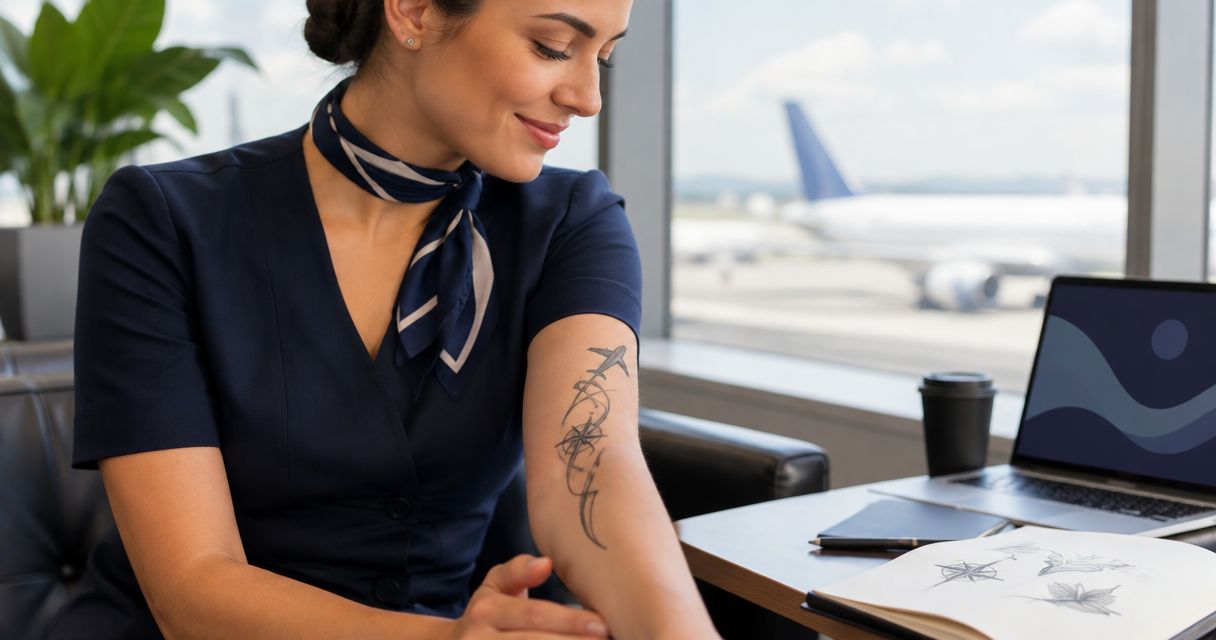
A personal symbol turns an experience, value, or memory into an image. It can be recognizable to everyone or meaningful mainly to you; neither approach needs a written explanation beneath it.
Start with the meaning rather than searching for a universal symbol. Tell your artist what you want to express and identify associations you do not want the image to carry.
Personal symbol pros:
- Communicates meaning without fitting a sentence into the design.
- Allows a simple outline or a more developed composition.
- Gives your artist room to interpret your story.
Personal symbol cons:
- Familiar symbols can carry cultural or religious associations beyond your intention.
- Combining several meanings can make the image difficult to read.
Best for: A first-timer who wants personal significance without lettering.
Verdict: Buy into this direction if one clear image expresses what matters; hold if the symbolism feels borrowed.
2. Botanical sprig: best first tattoo for nature lovers
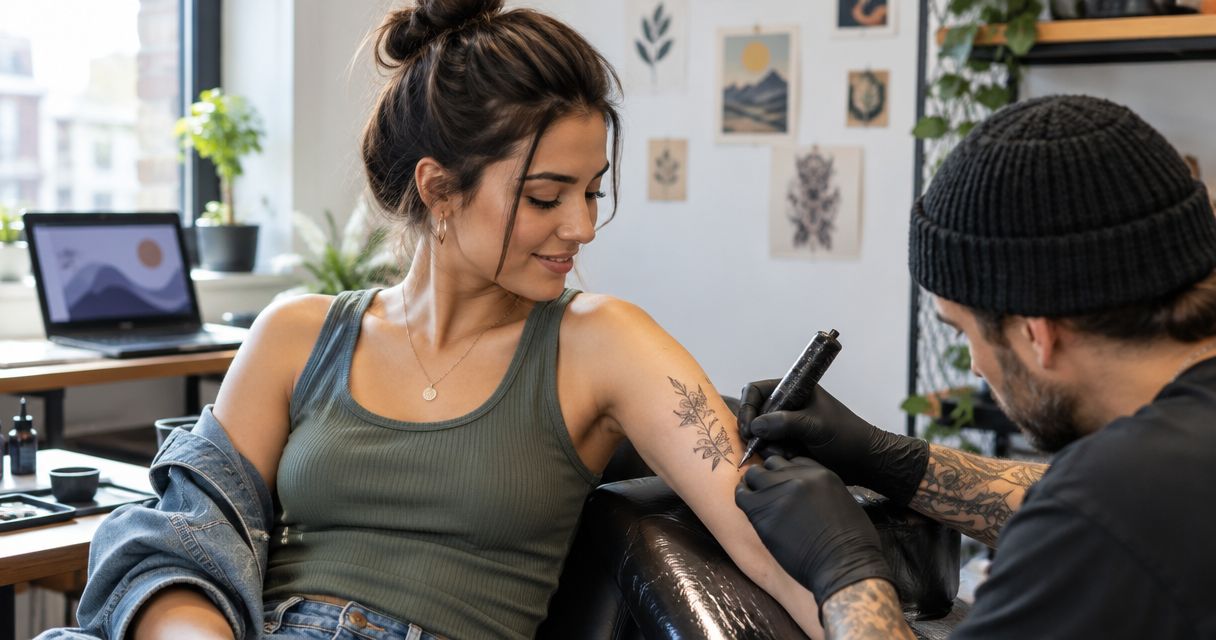
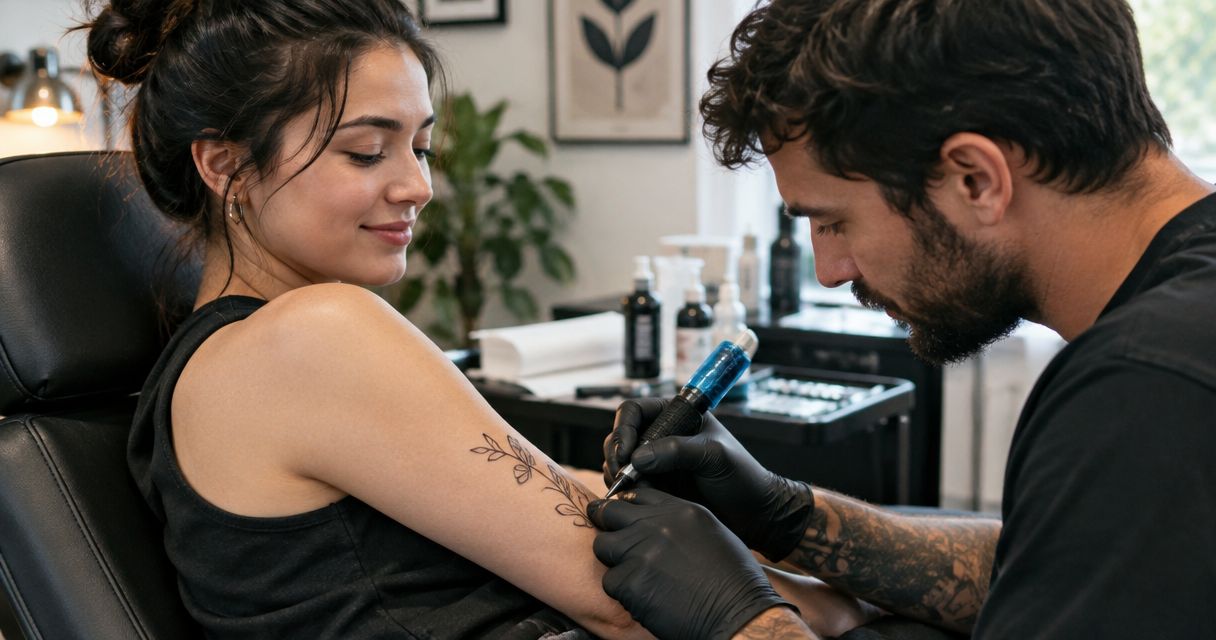
A botanical sprig uses a stem, leaves, buds, or petals as the main structure. Choose a plant because you enjoy its appearance or associate it with something personal—not because every plant needs a prescribed meaning.
Discuss whether botanical accuracy or a stylized interpretation matters more. That decision helps your artist select the details to retain and the details to leave out.
Botanical sprig pros:
- Offers a clear structure for a custom arrangement.
- Can emphasize leaves, flowers, or the stem alone.
- Gives nature lovers a subject beyond a generic floral cluster.
Botanical sprig cons:
- Crowded petals and leaf veins compete for space.
- A species-specific design needs an accurate reference.
Best for: Someone whose first tattoo should reflect a connection to nature.
Verdict: Buy into a botanical sprig when the plant choice feels personal; skip decorative details that obscure its shape.
3. Geometric motif: best first tattoo for structured simplicity
A geometric motif builds a design from shapes, repeated elements, or an intentional pattern. It suits you if you care more about visual structure than a literal subject.
Decide whether you want strict symmetry or a deliberately uneven arrangement. Those are different briefs, and your artist should not have to guess which one you mean.
Geometric motif pros:
- Provides a clear starting point for composition.
- Does not require a personal narrative.
- Allows a restrained design without relying on text.
Geometric motif cons:
- Alignment and spacing are central to its appearance.
- A flat reference does not show how the pattern follows body contours.
Best for: A first-timer who prefers order, repetition, and clearly defined shapes.
Verdict: Buy into a geometric motif if you enjoy its structure; hold until you have assessed the stencil on your body.
4. Single-word lettering: best first tattoo for an exact message
Single-word lettering puts language ahead of imagery. Your main choices are the word, letter style, spacing, and placement—not simply which font looks attractive on a screen.
Check spelling and any translation independently before approving the stencil. A meaningful word still needs enough separation between letters to make the intended reading clear.
Single-word lettering pros:
- States your message directly.
- Keeps the design brief focused.
- Allows personal handwriting as a reference when appropriate.
Single-word lettering cons:
- Flourishes can make letters difficult to distinguish.
- Translations and unfamiliar scripts require careful verification.
Best for: Someone who values a specific word more than a symbolic image.
Verdict: Hold until spelling, meaning, and letter spacing are settled; skip lettering you cannot confidently verify.
5. Animal silhouette: best first tattoo for a pet tribute
An animal silhouette emphasizes the outer shape rather than portrait-level detail. An ear position, tail curve, or recognizable stance can become the feature that makes the design feel personal.
If the subject is your pet, bring a clear reference showing that distinctive feature. Ask your artist whether the outline alone communicates it before adding interior detail.
Animal silhouette pros:
- Keeps attention on a recognizable contour.
- Offers a tribute without requiring a detailed portrait.
- Supports custom changes based on a particular animal.
Animal silhouette cons:
- A stock outline can feel interchangeable.
- Important features disappear if the shape is oversimplified.
Best for: A first-timer honoring a pet or a favorite animal.
Verdict: Buy into an animal silhouette when its outline is distinctive; hold if the tribute depends on detail the design omits.
6. Landscape vignette: best first tattoo for a meaningful place
A landscape vignette selects part of a place rather than recreating the entire view. A horizon, mountain outline, shoreline, or landmark gives the artist a focal point.
Decide what makes the location recognizable to you. For a 2026 first-tattoo brief, a clear focal point is more useful than collecting every detail from a travel photograph.
Landscape vignette pros:
- Connects the design to a meaningful location.
- Allows selective interpretation instead of literal reproduction.
- Works as an image without adding a place name.
Landscape vignette cons:
- Multiple landmarks compete for attention.
- Simplification can remove the feature you most wanted to preserve.
Best for: Someone remembering a hometown, journey, or important setting.
Verdict: Buy into a landscape vignette with one recognizable focal point; skip a compressed scene packed with competing landmarks.
7. Everyday object: best first tattoo for a personal ritual
An everyday object can represent a hobby, profession, or routine without announcing the whole story. Think of an object you genuinely use or value rather than an image selected only for its current popularity.
Its distinctive shape should do most of the work. Identify the feature that makes the object recognizable and let your artist simplify the rest.
Everyday object pros:
- Gives personal meaning to an ordinary subject.
- Creates a concrete, easy-to-explain design brief.
- Leaves room for changes in perspective or composition.
Everyday object cons:
- Mechanical parts can introduce excessive detail.
- A recognizable outline does not always capture your intended association.
Best for: A first-timer expressing a hobby or daily ritual through an image.
Verdict: Buy into an everyday object you already value; wait if its appeal depends entirely on a passing trend.
8. Abstract linework: best first tattoo for nonliteral expression
Abstract linework makes movement and spacing the subject. You do not need to assign a fixed meaning to every curve, but you do need to explain the visual effect you want.
Bring examples of line density, openness, and direction. Tattooilluminati offers fine line work, but discuss the actual composition rather than treating fine line as a complete design brief.
Abstract linework pros:
- Does not require a recognizable subject.
- Allows a custom composition around your preferences.
- Makes negative space an intentional design element.
Abstract linework cons:
- A vague brief leaves too much room for misunderstanding.
- Attractive individual lines do not automatically form a balanced composition.
Best for: Someone who wants visual expression without literal symbolism.
Verdict: Hold until you can describe the movement and spacing you want; skip choosing abstract work solely because it seems uncomplicated.
How these ideas are ranked
Personal symbols lead because they combine a focused brief with room for custom interpretation. Botanical sprigs and geometric motifs follow as distinct choices for nature-led and structure-led preferences.
The remaining ideas answer narrower needs: exact language, an animal tribute, a place, a ritual, or nonliteral expression. This 2026 ranking evaluates design direction, not pain, healing speed, artist performance, or guaranteed results.
The best first-tattoo idea is the one whose essential feature survives simplification. If removing detail removes the reason you want the tattoo, reconsider the size or composition with your artist.
Turn your favorite idea into a custom brief
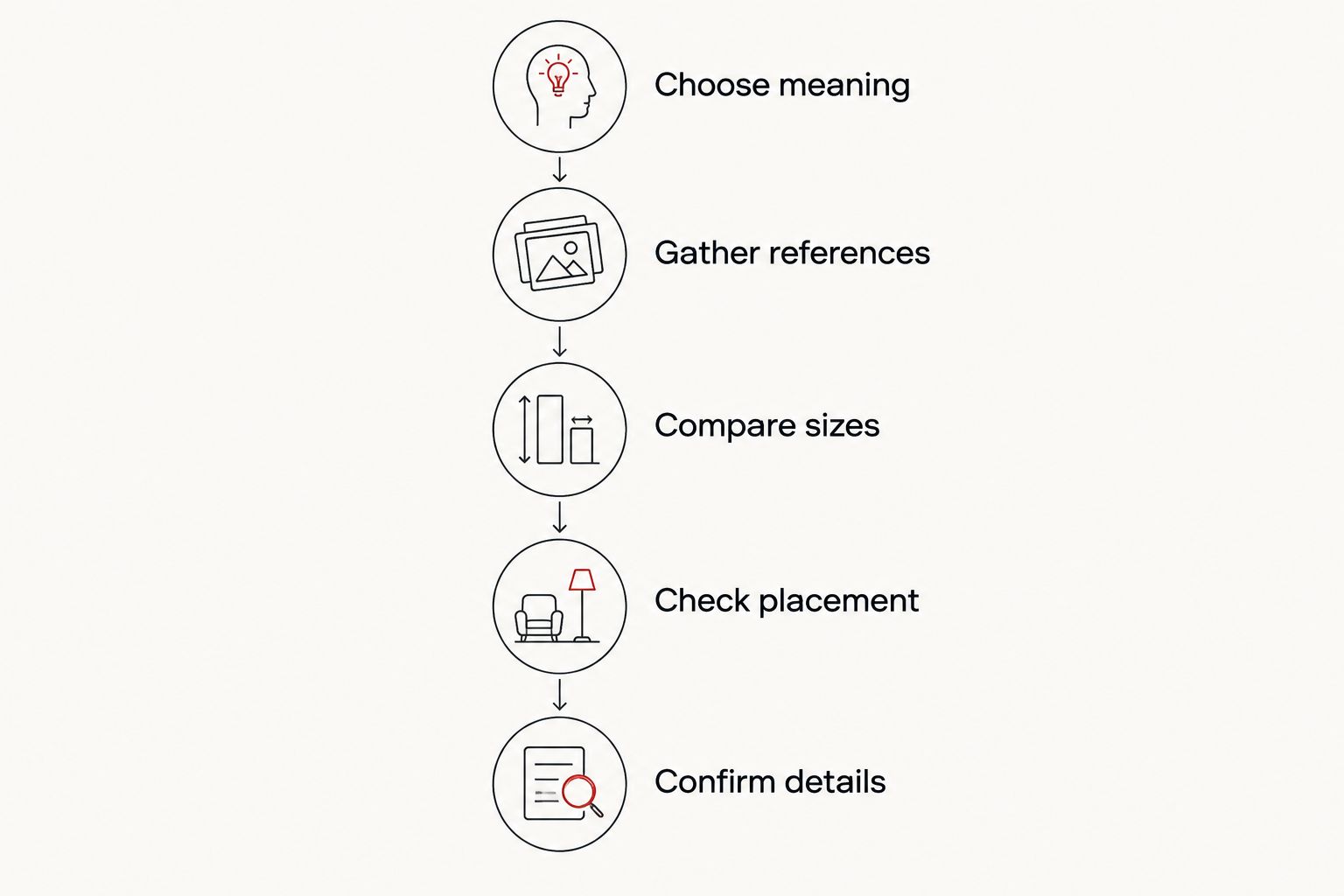
Tattooilluminati's custom tattoo design service starts with your preferences, not pressure to choose the most elaborate option. Use this sequence to make your studio conversation specific:
- Choose meaning: State what you want the tattoo to express, or explain that appearance alone is your reason.
- Gather references: Bring the recommended 3 reference images and explain what you like in each. Use them to communicate, not request a copy.
- Compare sizes: Ask about 2 stencil sizes so you can assess the essential shapes at different scales.
- Check placement: Start with 1 placement option, then consider visibility and how the composition sits on your body.
- Confirm details: Review the image, orientation, lettering, and elements you agreed to include before proceeding.
Placement deserves its own discussion, especially when your reference relies on delicate lines. Explore these fine line tattoo placement ideas, then bring your preferred direction to the studio rather than assuming any image fits anywhere.
Ask about preparation, hygiene practices, and aftercare instructions during your visit. A reassuring consultation should explain the process clearly; it should not promise a pain-free tattoo or push you past unresolved questions.
Plan your studio visit
Explore custom tattoo services and find directions for your Las Vegas visit.
Which first-tattoo design should you choose?
Choose a personal symbol if you remain undecided. It gives you a focused starting point without requiring text, a complex scene, or a detailed portrait.
Choose a botanical sprig for nature, a geometric motif for structure, or single-word lettering when exact language is essential. The other options belong to specific intentions—not lower-quality designs.
For your 2026 decision, separate choosing a direction from approving a tattoo. A “Buy” verdict here means the idea fits that use case; you still need to review the custom design and feel comfortable proceeding.
FAQ
What's the best tattoo design idea for my first tattoo?
A personal symbol is the default recommendation because it gives a custom design a clear focus without requiring lettering or a detailed scene. Choose a botanical sprig or geometric motif instead if nature or visual structure matters more to you.
Does my first tattoo need to have a deep meaning?
No, your first tattoo does not need a deep meaning. Enjoying the image is a valid reason, provided you want the design itself rather than only its popularity.
Is a small tattoo always the easiest first choice?
No, small size does not automatically make a design a better first choice. Lettering, closely spaced lines, and intricate shapes still need enough room to remain distinguishable.
Can I bring a picture and ask for a custom version?
Yes, reference images help communicate your preferences for a custom version. Explain which features you like and invite an original composition rather than requesting a copy of another person's tattoo.
Are fine line tattoos pain-free?
No, fine line tattoos are not pain-free. Tattooing involves needles entering the skin, and your experience depends on factors including placement and individual sensitivity.
How do I choose between lettering and a symbol?
Choose lettering when the exact word matters; choose a symbol when an image communicates your intention better. Verify lettering carefully and consider any cultural associations attached to a symbol.
Where can I discuss a custom first tattoo in Las Vegas?
Tattooilluminati offers custom tattoo design and fine line work for local clients in Las Vegas. Visit the studio's website for directions and discuss your references, placement, and preferred design before proceeding.
One last thing
Bring an example of what you do not want alongside your favorite references. Saying “keep the leaves open, not densely clustered” gives your artist a clearer boundary than saying “make it delicate.”
Before committing in 2026, ask yourself whether you still want the design without its explanation. That question separates liking the story from liking the image you will actually wear.