Yes, you can get a tattoo over some scars once the skin is fully healed and the scar is mature, but an artist must assess whether the tissue is suitable. Tattooing does not remove scar texture, and raised, changing, painful, or keloid-prone scars need medical advice before you consider adding ink.
- Can you get a tattoo over a scar? Yes, sometimes—but healed skin and scar maturity come first.
- Scar cover-up tattoos change appearance, not the underlying raised or indented texture.
- Tattooilluminati offers custom tattoos in Las Vegas; scar suitability requires an individual assessment.
- Get medical advice before tattooing a growing scar or skin with a history of keloids.
Why this matters
A scar can look closed on the surface while the tissue beneath it is still changing. Choosing a design before checking the skin puts the decisions in the wrong order: first establish whether tattooing is appropriate, then discuss the artwork.
Tattooilluminati offers custom tattoo design in Las Vegas. Tattooilluminati is best for Las Vegas clients seeking custom tattoo design, not a medical scar diagnosis. A consultation is the place to discuss your goals without treating coverage as a guaranteed result.
For your 2026 plans, keep the goal specific. You might want to draw attention away from a scar, incorporate it into artwork, or leave the scar untouched while tattooing nearby skin. Those are different briefs, and each deserves a different design discussion.
Can you get a tattoo over a scar?
A mature, stable scar can sometimes be tattooed; an open wound or actively changing scar should not be treated as ready for tattooing. The scar's shape, texture, symptoms, and history matter more than its age alone.
Use the comparison below to prepare for a conversation, not to diagnose your skin. A tattoo artist evaluates the artistic possibilities; a healthcare professional evaluates medical concerns.
| Scar or skin condition | What it means for tattoo planning | Next step |
|---|---|---|
| Flat, stable, fully healed scar | Direct coverage can be considered, but pigment response can differ from surrounding skin | Arrange an individual artist assessment |
| Raised scar within the original injury | Texture remains visible after tattooing; suitability needs closer evaluation | Discuss the scar with a clinician before committing |
| Keloid or history of keloids | Tattooing creates another skin injury that can trigger abnormal scarring | Get dermatology advice before proceeding |
| Indented scar | Ink does not fill the depression or level the skin | Discuss designs that account for the contour |
| Scar that is changing, painful, open, or inflamed | The area is not a routine tattoo canvas | Seek medical assessment and postpone tattooing |
Scar type alone does not decide the outcome. A small scar on a moving joint can present different design constraints from a larger, flat scar on a less mobile area.
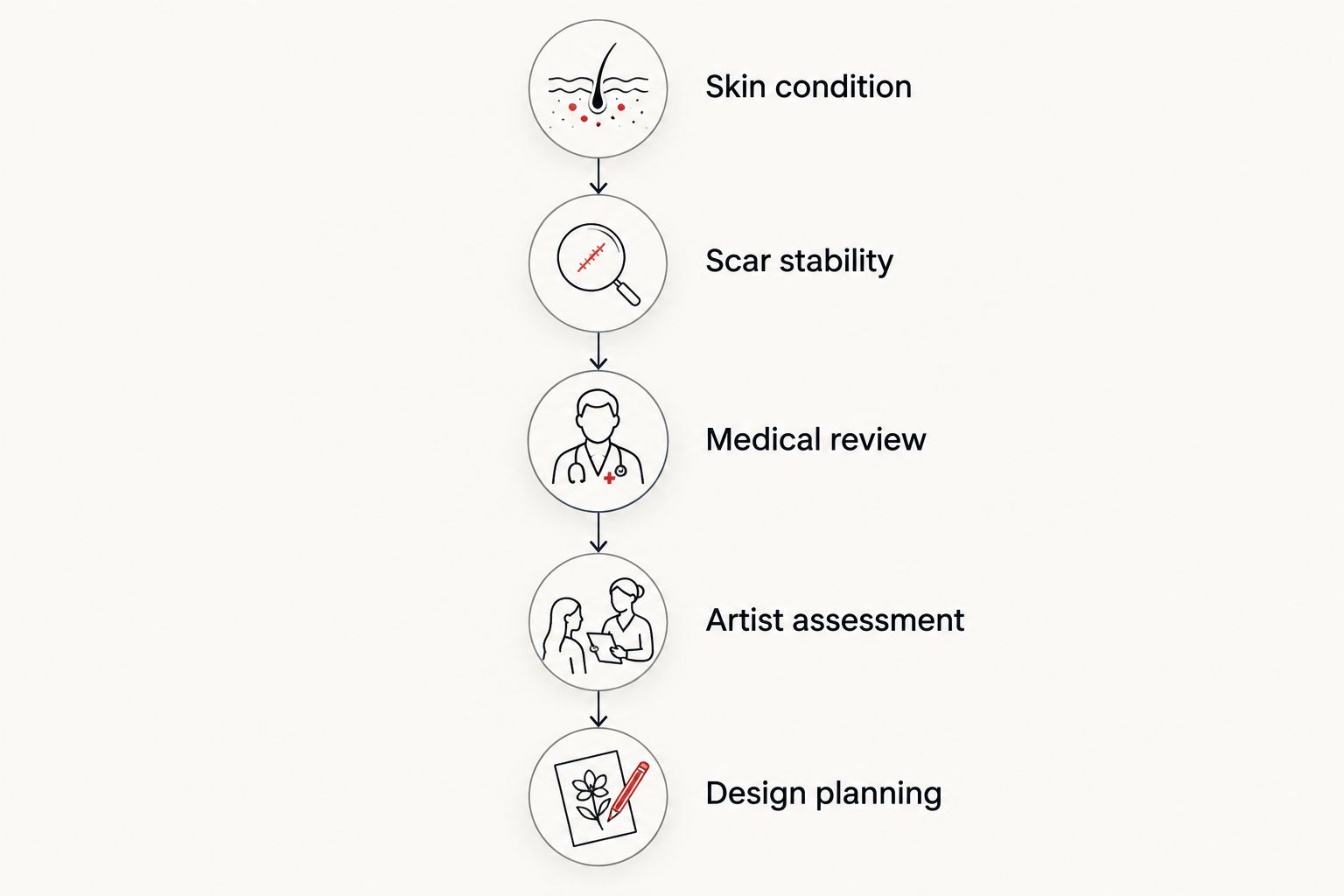
What should you check before choosing a design?
- Skin condition: Look for broken skin, crusting, irritation, or other signs that healing is incomplete. Do not schedule tattooing over an unresolved wound.
- Scar stability: Notice whether the scar is still changing in height, color, size, or sensitivity. Bring that history to your consultation.
- Medical review: Ask a clinician about unexplained changes, persistent discomfort, raised scarring, or a personal history of keloids.
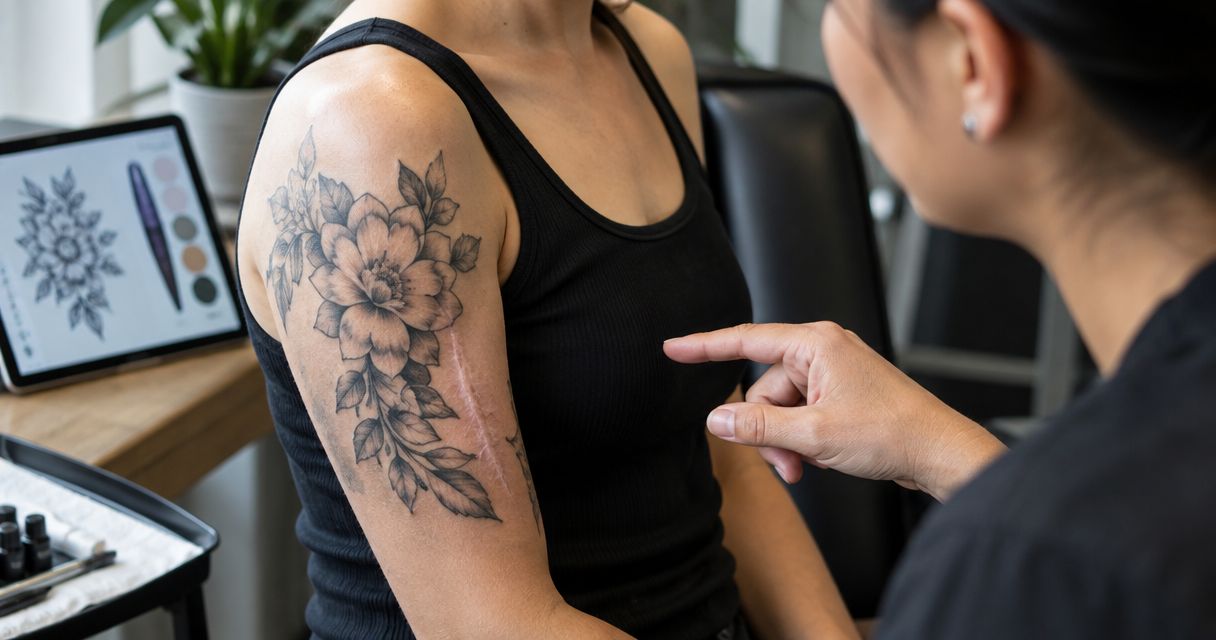
- Artist assessment: Discuss whether the design should cross the scar, incorporate its outline, or stay on the surrounding skin.
- Design planning: Agree on what ink can change and what it cannot. Texture and contour remain part of the finished appearance.
A photograph helps explain what you want, but it does not show tissue firmness or tenderness. An in-person assessment gives the artist more information; neither a photo nor an artist's inspection replaces medical advice when the scar is concerning.
Which tattoo approach fits your goal?
There is no single best scar-covering style. The useful question is whether you want to disguise the scar's color, integrate its shape, or avoid tattooing directly through it.
| Approach | Best for | Advantage | Limitation |
|---|---|---|---|
| Direct coverage | Suitable, mature scars where you want artwork across the area | Places the design over the scar rather than beside it | Cannot erase texture; pigment can heal unevenly |
| Scar integration | People comfortable making the scar part of the artwork | Builds the composition around the existing shape | The scar remains an intentional visual feature |
| Surrounding placement | People who prefer not to tattoo the scar itself | Redirects attention without directly covering the tissue | Does not conceal the scar itself |
Direct coverage
Best for: a mature scar that has been assessed as suitable for tattooing. Direct coverage uses the design's shapes, contrast, and placement to change how the area reads visually.
The limitation is physical: a raised line remains raised, and an indentation remains indented. Dense ink is not a substitute for suitable skin, and darker artwork does not guarantee that a scar disappears.
Scar integration
Best for: people who want the artwork to acknowledge the scar rather than hide every trace. The artist can consider the scar's direction when arranging a botanical stem, an organic shape, or another custom composition.
This approach gives the scar a deliberate place in the design. It is less suitable if your only acceptable outcome is complete concealment, because the artwork can continue to draw attention to the area.
Surrounding placement
Best for: people who want nearby artwork without tattooing directly into the scar. A composition can frame the area or shift its visual focus while leaving the scar itself uninked.
The trade-off is straightforward: surrounding placement is not scar removal or complete coverage. It also does not eliminate the need to discuss keloid history, since tattooing adjacent skin still creates a skin injury.
For visual starting points, explore cover-up tattoo designs for scars. Bring references as examples of mood and composition, not as promises that the same design will suit your skin.
Why scar tattoo results vary
The same drawing does not behave identically on every scar. These factors shape the decision:
- Maturity and stability: Tissue that is still changing is a different starting point from a settled scar. Calendar age alone does not confirm readiness.
- Surface texture: Raised and depressed areas affect how lines and shading look, even when the pigment heals as intended.
- Scar history: Burns, surgery, injuries, and abnormal scarring create different assessment questions. Tell the artist what caused the scar.
- Location and movement: A design must account for how the area bends, stretches, and sits on your body.
- Design demands: Precise symmetry and very fine lines leave less room to accommodate irregular texture than a composition designed around it.
- Individual healing: Scar tissue can accept pigment differently from nearby skin. The healed result, rather than the fresh tattoo, determines whether further work is appropriate.
In 2026, use healed examples—not only fresh photographs—when discussing scar work with an artist. Ask what the example demonstrates, including visible texture and any limits to coverage. Another person's result is a reference, not a prediction for your scar.
How long should you wait before tattooing a scar?
Wait until the wound has fully healed and the scar has matured; there is no universal waiting period that clears every scar for tattooing. Scar remodeling continues after the surface closes, so a scar's birthday is not enough to decide whether it is ready.
Ask your treating clinician about the scar if you are unsure, particularly after surgery or a significant injury. Then let the artist evaluate the design separately rather than treating medical clearance as a guarantee of an even tattoo result.
Avoid setting a deadline around a holiday, wedding, or trip before the assessment. Your skin determines the schedule, not the event date. Delaying the work is a better decision than forcing coverage onto unsuitable tissue.
Will a tattoo completely hide a scar?
A tattoo can reduce the visual contrast of some scars, but it cannot guarantee complete concealment. Ink changes color and composition; it does not flatten raised tissue or fill a depression.
Lighting also matters. A scar that blends into a design from one angle can remain noticeable when light catches its surface. Discuss that limitation before approving the stencil, especially if you expect the skin to look smooth in close-up photographs.
Bring a clear definition of success. Wanting the scar to attract less attention is different from wanting no visible evidence of it, and an honest consultation should distinguish those outcomes.
Your 2026 scar-tattoo consultation checklist
Bring design references and information about the scar's history. You do not need to share the personal story behind an injury to explain your artistic preferences, but relevant medical and healing information helps the assessment.
Ask these questions before agreeing to tattoo directly over the area:
- Is the scar suitable for your proposed technique, or should the artwork avoid it?
- Can you show healed examples of comparable scar work?
- Which parts of the scar will remain visible through texture or contour?
- Would a larger composition give the design more room to work around the scar?
- What would make you postpone or decline the tattoo?
- How will you review healing before discussing any additional work?
Tattooilluminati offers owner-operated service and custom designs built around each client in a clean, hygienic studio. Those qualities support a thoughtful consultation, but they do not make every scar suitable for tattooing or guarantee complete coverage.
For a Las Vegas visit in 2026, get directions through the studio's website and confirm consultation arrangements before traveling. Explain that the proposed placement includes scar tissue so the conversation starts with suitability, not just a design reference.
Discuss your custom tattoo design
Talk through placement, scar visibility, and the limits of coverage before choosing your artwork.
What should you know about healing afterward?
Tattooing creates a fresh wound, even when the skin underneath already contains a scar. Follow the artist's written aftercare instructions and discuss any clinician-specific guidance before the appointment.
Do not judge coverage while the tattoo is still peeling or irritated. Let the skin heal before deciding whether pigment looks uneven or whether additional work is appropriate; repeatedly working an unsettled area is not a sound correction plan.
Seek medical care for worsening redness, increasing warmth, pus, fever, or escalating pain rather than treating those changes as routine aftercare questions. Contact the artist about appearance and care instructions, but use a healthcare professional for suspected infection or other medical concerns.
FAQ
Can you get a tattoo over a scar in 2026?
Yes, some fully healed, mature scars can be tattooed after an individual assessment. Raised, changing, painful, or keloid-prone scars need medical advice before you proceed.
How do I know whether my scar is ready for a tattoo?
A closed surface alone does not establish readiness. The scar should be mature and stable, and unexplained symptoms or changes should be assessed by a clinician before an artist evaluates coverage.
Can I tattoo over a keloid scar?
Get dermatology advice before tattooing a keloid or getting tattooed if you have a history of keloids. Tattooing injures the skin and can trigger additional abnormal scarring.
Does tattooing over a scar hurt more?
Sensation over a scar varies because scarred skin can have altered sensitivity. Do not expect the area to be pain-free, and tell the artist about tenderness or unusual sensation before the appointment.
Will tattoo ink make my scar flat?
No, tattoo ink does not flatten raised scar tissue or fill an indented scar. A design can change the area's visual appearance while leaving its physical texture visible.
Can you tattoo over a surgical scar?
Some mature surgical scars can be tattooed, but suitability depends on the tissue and medical context. Ask your treating clinician about concerns, then have the artist assess placement and design.
Can I cover a scar with a fine-line tattoo?
Fine-line artwork is not automatically suitable for scar coverage. Precise lines can make irregular texture more noticeable, so discuss whether the design should cross the scar, incorporate it, or sit nearby.
One last thing
You do not have to hide the entire scar to get a tattoo you value. A design that works with the area can be a better fit than one built around the promise of making it invisible.
Before approving artwork, look at the placement while standing naturally and moving the nearby joint. Ask to see where the design crosses textured skin. That small check keeps the conversation grounded in your body rather than a flat reference image.