
Yes, you can cover up a tattoo without removing it first when the existing ink, skin condition, and proposed design allow effective coverage. The trade-off is design flexibility: a successful cover-up often needs more space, darker shading, or a different composition than you originally pictured. Laser lightening is an option when the old tattoo conflicts with the result you want, not an automatic requirement.
- Can you cover up a tattoo without removing it first? Yes, when the existing ink and new design are compatible.
- A tattoo cover-up adds a new design; it does not erase the old pigment or flatten scars.
- Tattooilluminati offers custom tattoo cover-ups in Las Vegas; start with an assessment rather than a fixed design.
- Consider laser lightening when existing dark ink prevents the lighter, smaller, or more open design you want.
Can you cover up a tattoo without removing it first?
Removal is not a prerequisite for a tattoo cover-up. A cover-up artist builds a new composition around the existing tattoo, placing shading, texture, and focal points where they can disguise the old image. The original pigment remains in your skin.
The practical question is whether the new design can conceal the old tattoo without becoming something you do not want. For heavily saturated work, the guide to covering a dark tattoo addresses that specific challenge.
| Approach | Best for | Main benefit | Main limitation |
|---|---|---|---|
| Direct cover-up | People open to a new composition built around existing ink | Replaces the visible design without a separate removal procedure | Existing dark areas restrict placement, shading, and open skin |
| Rework | People who still like the original subject | Improves or incorporates the existing tattoo | Does not fully replace the original concept |
| Laser lightening before a cover-up | People whose preferred design conflicts with dense existing ink | Reduces existing pigment before redesigning | Adds a separate treatment process and requires recovery before tattooing |
For your 2026 cover-up plan, choose the approach that fits the finished result—not simply the approach with the fewest appointments. A direct cover-up is useful only if you also want the design it requires.
Why this matters
A cover-up changes an existing tattoo rather than giving you a blank canvas. Choosing a reference image before considering the old ink can leave you attached to a design that cannot provide convincing coverage.
Start with your priorities. Decide whether hiding the original tattoo matters more than keeping the replacement small, light, or minimal. If those goals conflict, resolve that conflict before approving a stencil.
A good consultation should leave you understanding both the proposed artwork and its compromises. You should know which parts of the old tattoo will sit beneath the new shading, where the design needs to extend, and what the artist cannot promise.
Direct cover-up: keep the ink, change the design
A direct cover-up uses new tattooing to disguise an existing image. The artist works with the location of the old lines and pigment rather than treating the area as untouched skin.
Best for: someone willing to choose a custom composition around the existing tattoo. Your flexibility gives the artist room to place darker elements where coverage is needed and keep lighter details elsewhere.
The benefit is straightforward: you can change the visible subject without first undergoing laser treatment. The limitation is equally important. A pale image with broad empty spaces will not conceal dense black lettering simply because it is tattooed over it.
Ask the artist to explain the coverage map. You should be able to identify where the old tattoo sits inside the proposed design and why the new shapes belong there. If the explanation relies only on adding more ink, ask how the composition will remain readable.
Do not choose an oversized dark design solely because it hides the old one. The replacement still needs to be artwork you want to wear.
Rework: preserve the subject, improve the execution
A rework keeps recognizable parts of the original tattoo while changing its presentation. Depending on the piece, that can mean revising outlines, developing shading, or adding supporting elements.
Best for: someone who likes the original idea but dislikes how it looks. Keeping the subject avoids replacing a meaningful image just to correct its execution.
The drawback is that a rework does not erase the original structure. If you want a name, symbol, or subject completely gone, retaining its outline is not the same as concealing it.
Tell the artist exactly what you want to preserve. Separate meaningful features from details you are happy to lose, and ask whether improving the existing piece would actually meet your goal.
Laser lightening: create room for a different result
Laser lightening reduces existing tattoo pigment before a new tattoo is designed or applied. It is different from requiring complete removal: the goal can be enough reduction to make a particular cover-up workable.
Best for: someone whose preferred replacement is incompatible with the existing ink. Lightening deserves discussion when you want a lighter composition or when dense pigment occupies the area needed for a key detail.
The trade-off is a separate treatment and recovery process. A qualified laser provider should assess treatment suitability and risks; your tattoo artist should assess what the eventual design requires.
Do not schedule tattooing over recently treated skin based on a generic online timeline. Coordinate with the treating provider and tattoo artist, and wait until the area is ready for further work.
Why cover-up feasibility varies
These factors determine whether you can skip removal. For a 2026 consultation, bring clear photographs and be prepared to discuss the actual skin and tattoo—not just your preferred reference image.
- Ink density: A lightly shaded tattoo gives the artist different possibilities from a tightly packed dark area. The location of the darkest pigment matters as much as the overall appearance.
- Existing color: The old colors influence the replacement palette. New pigment does not function like an opaque coat of wall paint.
- Size and placement: Coverage needs room for a complete composition, not just a shape traced around the original boundary. Nearby tattoos and body contours also affect that space.
- Skin condition: Raised areas, irritation, or scarring change the assessment. A cover-up adds an image; it does not remove texture or treat a skin condition.
- Replacement design: Dense shading and texture offer different coverage possibilities from fine lines and open skin. Your chosen subject must work where the old ink already sits.
- Previous tattoo work: Earlier cover-ups and repeated tattooing affect what the artist has to work with. Disclose previous work and any laser treatment rather than leaving the artist to infer it.
There is no universal enlargement ratio or session count that proves a cover-up will work. Ask for an explanation tied to your tattoo instead of accepting a rule that ignores its pigment and placement.
How do you plan a cover-up without committing too early?
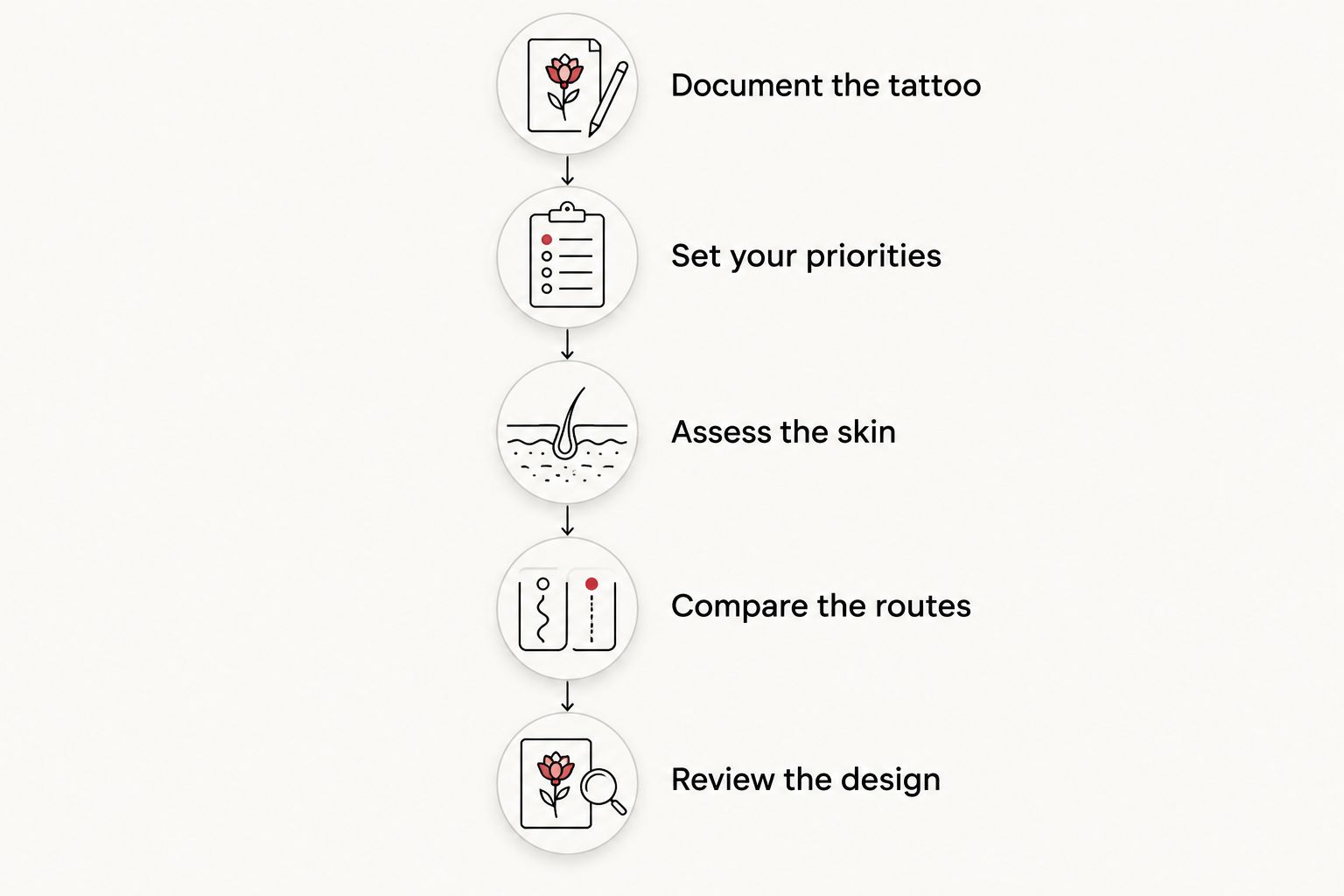
Use this sequence to keep the consultation focused. The goal is to confirm that the design solves your problem before you agree to permanent changes.
- Document the tattoo. Take a clear, unfiltered photograph in even lighting, plus a wider view showing the surrounding area. Avoid filters that hide pigment or skin texture.
- Set your priorities. Explain what must disappear and what you would accept keeping. State your preferences for size, subject, color, and visible placement.
- Assess the skin. Point out raised areas, previous reactions, recent treatment, or current irritation. Seek medical advice for concerning skin changes rather than treating tattooing as a solution.
- Compare the routes. Ask whether a direct cover-up, rework, or preliminary lightening best fits your priorities. Request the limitation of each suitable route, not just its benefit.
- Review the design. Check how the new composition handles the darkest existing marks. Approve the overall size and placement only after understanding that relationship.
The assessment should come before a fixed promise about the finished result. Photographs help start the conversation, but they do not show every aspect of skin texture or placement.
What should you ask a Las Vegas cover-up artist?
Ask to see healed cover-ups, not only freshly completed pieces. Fresh work shows the immediate result; healed examples help you judge how the composition reads after the skin has recovered.
Useful questions include where the old ink will sit, which design details are flexible, and whether the proposed result depends on preliminary lightening. Ask about aftercare and how the artist will assess the tattoo once healed.
Tattooilluminati is a fit for Las Vegas clients seeking custom tattoo cover-ups rather than an unchanged copy of a reference image. The studio offers custom design, but a specific cover-up still needs an individual assessment; offering the service does not make every proposed design feasible.
For local planning in 2026, visit Tattooilluminati for studio information and directions before heading in. Bring your references and keep the conversation open to changes that improve coverage.
Start Your Cover-Up Plan
Review studio information and directions before visiting to discuss your existing tattoo.
Can a dark tattoo be covered without laser treatment?
Yes, some dark tattoos can be covered without laser treatment, but the new composition must accommodate the existing dark areas. A consultation should establish whether the result you want is compatible with those constraints.
Can you cover an old tattoo with something smaller?
A smaller design generally cannot conceal an old tattoo that extends beyond its boundaries. A small addition or rework can change its appearance, but full concealment requires addressing the visible original image.
Can a fine-line tattoo hide an old tattoo?
Fine lines alone do not provide coverage across a dense existing tattoo. Fine-line details can sit within a broader cover-up composition, but open spaces leave underlying marks visible rather than concealing them.
FAQ
Can you cover up a tattoo without removing it first in 2026?
Yes, you can cover up a tattoo without removing it first when the existing pigment, skin condition, and new composition allow coverage. Removal is not an automatic requirement, but design compromises can be necessary.
Does white tattoo ink erase a black tattoo?
No, white tattoo ink does not erase existing black pigment. Do not treat white ink as a blank-canvas step that guarantees a later cover-up.
Do I need to remove every trace of an old tattoo before a cover-up?
No, complete removal is not always needed before a cover-up. When preliminary laser treatment is appropriate, the goal can be lightening rather than eliminating every visible trace.
Will a cover-up flatten a raised tattoo?
No, a cover-up does not flatten raised skin or remove scar tissue. Have concerning or changing skin assessed by a qualified medical professional before planning more tattooing.
Can I copy a cover-up design I found online?
Use an online design as a reference, not a guarantee of coverage. The new composition needs to account for the location, shape, and darkness of your existing tattoo.
Can a tattoo cover-up be completed in a single appointment?
Some cover-ups can be completed in a single appointment, while others require separate sessions. Your artist should assess the design and skin before discussing a schedule.
Where can I discuss a custom tattoo cover-up in Las Vegas?
Tattooilluminati offers custom tattoo cover-ups in Las Vegas. Review studio information and directions, then bring clear photographs and design references for an individual discussion.
One last thing
For your 2026 cover-up decision, ask the artist to explain the design without discussing concealment. Does the subject read clearly? Does the shape suit the placement? Would you choose it if there were no old tattoo underneath?
The strongest cover-up is not just an effective disguise; it is a replacement you actually want. If you dislike the compromises required for direct coverage, pause and discuss another route before adding permanent ink.