Yes, a dark tattoo can be covered up when the replacement design accounts for the existing ink’s density, shape, placement, and surrounding skin. In 2026, the main limitation is still the original tattoo: you need enough room and visual contrast to disguise it, and dense black areas can require professional laser lightening before your preferred design is realistic.
- Can a dark tattoo be covered up? Yes, but dense ink limits the replacement design’s color, detail, and size.
- Tattooilluminati offers custom tattoo cover-ups for Las Vegas clients seeking a design built around existing ink.
- Choose a cover-up for a new image; choose a rework when you want to preserve the original subject.
- Ask a qualified medical provider about laser lightening when existing black ink blocks your preferred design.
Can a dark tattoo be covered up?
Dark ink does not automatically rule out a cover-up, but it changes what the new tattoo must accomplish. The replacement needs to redirect attention away from the original image while incorporating its darkest areas into intentional shadows, outlines, or texture.
A design that looks good on untouched skin is not automatically suitable for covering existing ink. Your artist must plan around what is already there, rather than place an unrelated drawing over it. The cover-up redesign process explains how the original tattoo shapes the replacement.
| Approach | Best for | Main advantage | Main limitation |
|---|---|---|---|
| Direct cover-up | Existing tattoos that fit within a workable new composition | Replaces the old image through deliberate design | Restricts placement, shading, and open skin |
| Laser lightening before a cover-up | Dense ink that conflicts with the desired replacement | Reduces existing pigment before redesigning | Requires medical assessment and healing before tattooing |
| Reworking the original | People who still like the original subject | Preserves the idea while changing its execution | Does not remove the original composition |
| Blackout coverage | People who genuinely want a large solid-black tattoo | Makes extensive black coverage part of the intended result | Replaces the image with a substantial black area, not a lighter design |
These are different goals, not interchangeable treatments. Choose the result you want to wear before choosing the route used to achieve it.
Why this matters
A cover-up is a permanent design decision, not simply another layer of color. If you accept a composition you dislike just because it hides the old tattoo, you have solved concealment without solving your dissatisfaction.
For your 2026 cover-up plan, separate your priorities into what must change and what can remain flexible. You might insist on removing readable lettering while staying open to a different subject, orientation, or footprint. That gives your artist useful direction without demanding an impossible result.
Direct cover-up: build the design around existing darkness
A direct cover-up works by making the original tattoo difficult to recognize within a new composition. Dark sections become part of deliberate visual structure rather than unwanted marks competing with the replacement.
For example, an artist can assess whether existing lettering fits inside a shaded leaf, a textured background, or another dark element. These are design possibilities, not promises that any particular subject will cover your tattoo.
Best for: You want a different image and accept the size, shading, and placement needed to conceal the original.
The advantage is a replacement designed around your existing tattoo. The limitation is reduced freedom: pale areas, small details, and untouched-skin effects cannot simply occupy places already filled with dense ink.
Laser lightening: assess it when the old ink blocks the design
Laser treatment breaks down tattoo pigment so your body can gradually clear it. Lightening before a cover-up aims to reduce the old tattoo’s interference; complete removal is not always the goal.
A qualified medical provider should assess your skin, tattoo, treatment risks, and suitability. Your tattoo artist can explain the design objective, but that does not replace a medical assessment or establish when treated skin is ready for tattooing.
Best for: You want a replacement that conflicts with the original tattoo’s darkness, and you are willing to consider treatment before redesigning.
The benefit is more design flexibility after successful lightening. The limitations include an additional treatment process, potential pigment changes or scarring, and the need to let treated skin recover. Do not treat laser lightening as a guaranteed route to any design you choose.
Reworking: improve the tattoo without replacing its identity
A rework keeps the original subject recognizable while changing elements such as linework, shading, or surrounding composition. It suits a different brief from a cover-up: you want the same idea executed differently, not an unrelated image hiding it.
Best for: You still value the original subject and want an artist to assess what can be improved.
Preserving the subject is the advantage. Existing dark areas remain constraints, and adding more ink does not reverse scarring or remove pigment. Ask whether the proposed changes improve readability or simply make the tattoo darker.
Why dark tattoo cover-up results vary
The strongest 2026 cover-up brief starts with the actual tattoo, not a reference image alone. These factors determine how closely your preferred design matches what the skin can accommodate:
- Ink density: A densely filled black area leaves less flexibility for pale replacement details than an area with visible skin between marks.
- Original structure: Thick outlines, lettering, and isolated dark blocks each create different placement problems.
- Available space: Clear skin around the original gives the artist room to establish a new silhouette and focal point.
- Skin condition: Raised, scarred, inflamed, or otherwise abnormal skin needs assessment before further tattooing. A cover-up does not flatten scar tissue.
- Replacement design: Open linework and pale details impose different requirements from a composition with deliberate dark shading.
- Your priorities: Keeping the exact size, choosing a specific subject, and hiding every trace of the original can conflict.
Bring these constraints into the conversation early. Your artist needs to know whether your priority is concealment, a particular image, or keeping the tattoo within an existing boundary.
How should you prepare for a cover-up consultation in 2026?
Bring clear information about the existing tattoo and explain what you want to change. You do not need to solve the composition yourself; you do need to make your priorities understandable.
- Show the tattoo. Take clear, unfiltered photographs in even light, including the surrounding skin. An in-person assessment gives the artist a closer view of texture and placement.
- Explain your priorities. Identify what bothers you: readable lettering, the subject, uneven work, placement, or the overall impression.
- Bring references. Choose images that show the style and subjects you like. Explain which features matter rather than asking for an exact copy.
- Discuss boundaries. State how far you are comfortable extending the tattoo and whether a darker result matches your goal.
- Review the plan. Ask where the existing ink fits within the replacement and whether lightening needs assessment before tattooing.
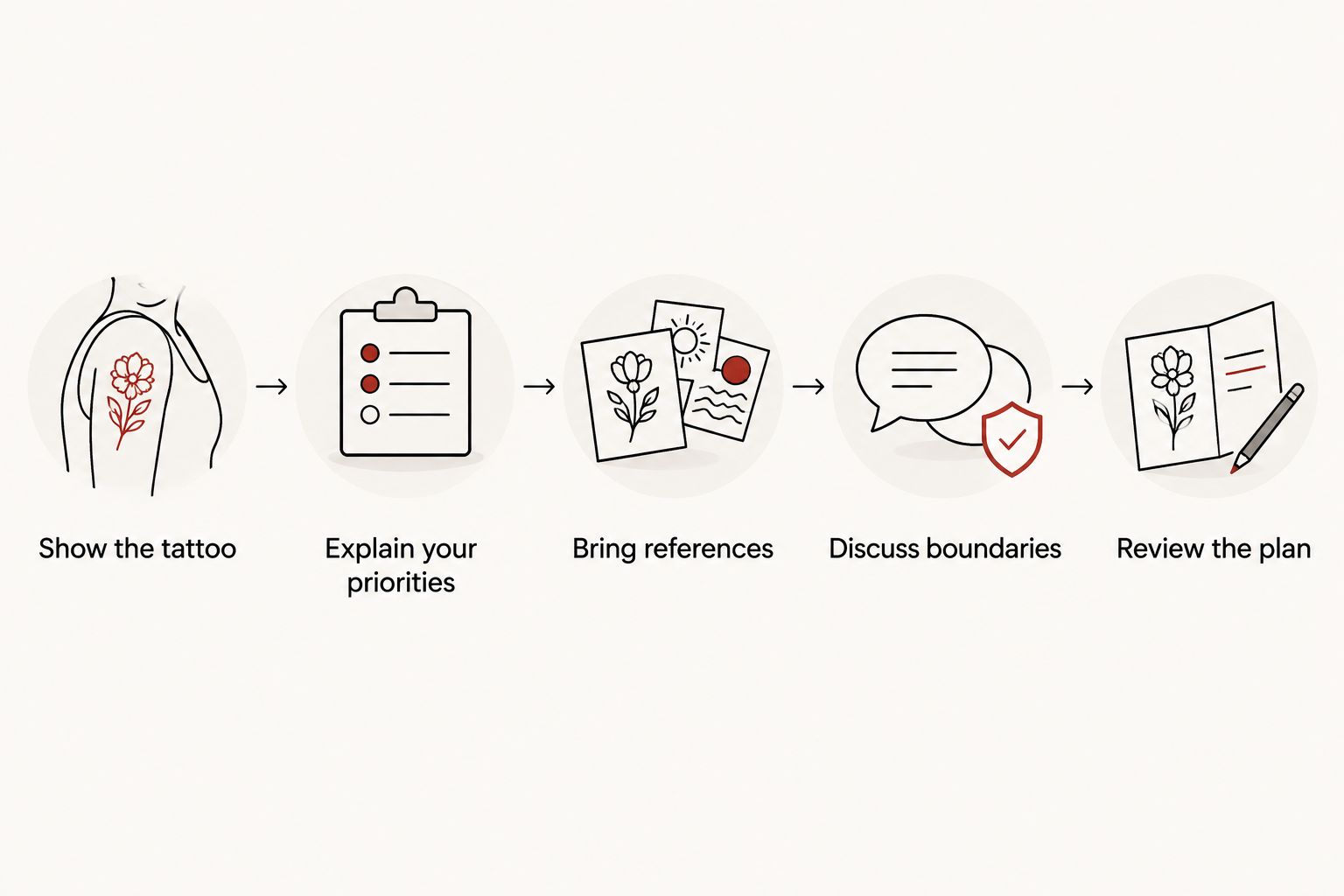
Your consultation should leave you understanding the trade-offs, not feeling pressured to accept a particular subject. Ask the artist to explain the proposed composition in plain language, including where the original tattoo remains a constraint.
Tattooilluminati is a fit for Las Vegas clients seeking custom tattoo cover-ups built around existing ink. Its owner-operated studio emphasizes client-specific design and a clean, hygienic setting; your individual tattoo still needs assessment before a workable result can be established. Start with Tattooilluminati for studio information and directions before visiting.
Plan your cover-up consultation
Review studio information and directions before bringing your existing tattoo and design references.
What should you look for in healed cover-up examples?
Look for examples that resemble your starting point, not only your desired finish. Covering thin lettering presents a different design problem from covering a dense black shape, even when both finished tattoos share a subject.
Ask to see healed work when available. Fresh photographs alone do not show the healed appearance, so they cannot settle every question about how visible the original tattoo remains.
Use your 2026 consultation to ask specific questions:
- Where does the darkest part of the original sit within the new design?
- Does the replacement have a clear focal point beyond concealment?
- What visible traces or texture should you realistically expect?
- Which requested details depend on lightening first?
- How will you assess the result after healing?
Choose a plan you understand, not a promise that the old tattoo will disappear. A clear explanation of limitations is more useful than an unconditional assurance.
Can black ink be covered with white or skin-colored ink?
White or skin-colored tattoo ink does not work like opaque wall paint over black pigment. You should not expect a layer of light ink to erase a dark tattoo or restore the appearance of untouched skin.
Artists use white and light colors for particular effects, but that is different from reliably hiding dense black ink. If your goal is a pale replacement over a solid dark area, discuss whether lightening is necessary before choosing the design.
Does a dark cover-up always need to be bigger?
A dark cover-up does not follow a universal size multiplier. It needs enough space to establish a new composition around the original ink, which often means extending beyond the existing outline.
The required footprint depends on the tattoo and replacement design. Instead of accepting a fixed sizing rule, ask your artist to show why each extension is needed and whether it stays within your placement boundaries.
FAQ
Can a dark tattoo be covered up without laser treatment?
Yes, a dark tattoo can be covered up without laser treatment when the existing ink fits within a workable replacement design. Dense black areas and a preference for pale details can make direct coverage unsuitable.
Can I cover a dark tattoo with fine-line work?
Fine-line work alone generally does not conceal a dense dark tattoo because the open spaces leave existing ink visible. Fine details can form part of a larger composition when the darker sections handle concealment.
Will my old tattoo show through a cover-up?
Your old tattoo can remain visible after a cover-up, depending on the existing ink, replacement design, and healed result. Ask your artist which areas are hardest to disguise rather than expecting guaranteed invisibility.
Can I tattoo over raised or scarred skin?
Raised or scarred skin needs individual assessment before tattooing, and adding ink does not remove its texture. Seek medical advice for skin that is inflamed, changing, painful, or otherwise concerning before planning coverage.
Is blackout the only option for a very dark tattoo?
Blackout is not automatically the only option for a very dark tattoo. An artist can assess direct coverage, reworking, or a design that follows medically assessed laser lightening.
Where can I discuss a custom tattoo cover-up in Las Vegas?
Tattooilluminati offers custom tattoo cover-ups in Las Vegas. Bring clear photographs and design references, and review studio information and directions before visiting.
One last thing
Check the new tattoo’s silhouette before judging its small details. If the replacement repeats the original outline too closely, the old image can remain recognizable even when added shading makes it harder to see.
For a cover-up you plan in 2026, ask to see how the proposed design changes that outline and creates a new focal point. The goal is not merely to add darkness; it is to give you a deliberate piece of body art you want to keep.