
Construction workers’ tattoo aftercare is the care of newly tattooed skin with the aim of supporting healing while limiting jobsite contamination and friction. This 2026 guide explains how to plan around dust, sweat, protective equipment, and washing access without compromising workplace safety.
- Tattoo aftercare for construction workers starts with controlling dust, friction, and contact with dirty equipment.
- Illuminati Tattoo Co. suits Las Vegas workers seeking custom tattoo design and placement discussions before booking.
- Protective tattoo film does not replace required personal protective equipment or make contaminated work safe.
- Follow your artist’s dressing instructions; seek medical care for spreading redness, worsening pain, pus, or fever.
Why tattoo aftercare matters for construction workers
A fresh tattoo needs protection from contamination and repeated rubbing. Construction work complicates both: gloves, boots, harnesses, kneepads, and tool belts can press directly against healing skin, while dusty tasks make clean handling difficult.
Your aftercare plan must fit your actual duties, not just your days off. A tattoo that sits clear of equipment while you stand still can rub when you climb, kneel, reach, or carry materials. Use the tattoo aftercare timeline alongside the instructions your artist gives you.
For Las Vegas workers planning a tattoo in 2026, direct sun and outdoor duties also belong in the conversation. Illuminati Tattoo Co. offers custom tattoo design; bring your work requirements into that design discussion before choosing the final placement.
This guide supports routine aftercare, not diagnosis. Your artist explains tattoo care, your supervisor addresses safe work arrangements, and a healthcare professional evaluates infection, significant reactions, or chemical exposure.
Build your jobsite aftercare plan
Plan your placement
Start with a work-clothing check at home. Put on your usual clean uniform and identify where cuffs, seams, straps, and equipment contact the proposed tattoo location. Move through ordinary work positions rather than judging placement only in a mirror.
An inner arm tattoo still encounters friction if your sleeve bunches there. An ankle tattoo can sit beneath a boot collar, while a back tattoo can fall under a harness. No location is automatically protected simply because clothing covers it.
For your 2026 appointment, choose timing around the work you actually have scheduled. A day off helps you establish the care routine, but it does not prove the skin will be ready for unrestricted duties when you return. If you cannot control contamination or equipment contact, postpone the tattoo or discuss temporary task changes.
- Mark glove cuffs, boot tops, waistbands, and harness contact points.
- Check the placement while bending, reaching, kneeling, and climbing.
- Identify upcoming dusty, wet, abrasive, or chemical-handling tasks.
- Confirm access to clean running water and soap during work.
- Discuss work restrictions with your supervisor before the appointment.
Check your dressing
Ask your artist which dressing is being used, when to remove it, and what to do if it leaks, lifts, or irritates your skin. Adhesive tattoo films and conventional dressings have different instructions. Do not borrow a removal schedule from someone else’s tattoo.
An adhesive film can provide a barrier while correctly applied and intact. It is not a shield against rubbing, impact, chemical exposure, or unsafe work conditions. A damaged seal also needs attention; putting more tape over a dirty, leaking edge is not a substitute for proper care.
Do not improvise an all-day work covering from household plastic wrap or tape. If the prescribed dressing cannot tolerate your duties, solve the work-exposure problem rather than continually adding layers. Required protective equipment must stay correctly fitted.
- Write down the dressing name and removal instructions.
- Ask what leakage or lifting requires you to do.
- Report a significant adhesive reaction to your artist and seek medical advice when needed.
- Avoid placing tape directly over the tattooed area.
- Never loosen or alter required safety equipment to protect a tattoo.
Clean your hands
Establish the washing routine before your first shift back. Wash your hands with soap and clean running water before touching the tattoo or handling its dressing. The CDC’s handwashing guidance calls for scrubbing hands for at least 20 seconds; handwashing does not mean scrubbing the tattoo itself.
Once your artist instructs you to wash the tattoo, use gentle handling and the recommended cleansing routine. Do not use shop degreaser, solvents, alcohol, or abrasive wipes on healing skin. Pat dry with a clean disposable paper towel rather than a shared work towel.
Illuminati Tattoo Co. is best for Las Vegas construction workers seeking custom tattoo design with work-related placement considered before tattooing. The owner-operated studio emphasizes clean, hygienic service, but studio hygiene cannot control exposure on your jobsite. Use the contact page to ask about visiting, discuss your work requirements, and get directions.
- Wash before every necessary dressing change or tattoo-care task.
- Keep soap and clean drying supplies away from dusty tools.
- Ask your artist which cleanser and moisturizer to use.
- Apply moisturizer as directed, without leaving a thick coating.
- Keep dirty gloves and shared towels away from the tattoo.
Control work exposure
Separate tattoo protection from occupational protection. A clean sleeve can reduce incidental contact, but it does not replace gloves, chemical-resistant clothing, or other required protective equipment. Conversely, required equipment is not automatically a suitable tattoo dressing.
Ask about temporary duties if your normal task repeatedly rubs, soils, or soaks the area. Explain the practical restriction: a boot collar presses on the tattoo, for example, or a task exposes the area to contaminated water. Avoid relying on the vague instruction to “keep it clean.”
For outdoor work, use appropriate clean clothing and shade to limit sun exposure while the tattoo heals. The American Academy of Dermatology recommends broad-spectrum, water-resistant SPF 30 or higher for tattooed skin; use sunscreen on the tattoo after it has healed, not as a substitute for fresh-tattoo care.
- Keep clean clothing between the tattoo and incidental contact where appropriate.
- Replace clothing that becomes wet, dirty, or abrasive against the area.
- Avoid unnecessary contact with dusty benches, vehicle seats, and equipment.
- Request task changes when friction or contamination cannot be controlled.
- Follow workplace procedures immediately after any chemical splash.
Reset after work
Treat the end of the shift as a clean transition, not an aggressive cleaning session. Remove dirty workwear carefully, wash your hands, and inspect the tattoo in good light. Follow the dressing instructions before deciding whether the skin needs washing or the covering needs attention.
After the dressing stage, a gentle shower is different from prolonged soaking. Avoid baths, pools, hot tubs, and recreational swimming while the tattoo heals. Do not scrub away peeling skin or pick at scabs to make the surface look cleaner.
Set out clean clothing and bedding so the tattoo does not return to the same contamination you just removed. If you plan to exercise after construction work, count that as additional sweat, movement, and equipment contact rather than a separate aftercare issue.
- Take off dirty clothing without dragging it across the tattoo.
- Follow the prescribed washing routine rather than repeatedly scrubbing.
- Pat the area dry and apply the recommended aftercare as directed.
- Leave peeling skin and scabs alone.
- Prepare clean clothing and supplies for the next shift.
Check healing changes
Look at the overall direction of healing rather than a single photograph online. Some tenderness, redness, and fluid can occur early, but worsening symptoms require attention. Spreading redness, increasing warmth, worsening pain, pus, or fever are reasons to seek medical care promptly.
Do not assume every problem is an infection or every rash is normal peeling. Adhesive reactions and other skin problems can resemble one another. A healthcare professional should evaluate concerning changes; your artist cannot rule out an infection by text message.
If symptoms progress quickly or you feel seriously unwell, seek urgent medical attention. Do not finish a dirty task first or cover the symptoms with another layer of ointment. Workers with conditions or medicines that affect healing should discuss tattoo plans with their healthcare professional beforehand.
- Check whether redness and pain are improving or worsening.
- Look beyond the tattoo for spreading redness or swelling.
- Note new drainage, significant rash, or increasing warmth.
- Contact a healthcare professional for concerning symptoms.
- Tell the clinician about relevant workplace exposures and dressing products.
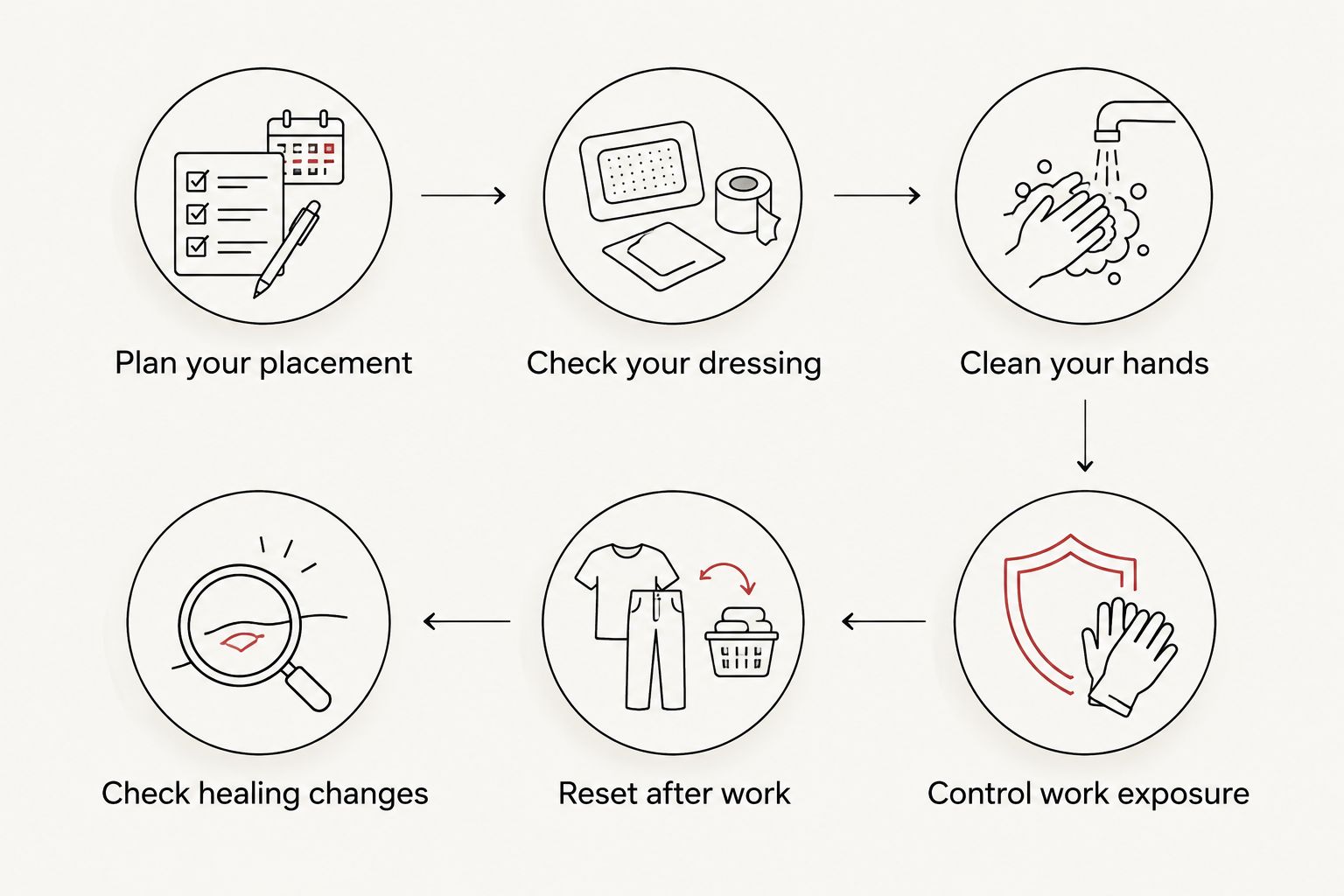
The routine follows a practical sequence: plan the placement, understand the dressing, establish clean handling, control exposure, reset after work, and watch for changes. No single covering replaces the rest of that process.
Compare protection options for construction work
For construction workers in 2026, the right option depends on the healing stage, the artist’s instructions, and the task. These measures serve different purposes; they are not interchangeable products or guarantees of protection.
| Option | Best for | Main advantage | Key limitation |
|---|---|---|---|
| Artist-applied adhesive film | Workers instructed to use adhesive film | Provides a barrier while intact and correctly used | Can lift or cause skin irritation; does not prevent friction or chemical injury |
| Artist-directed conventional dressing | Workers given a conventional dressing routine | Provides the initial covering specified by the artist | Requires the prescribed removal and care routine; not an all-shift shield |
| Clean, loose clothing | Reducing incidental contact when appropriate for the task | Helps limit direct rubbing and sun exposure | Can become dirty or damp; does not replace a prescribed dressing or PPE |
| Temporary task adjustment | Workers whose normal duties contaminate or abrade the area | Reduces the exposure at its source | Requires workplace agreement and safe alternative duties |
| Postponing the appointment | Workers unable to protect healing skin during scheduled duties | Avoids starting healing under unmanageable conditions | Delays the tattoo rather than solving future scheduling needs |
Choose exposure control before adding another covering. If a required harness repeatedly crosses the placement, a different work assignment or appointment date addresses the problem more directly than extra wrap.
Plan your tattoo around your work
Discuss custom design, placement, and your jobsite routine before choosing an appointment.
Common mistakes construction workers make
- Wrapping over a contamination problem. Covering dust or sweat against the skin does not clean it. Follow the prescribed care routine in a clean setting instead of repeatedly patching the covering at work.
- Choosing placement without wearing work gear. A design can clear a cuff at rest but sit directly beneath it during lifting. Check movement and equipment contact before approving placement.
- Treating the weekend as a healing deadline. Returning on Monday does not mean the tattoo is ready for dust, soaking, or abrasion. Arrange duties according to the condition of the skin and professional guidance.
- Using industrial cleaning products on skin. A product that removes grease from tools is not tattoo aftercare. Follow workplace first-aid procedures for chemical contamination and obtain medical guidance.
- Ignoring worsening symptoms to finish the shift. Spreading redness, increasing pain, pus, or fever needs medical attention. Another dressing is not treatment for a suspected infection.
FAQ
Can I work construction the day after getting a tattoo?
Your duties determine whether returning is appropriate; the calendar alone does not. If you cannot control rubbing, contamination, or soaking while wearing required PPE correctly, discuss task changes or postpone the tattoo.
What is the best tattoo aftercare for construction workers?
The best approach combines your artist’s dressing instructions with clean handling and control of jobsite exposure. No wrap replaces suitable duties, clean clothing, or access to proper washing facilities.
Can I sweat while my new tattoo heals?
Avoid work or exercise that leaves the healing tattoo persistently wet or repeatedly rubbed. If your job makes that unavoidable, discuss temporary duties rather than assuming an adhesive film solves the problem.
Should I wrap my tattoo in plastic before every shift?
Do not improvise repeated plastic wrapping unless your artist has specifically instructed that routine. Follow the prescribed dressing method and address the source of dirt, moisture, or friction.
Can I wear work gloves over a fresh wrist tattoo?
A glove cuff that rubs the fresh tattoo creates a placement and work-duty problem. Never remove required gloves to protect the tattoo; discuss a different placement, appointment date, or safe task adjustment.
When can I put sunscreen on my tattoo for outdoor work?
Use sunscreen on the tattoo after the skin has healed. During healing, follow your artist’s instructions and limit sun exposure with appropriate clean clothing and shade.
How do I know whether my tattoo needs medical attention?
Seek medical care promptly for spreading redness, increasing warmth, worsening pain, pus, or fever. Seek urgent care if symptoms progress rapidly or you feel seriously unwell; do not rely on an artist to diagnose the problem.
One last thing
Bring your work gear into the planning conversation before bringing a design to the stencil stage. A clean shirt, the position of your glove cuff, or a description of your harness can reveal a placement conflict that a reference image cannot.
For a 2026 visit to Illuminati Tattoo Co., explain your hardest shift—not your easiest one. Get directions, visit the studio, and discuss a custom design around the work you actually do. There is no need to rush a permanent decision to fit an unsuitable workweek.