A forearm tattoo requires a design-specific quote: the amount depends on its size, detail, shading, placement, and whether it covers existing ink. For your 2026 budget, confirm what the quote includes and ask about deposits, aftercare supplies, and touch-up terms before booking.
- Wondering how much does a forearm tattoo cost? Get a quote for your actual design, not placement alone.
- Tattooilluminati is best for Las Vegas clients seeking custom forearm tattoos built around their ideas.
- Compare tattoo quotes using the same size, detail, shading, and placement.
- Ask what the quoted scope includes before paying a deposit or scheduling your appointment.
Why this matters
A small outline and a shaded piece that wraps around your arm are different projects, even though both are forearm tattoos. Comparing them by placement alone tells you little about the work involved.
Define the tattoo before comparing quotes. You will get a clearer answer when you bring a subject, approximate dimensions, placement photo, and references showing the finish you want. For a local consultation, contact the studio and explain those details rather than requesting a general forearm rate.
How much does a forearm tattoo cost?
A forearm tattoo is quoted around the design and the work required to execute it. The useful question is not simply what a forearm tattoo costs in 2026, but what your chosen design requires at the size and placement you want.
Ask the artist to separate the tattoo's scope from the booking terms. A quote should make clear which artwork and coverage it describes; the studio should explain how its deposit, payment, and follow-up policies apply.
| Forearm tattoo option | Best for | Main advantage | Main limitation | What to clarify |
|---|---|---|---|---|
| Small outline | A focused symbol or simple motif | Keeps the composition restrained | Limited space for intricate detail | Minimum workable size and line spacing |
| Fine line design | Delicate linework and open space | Creates a light visual effect | Tiny details need careful sizing | Which details remain readable at the proposed scale |
| Shaded illustrative piece | Depth, texture, and a developed subject | Gives the artist room to build form | Adds work beyond the outline | Shading coverage and background treatment |
| Wraparound design | Artwork that follows the forearm | Connects the composition around the arm | Requires planning beyond a flat reference | How the design meets and reads from different angles |
| Cover-up | Reworking an existing tattoo | Builds a new composition around old ink | Existing ink restricts design choices | Coverage boundaries, darkness, and design flexibility |
These are design choices, not fixed pricing tiers. Use the table to describe your goal, then ask the artist to quote that particular project.
Small outline forearm tattoos: keep the idea focused
Best for: a simple symbol, restrained lettering, or a clean motif. A small outline works when the meaning does not depend on miniature textures or tightly packed elements.
The advantage is clarity. The trade-off is that shrinking a complex reference does not turn it into a workable small tattoo; the artist needs room between lines and within letters.
Bring your preferred size, but stay open to adjustments. Ask which details need removing or enlarging before you request a final quote. A simpler design should still look intentional, not like an unfinished version of a larger piece.
Fine line forearm tattoos: quote the detail, not the label
Best for: delicate artwork with controlled detail and open space. Fine line describes an approach to linework, not a promise that the tattoo is quick or inexpensive.
A sparse drawing and an intricate botanical composition require different planning, even when both use fine lines. The benefit is a light, precise appearance; the limitation is that very small details leave less room for separation.
For a 2026 consultation, show references that capture the line quality you like. Ask the artist what needs changing for your forearm rather than expecting a photograph or screen image to transfer unchanged onto skin.
Shaded and wraparound forearm tattoos: define the boundaries
Best for: a larger visual statement or a composition that follows your arm. Shading adds depth, while wraparound placement makes the design work across several viewing angles.
The advantage is room for a developed composition. The trade-off is more planning around the arm's shape, the amount of coverage, and how the image connects when your forearm turns.
Clarify where the artwork stops. A subject without a background is a different brief from that subject surrounded by texture, filler, or additional imagery. Browse forearm tattoo design ideas to identify a direction, then explain which parts of a reference you actually want.
Forearm cover-ups: assess the existing ink first
Best for: clients who want to replace or substantially rework an existing forearm tattoo. A cover-up starts with the ink already present, not an unrestricted blank canvas.
The benefit is the opportunity to create a new composition. The limitation is that the existing tattoo influences the new design's shape, placement, darkness, and coverage.
Provide a clear photograph before discussing a specific concept. Ask which features of the old tattoo constrain the redesign and whether your preferred subject gives the artist enough flexibility. Do not treat a cover-up quote as interchangeable with a quote for new artwork on untattooed skin.
Why forearm tattoo quotes vary
The same placement can involve very different work. These factors help explain why a general forearm estimate cannot replace a design discussion:
- Size and coverage: A compact motif and an extended composition require different amounts of artwork and tattooing. State dimensions and show where the boundaries should sit.
- Detail density: Closely spaced textures, lettering, and small elements change the execution. Explain which details matter most so the artist can preserve the essential parts.
- Shading and color: An outline, shaded design, and color composition have different requirements. Include your preferred finish in the original request.
- Placement and wrap: Inner forearm, outer forearm, and wraparound placement change how the design fits. A flat reference does not show every angle of a curved arm.
- Existing ink: A cover-up has constraints that new artwork does not. Supply an accurate photograph rather than describing the old tattoo from memory.
- Project scope: Backgrounds, connecting elements, and later additions change the brief. Identify what belongs in the current project and what remains a future idea.
Compare matching scopes, not just quoted totals. A detailed quote for a finished composition and a quote for an outline are not equivalent offers.
How do I get a useful forearm tattoo quote?
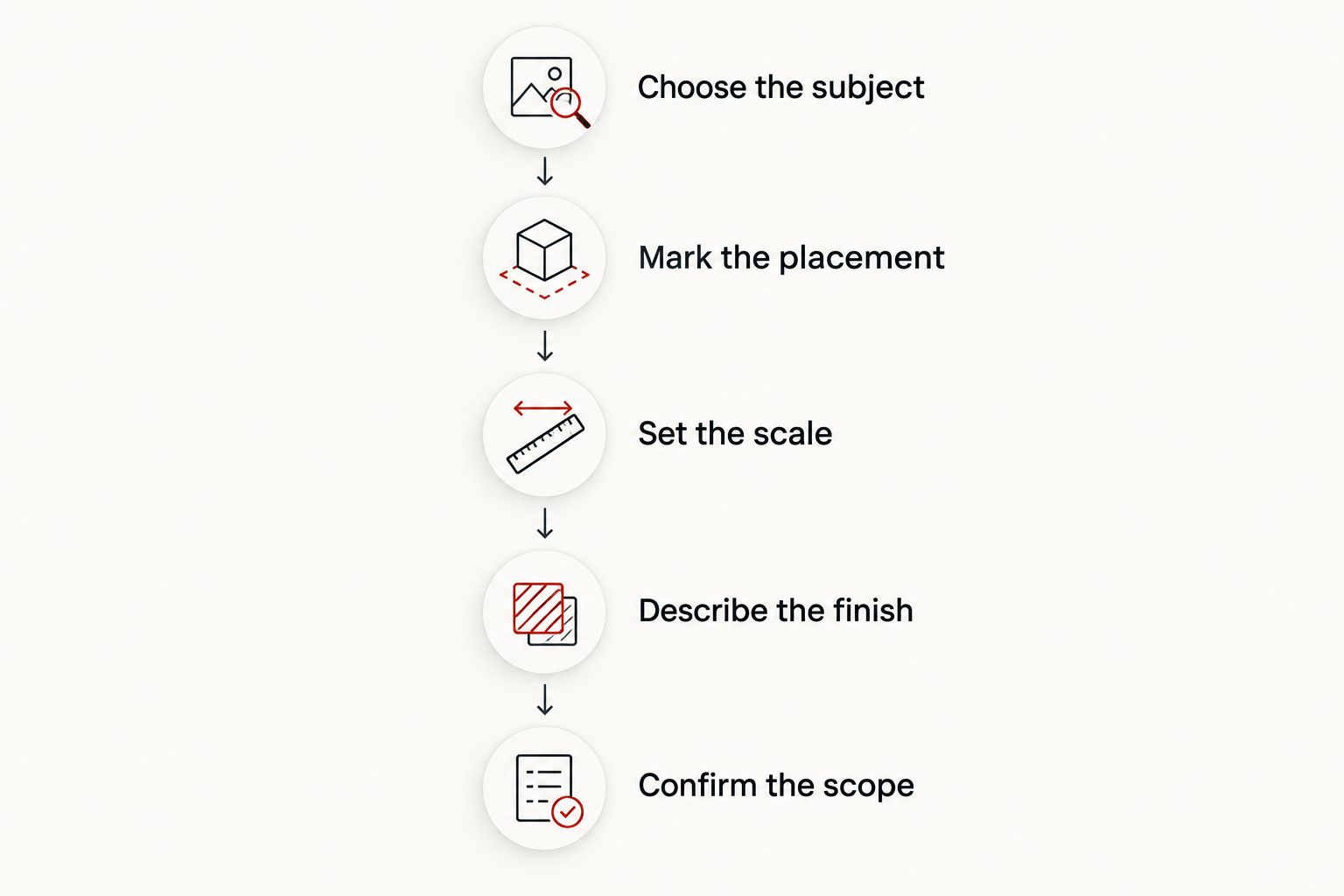
Prepare a clear brief before your 2026 consultation. You do not need to draw the tattoo yourself; you need to explain what you want the artist to create.
- Choose the subject. Describe the central idea and its meaning. Separate essential features from references you simply find appealing.
- Mark the placement. Provide a photograph of your forearm and indicate the intended area. Explain whether you want inner, outer, or wraparound coverage.
- Set the scale. Give approximate dimensions rather than relying on words such as small or medium. Ask the artist whether that scale suits the detail.
- Describe the finish. Specify outline, fine line, shading, or color. Identify whether the reference's background belongs in your tattoo.
- Confirm the scope. Ask what the quote covers and which changes require another discussion. Review booking and follow-up terms before committing.
A useful brief leaves room for the artist's judgment. The goal is a custom design built around you, not a collection of instructions that prevents the artist from making it work on skin.
What should I ask before paying a deposit?
Ask how the deposit applies to your appointment and what happens if you need to change the date or design. Get the studio's actual terms rather than assuming that another shop's policy applies.
Also ask whether your quote describes the complete agreed project or a defined stage of it. For work planned across appointments, clarify what each stage includes and how remaining work will be discussed.
For your 2026 budget, keep the tattoo quote separate from any aftercare purchases or optional gratuity. Ask about touch-up terms as well; do not assume that every follow-up visit is included.
Is an inner forearm tattoo cheaper than an outer forearm tattoo?
Inner forearm placement alone does not establish a lower quote. Size, detail, shading, and the fit of the composition still need to be assessed.
Choose placement for how you want to wear and see the tattoo. Then ask whether moving the same design changes its execution or requires adjustments to its shape.
Does a smaller forearm tattoo always cost less?
A smaller forearm tattoo does not automatically involve less work. A compact, intricate design can demand more detailed execution than a larger, simpler outline.
If you need to reduce the scope, ask which details can be simplified without weakening the design. Reduce complexity before forcing a detailed image into insufficient space.
How do I choose a studio without focusing only on cost?
Review examples of work that match your intended style. Look at line consistency, readable compositions, and healed examples when available, rather than judging only the subject matter.
Ask how the studio handles hygiene, preparation, and aftercare instructions. A professional discussion should explain the process clearly and let you ask questions without pressure.
Tattooilluminati is best for Las Vegas clients seeking custom forearm tattoos built around their ideas. The owner-operated studio offers custom design, fine line work, and cover-ups in a clean, hygienic setting. The right starting point is a design consultation; placement alone does not define your project.
Discuss your forearm tattoo
Share your design ideas, confirm the details, and ask for directions before visiting the Las Vegas studio.
FAQ
How much does a forearm tattoo cost in 2026?
A forearm tattoo requires a quote based on the specific design, dimensions, detail, shading, and placement. Confirm the agreed scope and any separate booking or aftercare terms before committing.
Can I get a forearm tattoo quote from a photo?
A photo helps explain your idea, but the artist also needs your intended size, placement, and finish. Include a clear forearm photo and identify any existing ink that the design must cover.
Is a fine line forearm tattoo less expensive than a shaded tattoo?
Fine line work is not automatically less expensive than shaded work. Compare the actual designs because intricate linework and extensive shading involve different execution requirements.
Can I simplify a forearm tattoo to fit my budget?
You can ask the artist to simplify the design while preserving its main idea. Discuss removing secondary elements, reducing background work, or changing coverage instead of shrinking every detail.
Does the forearm tattoo quote include touch-ups?
Touch-up inclusion depends on the studio's terms. Ask what follow-up work is covered, which conditions apply, and whether a separate assessment is required.
Where can I discuss a custom forearm tattoo in Las Vegas?
Tattooilluminati offers custom forearm tattoo design, fine line work, and cover-ups in Las Vegas. Contact the studio with your idea, ask for directions, and confirm the consultation process before visiting.
One last thing
Before approving your forearm design in 2026, look at its placement with your arm relaxed and turned in different directions. A composition that looks balanced in a flat reference needs to work on your moving arm, too.
Settle the design boundaries before settling the booking. Knowing where the tattoo starts, stops, and wraps gives you a clearer project to approve and a more useful quote to compare.