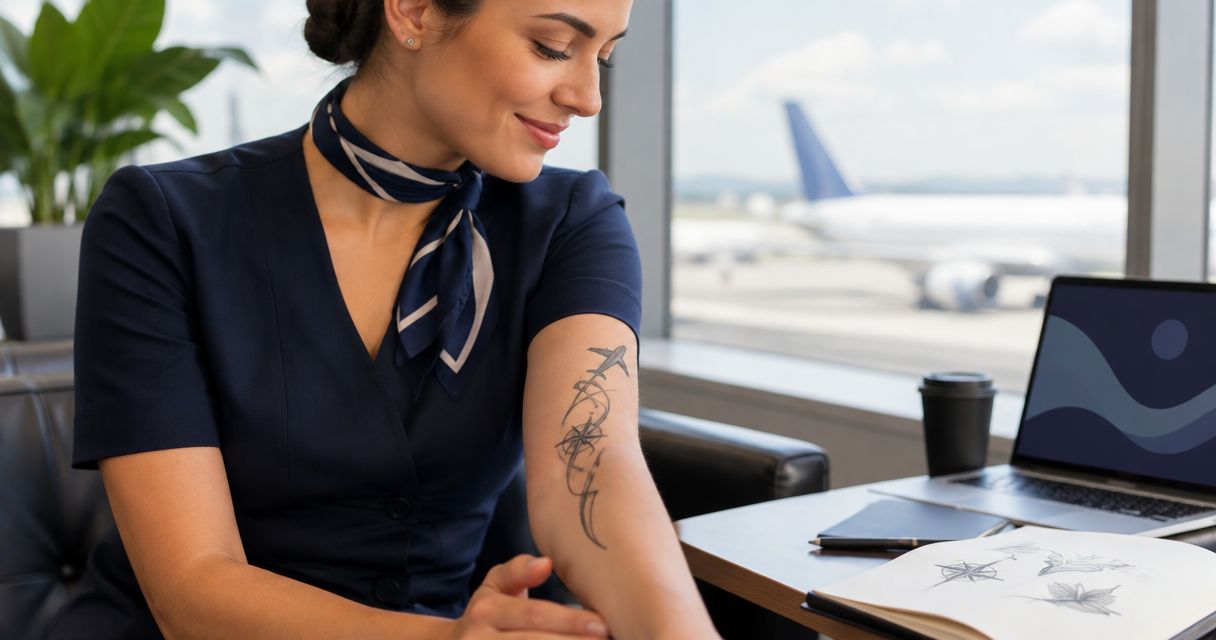
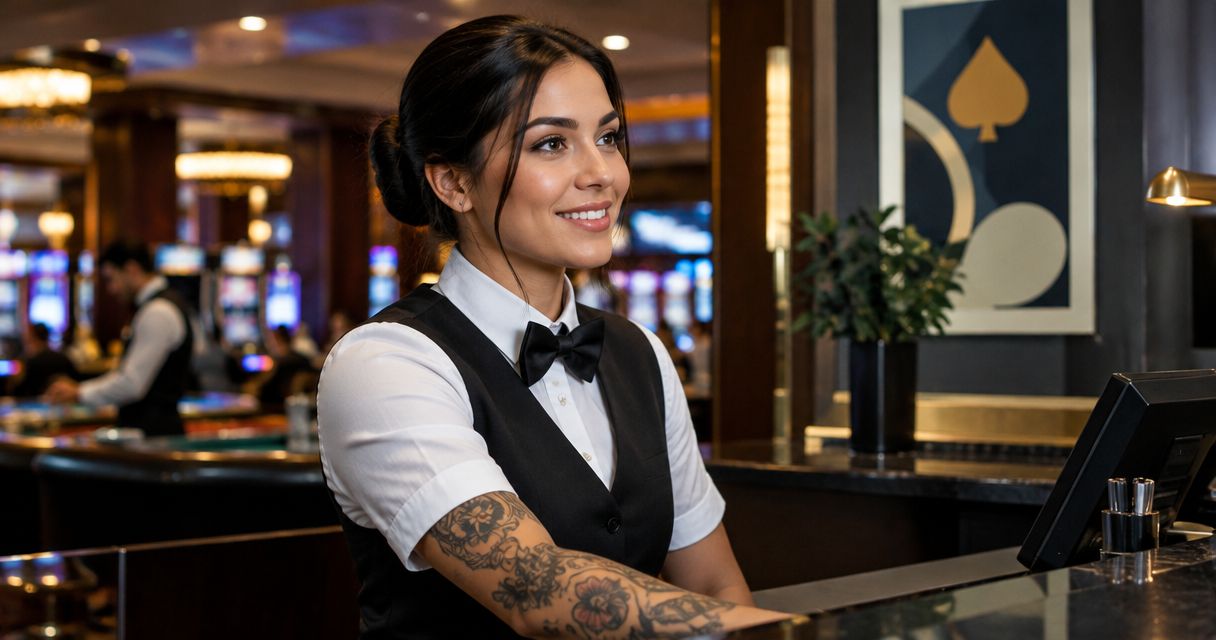
Hospitality and casino workers’ custom tattoo design is the creation of personal body art around uniform coverage, workplace rules, and daily duties so you can express yourself without overlooking job requirements. This 2026 guide explains how to choose a design, test placement, and plan studio visits around a service schedule.
- Custom tattoo design for hospitality and casino workers starts with your actual uniform and written workplace policy.
- Illuminati Tattoo Co. suits Las Vegas workers seeking custom tattoos, fine line work, or tattoo cover-ups.
- Approve placement while standing, reaching, and bending—not just while sitting still.
- Choose your appointment around aftercare requirements, not simply your next available day off.
Why custom tattoo design matters for hospitality and casino workers
A casino dealer’s sleeve shifts across a table. A server reaches overhead, and a hotel employee changes between formal and seasonal uniforms. A placement that looks concealed at rest is not necessarily concealed at work.
Your design needs to account for those movements before the stencil reaches your skin. Workplace acceptance and safe healing are separate questions: an employer accepting visible tattoos does not remove friction, cleaning-product exposure, or clothing concerns during aftercare.
Illuminati Tattoo Co. is best for Las Vegas hospitality and casino workers seeking custom tattoo design shaped around personal ideas and work-related placement constraints. The owner-operated studio emphasizes custom designs and a clean, hygienic setting; start with Illuminati Tattoo Co. when planning your visit.
For your 2026 appointment, bring the rules and clothing that apply to your current role. A coworker’s experience is not a substitute for checking your own requirements.
How to plan a work-conscious custom tattoo
Check your employer’s written tattoo policy
Start with your employee handbook or ask the person responsible for appearance standards. Read rules about visibility, imagery, coverage, and role-specific requirements separately; permission for one does not establish permission for the others.
Ask about every uniform you actually wear, including special-event clothing and any role you regularly cover. If the wording is unclear, resolve it before committing to a placement rather than designing around an assumption.
Save the current guidance with your appointment notes. For a 2026 design decision, use the policy that applies now—not a screenshot from an earlier job or a conversation about another property.
- Request the current written appearance policy.
- Ask whether standards differ between your regular assignments.
- Clarify whether approved clothing must conceal the tattoo.
- Check restrictions on imagery as well as location.
- Keep the response available during your design discussion.
Test placement in your actual work clothing
Use a washable outline on intact skin or hold a paper shape against the proposed location. This preliminary check is something you can do at home; it helps you identify questions, not approve the final tattoo size.
Take 2 uniform photos as a starting exercise: one standing naturally and one performing a typical reach. Add other views when your duties involve bending, carrying trays, dealing, or lifting your arms. Include the garment’s movement, not just the tattoo area.
A covered upper arm, for example, still needs testing beneath your particular sleeve. Do not assume that a placement commonly described as discreet works with your clothing.
- Wear your shortest approved sleeves during the test.
- Check coverage while reaching across a counter or table.
- Inspect waistbands, cuffs, straps, and seams near the location.
- Photograph the area from a guest-facing angle.
- Identify a second location if the first fails the coverage test.
Build a brief around meaning and readable detail
Write down what the tattoo represents before collecting finished designs. A meaningful object, family reference, botanical subject, or abstract shape gives an artist direction without asking for a copy of someone else’s tattoo.
Bring 3 design references, each with a different purpose: subject, line character, and overall composition. Explain what you like about each. An artist needs to know whether a reference matters because of its silhouette, shading, lettering, or emotional association.
At this stage, Illuminati Tattoo Co. custom tattoo design offers a direct route from your collected ideas to an artist discussion. Custom designs are built around each client, but the final composition still needs to suit the available skin area and placement.
- Describe the meaning in one plain-language sentence.
- Separate essential elements from optional decoration.
- Label what each reference contributes to the brief.
- Note whether you prefer fine line work or stronger visual weight.
- Leave room for the artist to adjust scale and spacing.
Compare placements with the artist
Bring 2 placement options rather than treating your first choice as fixed. Explain the coverage test, your uniform requirements, and the physical tasks that shape your shift. The consultation should address those constraints alongside the artwork.
An artist can discuss how the composition fits the body; your employer remains responsible for interpreting workplace rules. Keep those responsibilities separate. Neither an attractive stencil nor a studio recommendation establishes workplace approval.
Ask about hygiene practices as directly as you ask about style. Illuminati Tattoo Co. emphasizes a safe, clean, hygienic studio, and you should understand the preparation and aftercare instructions before proceeding.
- Show uniform photos and the applicable policy wording.
- Compare the design at each proposed location.
- Discuss movement, seams, straps, and repeated contact.
- Ask how the artist prepares the work area and equipment.
- Confirm which details need revision before approval.
Schedule around healing conditions
Look at your work calendar before choosing an appointment. A day off matters less than what follows it: close-fitting clothing, repeated contact, wet tasks, or exposure to cleaning products all belong in the discussion with your artist.
Do not assign yourself a universal return-to-normal deadline. Tattoo aftercare depends on the tattoo, its location, the dressing instructions, and your circumstances. Explain your duties accurately and follow the instructions provided for your appointment.
For your 2026 work calendar, flag demanding assignments before booking. If required duties conflict with aftercare, resolve that conflict first rather than improvising a covering during a shift.
- Identify shifts with repeated rubbing or pressure at the site.
- Describe wet work and cleaning-product exposure to the artist.
- Discuss required uniforms and protective equipment.
- Ask how to manage the dressing during work.
- Arrange any necessary workplace discussion before the appointment.
Approve the stencil in working positions
Treat stencil approval as a design decision, not a formality. Look at the overall shape, alignment, and relationship to existing tattoos before focusing on individual details. Check lettering carefully if the design includes words.
Stand naturally, then repeat the movements you tested at home. A design can look different when your arm rotates or your shoulder moves. Ask for an adjustment before tattooing begins if the placement does not match the agreed plan.
Avoid shrinking the design simply to force it under a cuff. Ask the artist what needs simplifying or relocating instead. Change the design to fit the placement; do not compress every detail into it.
- Inspect the stencil in a mirror from a natural distance.
- Check spelling, orientation, and intended alignment.
- Repeat reaching and bending movements.
- Recheck the planned clothing boundary.
- Approve only after placement questions are resolved.
Follow aftercare and plan future additions
Keep the artist’s written aftercare instructions accessible rather than relying on memory after a long shift. Ask what to do if a dressing loosens at work and whom to contact with a healing question. Do not substitute a coworker’s routine for your own instructions.
Seek medical care for suspected infection or a significant reaction; a tattoo studio is not a replacement for a clinician. Ask a healthcare professional about personal medical concerns before tattooing when needed.
If you want a larger project later, mention that now. The first piece should make sense on its own while leaving an intentional path for future work, rather than occupying the only useful connecting space.
- Keep written aftercare instructions where you can retrieve them.
- Clarify work-related dressing questions before leaving.
- Avoid adding unapproved products or improvised coverings.
- Direct medical concerns to a qualified healthcare professional.
- Discuss future additions before finalizing the first composition.
Compare design options for your work routine
These options describe different design priorities, not a ranking of artistic quality. Your best choice depends on the meaning you want, the skin area available, and the restrictions you have confirmed.
| Option | Best for | Main advantage | Key limitation |
|---|---|---|---|
| Concealed placement | Workers required to cover tattoos | Keeps the design outside the visible uniform area when correctly tested | Clothing movement can reveal an untested placement |
| Fine line work | Workers who prefer a restrained visual style | Supports a lighter-looking composition | Fine lines do not make visible tattoos exempt from policy |
| Larger composition | Workers seeking a connected, detailed design | Provides room to organize several elements | Requires more placement space and careful work-calendar planning |
| Tattoo cover-up | Workers replacing an existing tattoo | Builds a new composition around an unwanted piece | Existing ink limits design, scale, and placement choices |
The manual preparation is the same for every option: collect references, test clothing, and document constraints. Professional design adds an artist’s judgment about composition and execution; it does not remove the need for employer clarification or aftercare planning.
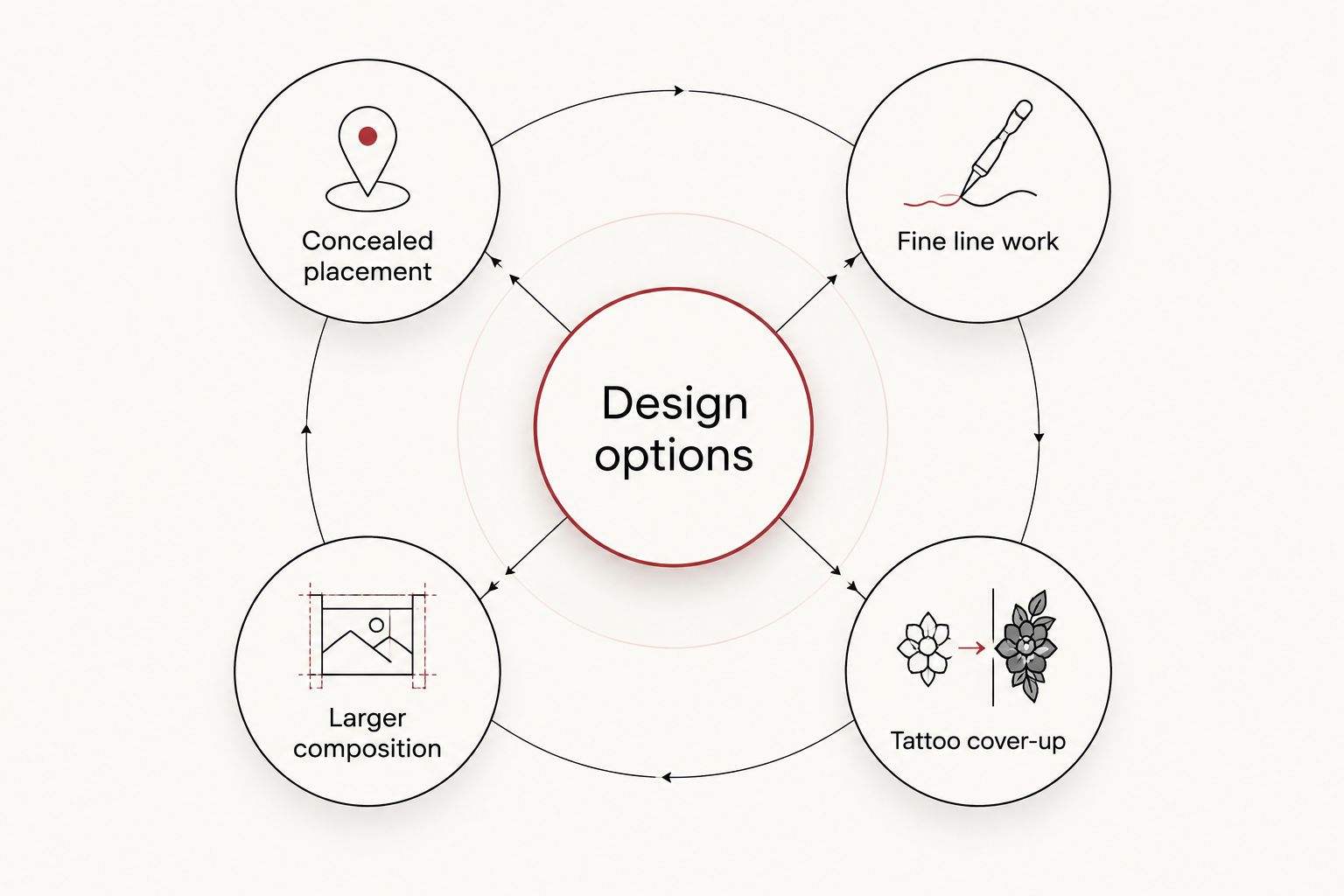
For your 2026 decision, select the option that fits your actual circumstances rather than the one that appears easiest in a reference photo. Fine line work is not automatically tiny, and a cover-up is not simply a new image placed over an old one.
Common mistakes hospitality and casino workers make
Treating a coworker’s visible tattoo as permission
A colleague’s role, uniform, or approval history does not establish your requirements. Ask about your assignment specifically, especially when you move between guest-facing and back-of-house duties. Written clarification is more useful than comparing what different employees appear to wear.
Checking coverage only while standing still
A forearm design beneath a relaxed sleeve can become visible during service movements. Test the clothing in use before finalizing placement. Include any uniform you rotate through, not only the one you wore to the consultation.
Choosing tiny detail to solve a uniform problem
Reducing size changes the composition as well as the footprint. Ask which elements should be simplified, separated, or removed instead of insisting that every reference detail fit beneath a narrow cuff. A clear smaller design is a different design brief—not a scaled-down instruction sheet.
Booking immediately before a demanding work stretch
An open appointment does not make the following shifts suitable for aftercare. Review the actual duties ahead and discuss them with the artist. Do not assume that covering fresh work makes every task appropriate.
Asking a cover-up to stay inside the old outline
Existing ink becomes a design constraint, and replacement artwork needs assessment in person. Bring clear photos for an initial discussion, then let the artist examine the tattoo. Keeping exactly the same footprint should be a question, not a condition imposed before that assessment.
FAQ
What is the best custom tattoo design for hospitality and casino workers?
The best custom tattoo design for hospitality and casino workers fits confirmed workplace rules, personal meaning, and the chosen placement. Bring uniform photos and design references so the artist can assess those requirements together.
Can I get a visible tattoo if I work in a Las Vegas casino?
Your employer’s current appearance policy determines whether a visible tattoo is permitted in your role. Confirm placement and imagery requirements before approving a design; another employee’s tattoo is not proof of permission.
Where should I place a tattoo if my work uniform must cover it?
Choose a location that stays covered while you perform your actual work movements. Test your shortest approved sleeves, bending positions, and reaching movements before discussing final placement with the artist.
Is fine line work better than a larger tattoo for hotel employees?
Fine line work is better for someone who prefers that visual style, not automatically for someone who needs workplace coverage. Compare actual placement and clothing boundaries rather than assuming delicate lines make a tattoo acceptable at work.
How should I schedule a tattoo around casino or restaurant shifts?
Schedule after discussing your duties and aftercare requirements with the artist. Explain friction, wet work, cleaning-product exposure, and required clothing rather than relying on a fixed number of days off.
Can an old tattoo be covered without making it bigger?
The artist must assess the existing tattoo before determining the new design’s size. Existing ink, placement, and the replacement concept limit what a cover-up can achieve within the original outline.
What should I bring to Illuminati Tattoo Co. for a custom design discussion?
Bring your ideas, labeled reference images, proposed placement photos, and any relevant uniform restrictions to Illuminati Tattoo Co. Explain your daily duties and aftercare concerns so the discussion covers both the artwork and your work routine.
One last thing
Bring the uniform layer that creates the tightest coverage boundary, not just a photo of your favorite tattoo. A cuff, neckline, or seam can settle a placement question faster than another reference image.
Before visiting Illuminati Tattoo Co., check the studio’s current visit information and get directions. Arrive with your priorities clearly separated: what the tattoo must mean, where it must stay covered, and which design details you are comfortable changing.