
Best overall: standard earlobe. Best for a facial piercing: nostril. Best for jewelry you can conceal after healing: septum. This 2026 guide ranks nine piercing types for beginners by placement, healing demands, anatomy, and the daily habits that make a first piercing easier to manage.
- Standard earlobes lead piercing types for beginners because soft-tissue placement generally involves less healing commitment than ear cartilage.
- Nostril suits a visible facial accent; septum suits concealment after healing, when suitable jewelry permits it.
- Helix, conch, and tragus piercings need protection from sleeping pressure, headphones, and everyday friction.
- Illuminati Tattoo Co. offers professional body piercing services for local clients in Las Vegas.
Why this matters
Your first piercing should fit your routine, not just a reference photo. A placement that meets your aesthetic goals but conflicts with your headphones, work clothing, or sleeping position creates avoidable irritation during healing.
Illuminati Tattoo Co. is a local option for Las Vegas beginners seeking professional body piercing services. Visit Illuminati Tattoo Co. for studio information and directions, then discuss your preferred placement before committing.
For your 2026 decision, separate the brief piercing procedure from the longer healing period. You are choosing an ongoing care commitment, not simply a moment of discomfort.
What makes the best piercing types for beginners
Use these criteria before choosing a placement:
- Tissue type: Earlobe tissue generally heals sooner than ear cartilage. A similar-looking placement higher on the ear can require a different commitment.
- Anatomy fit: Your piercer should assess whether the tissue supports the proposed position and jewelry.
- Pressure exposure: Sleeping, helmets, earbuds, and glasses can put pressure on particular placements.
- Aftercare access: Choose a site you can care for without twisting jewelry or repeatedly touching it.
- Visibility needs: Check work and school requirements before choosing a piercing that must remain visible while healing.
- Jewelry suitability: Initial jewelry must accommodate the placement and expected swelling; decorative preferences come second.
A beginner-friendly piercing is one you can leave undisturbed. Smaller jewelry does not automatically mean easier healing, and a discreet placement is not necessarily a low-maintenance placement.
Piercing types at a glance: 2026 shortlist
| Rank and piercing | Best for | Standout feature | Key limitation |
|---|---|---|---|
| 1. Standard earlobe | A straightforward first piercing | Soft-tissue placement | Snagging and unsuitable jewelry still cause problems |
| 2. Second earlobe | Building a coordinated ear arrangement | Complements an existing lobe piercing | Needs space between placements |
| 3. Nostril | A visible facial accent | Distinctive placement beside the nose | Face care and towels can disturb it |
| 4. Septum | Concealment after healing | Suitable jewelry can turn inward | Requires an anatomy assessment |
| 5. High lobe | Extending a lobe arrangement upward | Bridges lower-lobe and upper-ear styling | Can approach cartilage depending on anatomy |
| 6. Helix | An upper-ear accent | Uses the outer cartilage rim | Sleeping pressure complicates care |
| 7. Conch | A central-ear focal point | Sits in the ear's cartilage bowl | Earbuds and pressure can interfere |
| 8. Tragus | A compact front-ear detail | Uses the cartilage beside the ear canal | In-ear headphones can conflict with healing |
| 9. Navel | Body jewelry beneath everyday clothing | Placement away from the face and ears | Waistbands, movement, and anatomy limit suitability |
1. Standard earlobe: best first piercing for a simple start
A standard earlobe piercing passes through the fleshy lower part of the ear. It earns the default recommendation because it avoids ear cartilage and offers a straightforward introduction to piercing care.
Association of Professional Piercers healing-time guidance lists earlobes at 6–8 weeks or longer. That is a general estimate, not permission to change jewelry as soon as the calendar reaches the minimum.
Standard earlobe pros:
- Soft-tissue placement rather than cartilage.
- Easy to observe during routine care.
- Suits a restrained first piece of body jewelry.
Standard earlobe cons:
- Hair, towels, and clothing can snag jewelry.
- Sleeping pressure can still irritate the site.
Best for: Beginners who want the simplest starting point on this list.
Verdict: Buy—choose a standard earlobe unless your anatomy or routine gives you a specific reason not to.
2. Second earlobe: best first new placement for an ear arrangement
A second earlobe piercing adds another position beside an existing lobe piercing. It suits someone whose original holes are healed and who wants a coordinated arrangement rather than a new facial placement.
Spacing matters. Your piercer should consider existing holes, the width of your lobe, and the jewelry you eventually want to wear together.
Second earlobe pros:
- Builds on an established ear arrangement.
- Supports coordinated jewelry choices.
- Remains a soft-tissue option when correctly positioned within the lobe.
Second earlobe cons:
- Crowded spacing limits jewelry combinations.
- Existing holes can restrict placement.
Best for: Beginners adding to healed standard lobes.
Verdict: Buy—choose a second earlobe when there is enough suitable tissue and separation.
3. Nostril: best first piercing for a facial accent
A nostril piercing creates a visible accent on the side of the nose. Its position deserves careful discussion: the angle, your anatomy, and your eventual jewelry preference all matter.
Association of Professional Piercers guidance lists nostril healing at 3–4 months or longer. Plan around that longer commitment rather than treating it like an earlobe piercing.
Nostril pros:
- Offers a clear facial focal point.
- Allows placement planning around your features.
- Does not occupy the ear or interfere directly with earbuds.
Nostril cons:
- Towels and face washing can catch jewelry.
- Makeup and skincare require care around the healing site.
Best for: Beginners who want visible facial jewelry and can keep it undisturbed.
Verdict: Buy—choose nostril when visibility and a longer healing period fit your routine.
4. Septum: best first piercing for concealment after healing
A properly placed septum piercing passes through suitable soft tissue near the front of the nose, rather than being deliberately placed through septal cartilage. An experienced piercer must assess that tissue before proceeding.
After healing, suitable jewelry can turn inward for concealment. Do not repeatedly flip fresh jewelry to switch between visible and hidden positions; discuss the intended healing position beforehand.
Septum pros:
- Provides a centered facial accent.
- Suitable jewelry offers concealment after healing.
- Leaves your ears available for other jewelry.
Septum cons:
- Anatomy determines whether appropriate placement is possible.
- Frequent movement can irritate a healing piercing.
Best for: Beginners who want facial jewelry with a later concealment option.
Verdict: Buy—choose septum only after an anatomy assessment and a clear plan for healing.
5. High lobe: best first piercing for extending lobe styling
A high-lobe piercing sits above the usual lower-lobe position. It can create an upward progression without immediately choosing an obvious upper-ear cartilage placement.
The name does not guarantee soft tissue. Depending on your ear, the proposed position can approach or involve cartilage, which changes the healing discussion.
High lobe pros:
- Extends an existing lobe arrangement.
- Creates separation from lower jewelry.
- Offers a placement tailored to your ear shape.
High lobe cons:
- Available lobe tissue varies between people.
- A higher position can carry cartilage-related healing demands.
Best for: Beginners seeking an upward extension of healed lobe jewelry.
Verdict: Hold—confirm the tissue and spacing before treating high lobe as an easy lobe piercing.
6. Helix: best first cartilage piercing for an upper-ear accent
A helix piercing sits along the outer cartilage rim of the upper ear. It is a recognizable option, but its position exposes it to hair, glasses, headwear, and sleeping pressure.
Association of Professional Piercers guidance lists ear cartilage healing at 6–9 months or longer. For a 2026 helix appointment, plan your habits around that commitment rather than the appearance of the healed jewelry.
Helix pros:
- Creates a distinct upper-ear accent.
- Offers placement choices along suitable outer-rim anatomy.
- Complements lower-ear jewelry without crowding the lobe.
Helix cons:
- Side sleeping puts pressure on the site.
- Hair and eyewear can catch or rub jewelry.
Best for: Beginners ready for cartilage care who can protect the chosen ear.
Verdict: Hold—choose helix only when you can avoid sustained pressure during healing.
7. Conch: best first cartilage piercing for a central-ear focal point
A conch piercing passes through the bowl-shaped cartilage inside the ear. It gives the center of the ear a focal point rather than adding another piece along the outer edge.
Discuss your earbud use before choosing it. Also separate your eventual jewelry goal from the initial jewelry your piercer recommends for healing.
Conch pros:
- Creates a central-ear focal point.
- Leaves the outer rim visually separate.
- Works as the main feature of an ear arrangement.
Conch cons:
- Earbuds can press against the placement.
- Side sleeping still affects this cartilage site.
Best for: Beginners seeking one central ear feature who can adjust headphone habits.
Verdict: Hold—choose conch when you can protect it from earbud contact and sleeping pressure.
8. Tragus: best first cartilage piercing for a front-ear detail
A tragus piercing passes through the small cartilage projection beside the ear canal. It offers a compact accent, but a small anatomical feature is not automatically an easy healing site.
Your piercer should assess its shape and available tissue. Daily in-ear headphone use is an important practical objection, not a minor detail to solve afterward.
Tragus pros:
- Creates a distinct front-ear detail.
- Leaves the lobe arrangement unchanged.
- Offers a compact visual accent.
Tragus cons:
- Earbuds can contact the piercing.
- Limited suitable tissue can rule out the placement.
Best for: Beginners who want a front-ear accent and do not depend on in-ear headphones.
Verdict: Hold—choose tragus only when your anatomy and listening habits support it.
9. Navel: best first body piercing for clothing-aware beginners
A navel piercing involves suitable tissue around the navel; it is not simply a hole placed anywhere above the belly button. Your anatomy and the way the area moves when you sit must inform placement.
This ranks last because routine clothing and movement can interfere with healing. A placement hidden beneath clothing still needs protection from friction.
Navel pros:
- Keeps jewelry away from your face and ears.
- Offers a body-focused placement.
- Avoids conflicts with earphones and eyewear.
Navel cons:
- Waistbands can press or rub against jewelry.
- Anatomy can make the intended placement unsuitable.
Best for: Beginners whose clothing and activities leave the area undisturbed.
Verdict: Wait—choose navel only after assessing anatomy, waistbands, and everyday movement.
How this ranking works
Standard earlobe ranks first because soft-tissue placement generally requires less healing commitment than cartilage. Second earlobe follows when existing holes and anatomy allow appropriate spacing. Facial options occupy separate roles: nostril for visibility, septum for concealment after healing.
High lobe needs tissue clarification. Helix, conch, and tragus require longer-term protection from pressure, while navel introduces clothing and movement concerns. This is a suitability ranking, not a pain ranking: individual pain experiences do not establish a reliable order.
Prepare for your first piercing in 2026
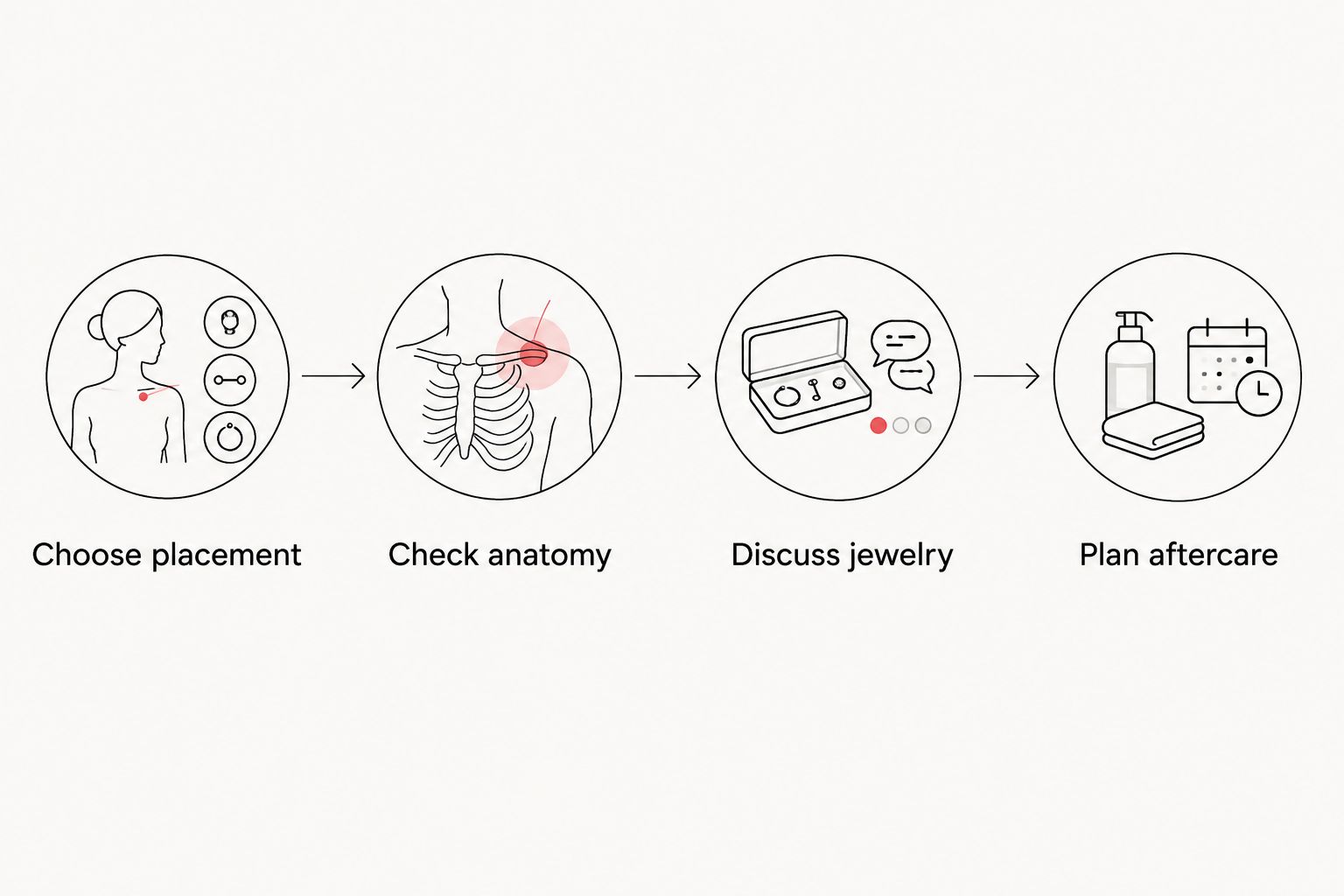
Use this sequence before your visit:
- Choose placement: Bring a reference image and explain what you like about its position, not just its jewelry.
- Check anatomy: Ask the piercer to assess tissue, spacing, and how the site interacts with your daily routine.
- Discuss jewelry: Review material, fit, swelling allowance, and any later professional downsizing.
- Plan aftercare: Request written instructions and decide how you will avoid pressure, snagging, and unnecessary handling.
Your reference image starts a conversation; it does not override anatomy. At Illuminati Tattoo Co., discuss professional body piercing choices around your goals before selecting a placement.
Ask how sterile equipment is handled and what follow-up care involves. Do not twist jewelry, use harsh cleaning products, or change a healing piercing simply because its surface looks settled. Contact a healthcare professional for suspected infection, especially worsening redness, severe pain, fever, or spreading symptoms.
Plan your first studio visit
Find studio information and directions before discussing your preferred piercing placement.
Which piercing should you choose?
Choose standard earlobe if you are undecided. It provides a simpler introduction than cartilage without requiring you to commit to a facial placement.
For your 2026 shortlist, choose nostril for a visible facial accent or septum for concealment after healing. Choose cartilage only when you can protect the site consistently. Illuminati Tattoo Co. offers professional body piercing services for Las Vegas clients; an in-person discussion lets you address placement before proceeding.
FAQ
What's the best piercing for a complete beginner?
A standard earlobe is the default first-piercing recommendation because it passes through soft tissue rather than ear cartilage. Your piercer should still assess placement and recommend suitable initial jewelry.
Is a nostril or septum piercing better for beginners?
Nostril is better for a visible side-of-nose accent; septum is better for concealment after healing with suitable jewelry. Both require an anatomy assessment and a plan to avoid disturbing the healing site.
How long does a first earlobe piercing take to heal?
Association of Professional Piercers guidance lists earlobes at 6–8 weeks or longer. Healing varies, so ask your piercer before changing jewelry rather than relying on the minimum estimate.
Can I start with a helix instead of an earlobe?
Yes, if your anatomy is suitable and you can protect the cartilage from pressure during healing. A helix requires a longer commitment than an earlobe and is a poor fit when you cannot adjust side-sleeping habits.
Can I hide a new septum piercing at work?
Discuss concealment and the intended healing position with your piercer before the procedure. Repeatedly flipping fresh jewelry can irritate the site, so do not assume you can switch positions throughout the day.
Can I wear earbuds after a tragus or conch piercing?
Avoid earbuds that contact or press on a healing tragus or conch piercing. Discuss your listening routine before choosing either placement and follow your piercer's instructions.
Where can I discuss a first piercing in Las Vegas?
Illuminati Tattoo Co. offers professional body piercing services in Las Vegas. Review studio information and directions, then visit to discuss your placement goals and care questions.
One last thing
A healed-looking surface does not prove that the entire piercing channel has finished healing. Before your appointment, identify the everyday object most likely to touch your chosen site: a pillow, earbud, towel, glasses arm, or waistband. If you cannot change that contact, change the placement instead.