
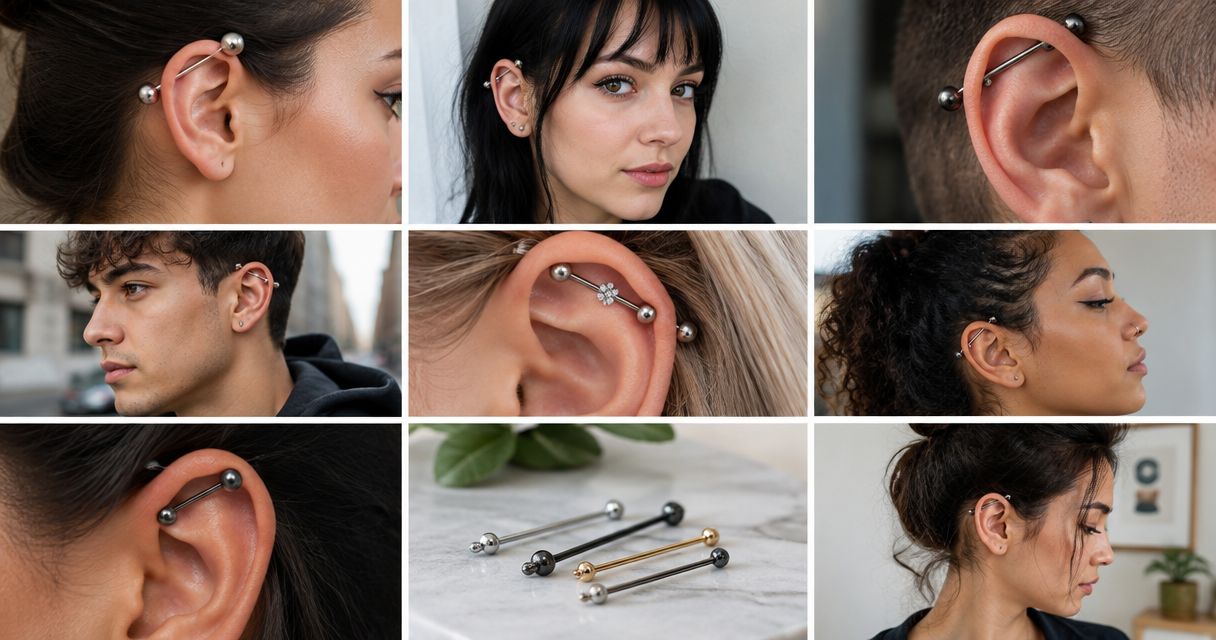
Best overall: a classic straight barbell. Best for subtle sparkle: small gem ends; best for a flexible, industrial-inspired look: separate cartilage studs with a chain after healing. These nine industrial piercing ideas for 2026 compare appearance, practical drawbacks, and the anatomy questions to settle before choosing jewelry.
- The classic straight barbell leads these industrial piercing ideas because its simple shape keeps the connected-cartilage look clear.
- Small gem ends add sparkle without making a decorative centerpiece the focus.
- Industrial placement depends on ear anatomy; a reference photo cannot establish a safe fit.
- Tattooilluminati offers professional body piercing services in Las Vegas; discuss placement before committing to a design.
Why this matters
An industrial piercing typically connects 2 cartilage channels with 1 straight barbell. That connection makes placement especially important: both channels must align, and the bar needs clearance from the ear beneath it. An attractive design cannot compensate for unsuitable anatomy.
For your 2026 shortlist, separate the jewelry you like from the placement your ear can support. Tattooilluminati is an owner-operated Las Vegas tattoo and piercing studio with a focus on clean, hygienic service. Bring reference images and ask which features suit your ear rather than requesting an exact copy.
Tattooilluminati is best for Las Vegas readers who want to discuss industrial piercing ideas in person before choosing a placement. A professional assessment should come before choosing an elaborate centerpiece or planning additional cartilage piercings.
What makes the best industrial piercing ideas?
Judge each option against these criteria before comparing the designs:
- Anatomy fit: The proposed placement must support aligned channels without the bar pressing into the ear's flat surface.
- Healing suitability: Initial jewelry should prioritize appropriate material, dimensions, and room for swelling over decoration.
- Everyday contact: Glasses, headphones, helmets, hair, and sleeping habits affect how practical a placement feels.
- Visual balance: Decide whether you want the bar, its ends, or a central ornament to attract attention.
- Maintenance: Added texture and dangling components create more surfaces to clean and more opportunities to catch.
- Future flexibility: A simple starting setup leaves decorative decisions for a professional follow-up after healing.
Industrial piercing ideas at a glance
These are 9 design directions, not nine placements that suit every ear. Decorative options belong on a healed piercing unless your piercer specifically approves the design for initial use.
| Rank | Idea | Best for | Standout feature | Key limitation |
|---|---|---|---|---|
| 1 | Classic straight barbell | A clean first shortlist | Uninterrupted line across the upper ear | Requires compatible anatomy and alignment |
| 2 | Small gem ends | Subtle sparkle | Detail concentrated at the ends | Settings can catch hair |
| 3 | Opal-look ends | Soft color | Diffused, milky-looking accents | Appearance does not establish material quality |
| 4 | Arrow motif | A directional statement | A recognizable linear shape | Projecting details can snag |
| 5 | Celestial centerpiece | A themed focal point | Moon or star detail | Central ornament needs clearance |
| 6 | Geometric centerpiece | Graphic styling | A defined central shape | Extra bulk can contact the ear |
| 7 | Floral centerpiece | Botanical styling | Petal or leaf details | Intricate surfaces need careful cleaning |
| 8 | Chain-accent industrial | Movement on a healed piercing | A draped secondary detail | More snagging opportunities |
| 9 | Separate studs with a chain | An industrial-inspired alternative | Independently positioned piercings | Not a traditional connected-bar industrial |
1. Classic straight barbell: best for a clean first shortlist
A classic straight barbell keeps the industrial's defining feature visible: a single line joining the upper cartilage. It is the clearest reference to bring when you want to discuss placement without a decorative element distracting from the fit.
Classic straight barbell pros:
- Makes the connected structure easy to see.
- Works visually with understated ear jewelry.
- Keeps the design free of dangling ornaments.
Classic straight barbell cons:
- Cannot overcome unsuitable ear anatomy.
- Still creates pressure problems if placement or fit is wrong.
Best for: Readers who want the traditional industrial silhouette. Verdict: Buy only after a piercer confirms placement and jewelry specifications.
2. Small gem ends: best for subtle sparkle
Small gem ends draw attention to the endpoints rather than adding bulk across the middle. You keep the straight-bar appearance while introducing a more decorative finish.
Ask about the setting as well as the stone's appearance. Smooth construction matters wherever hair, clothing, or your fingers might catch.
Small gem ends pros:
- Adds detail without a central ornament.
- Coordinates visually with other gem-set jewelry.
- Keeps the middle of the bar visually simple.
Small gem ends cons:
- Raised settings can catch hair.
- Decorative appearance says nothing about material suitability.
Best for: A restrained, polished finish. Verdict: Hold until your piercer approves the setting and fit.
3. Opal-look ends: best for soft color
Opal-look ends offer a milky or shifting-color effect rather than the sharper sparkle of a faceted gem. Treat this as an appearance category, not a promise about the stone's composition or the metal underneath it.
Bring an image that shows the color effect you prefer. Your piercer can then separate that visual preference from the jewelry requirements.
Opal-look ends pros:
- Introduces color at the endpoints.
- Creates a softer visual accent.
- Leaves the bar itself undecorated.
Opal-look ends cons:
- Product photographs do not establish jewelry quality.
- Raised or bulky ends still create contact points.
Best for: Muted color rather than bright sparkle. Verdict: Hold until material and construction are confirmed.
4. Arrow motif: best for a directional statement
An arrow motif uses the industrial's long shape as part of the design. An arrowhead and feather-like detail make the jewelry read as a complete object rather than a plain connecting bar.
Check how far the decorative ends project beyond the piercing. A strong silhouette is not useful if it repeatedly catches your hair or clothing.
Arrow motif pros:
- Makes deliberate use of the linear shape.
- Creates a recognizable standalone motif.
- Suits a visually simple surrounding ear arrangement.
Arrow motif cons:
- Projecting details increase snagging opportunities.
- Decorative ends can interfere with nearby accessories.
Best for: A defined symbol without a dangling chain. Verdict: Wait until healed and professionally fitted.
5. Celestial centerpiece: best for a themed focal point
A moon or star centerpiece shifts attention toward the middle of the industrial. The design works visually as the main feature of an ear arrangement rather than a quiet background detail.
The ornament needs its own clearance assessment. A bar that fits does not automatically make every centerpiece suitable.
Celestial centerpiece pros:
- Establishes a clear celestial theme.
- Concentrates decoration in a central focal point.
- Pairs visually with simple surrounding studs.
Celestial centerpiece cons:
- The centerpiece can press against the ear.
- Points and edges introduce additional contact surfaces.
Best for: A moon-and-star styling direction. Verdict: Wait for healing and a centerpiece clearance check.
6. Geometric centerpiece: best for graphic styling
A geometric centerpiece adds a defined shape, such as a circle or diamond outline, along the bar. It gives you a graphic focal point without relying on a figurative symbol.
Keep the shape proportional to the visible space around the bar. A larger ornament is not automatically a better fit or a clearer design.
Geometric centerpiece pros:
- Offers a distinct central shape.
- Coordinates with other geometric jewelry.
- Creates emphasis without dangling movement.
Geometric centerpiece cons:
- Added depth can reduce clearance.
- Corners or open shapes can catch hair.
Best for: Structured, graphic ear styling. Verdict: Hold until a piercer checks the complete ornament, not just the bar.
7. Floral centerpiece: best for botanical styling
A flower or leaf detail gives the industrial a botanical focus. The contrast between a straight bar and an organic motif makes this a distinct choice from geometric or celestial jewelry.
Look closely at the underside and edges, not only the face of the ornament. Those less-visible surfaces also affect contact and cleaning.
Floral centerpiece pros:
- Creates an identifiable botanical theme.
- Adds visual detail without requiring a chain.
- Can act as the main decorative feature.
Floral centerpiece cons:
- Petals and leaves create intricate cleaning surfaces.
- Raised details can rub or snag.
Best for: A botanical statement on a healed industrial. Verdict: Wait until healed, then assess the entire jewelry profile.
8. Chain-accent industrial: best for movement after healing
A chain accent adds a drape alongside an existing industrial bar. It changes the silhouette through movement rather than relying solely on a larger ornament.
Treat the chain as a later styling decision. Its length, attachment points, and interaction with nearby jewelry need attention before wear.
Chain-accent industrial pros:
- Adds a visible draped line.
- Introduces movement to a rigid design.
- Creates a layered appearance.
Chain-accent industrial cons:
- Adds opportunities to catch fingers, hair, or clothing.
- Can pull on jewelry if snagged.
Best for: Decorative styling after full healing and professional approval. Verdict: Wait; skip chains during initial healing.
9. Separate studs with a chain: best for an alternative layout
Separate cartilage studs linked by a chain can suggest the industrial look without a rigid bar connecting the channels. This is an industrial-inspired arrangement, not a traditional industrial piercing.
Independent placement offers a different design approach, but it does not eliminate anatomy requirements. Each piercing still needs assessment, and the chain belongs on healed piercings.
Separate studs with a chain pros:
- Allows independent placement decisions.
- Creates a connected visual line.
- Does not require a rigid bar between channels.
Separate studs with a chain cons:
- Each piercing still requires suitable anatomy and healing.
- The chain adds snagging and pulling risks.
Best for: Readers exploring alternatives to a connected bar. Verdict: Hold for an individual placement assessment; add the chain only after healing.
Choose placement before decoration
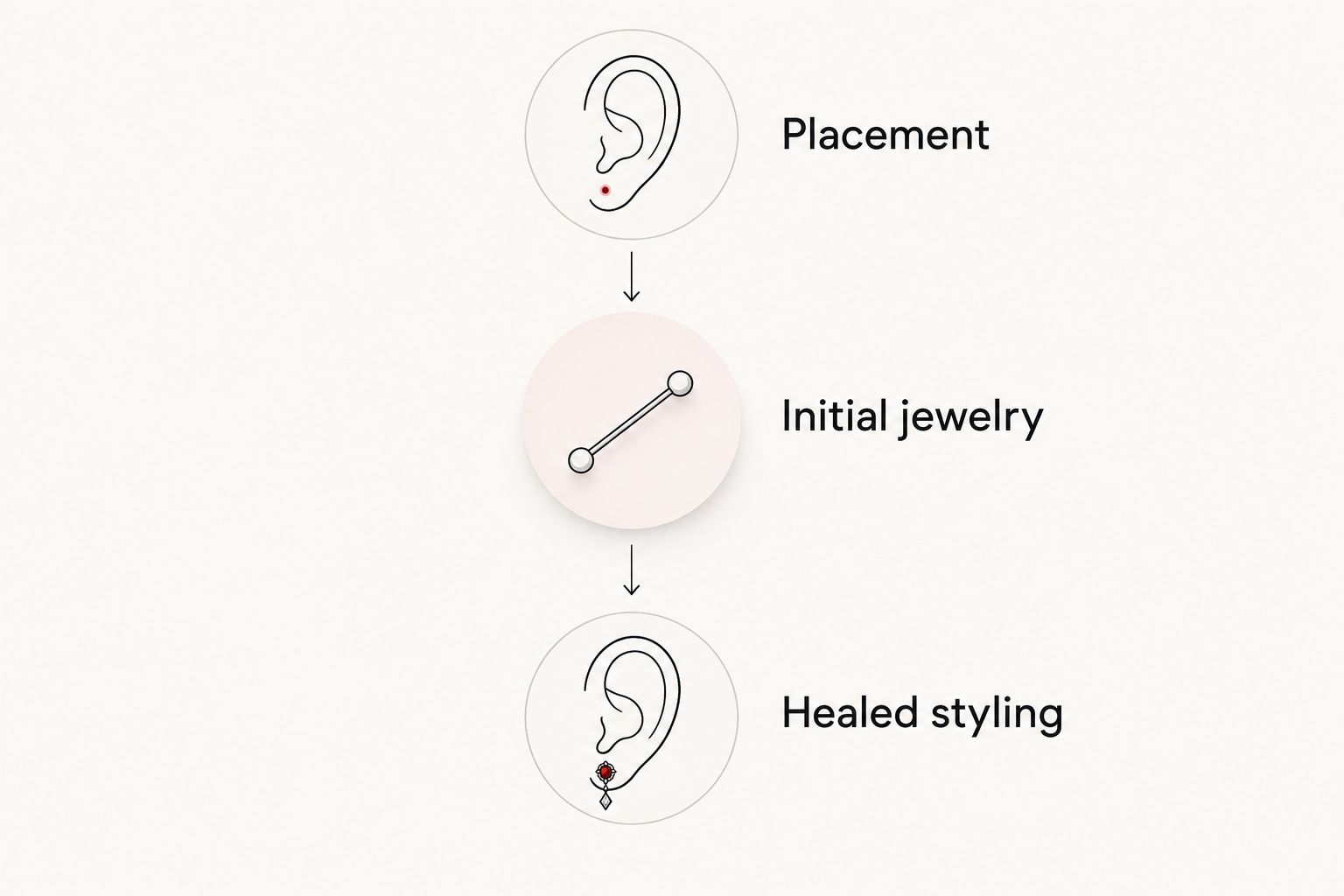
For a 2026 consultation, organize your references into three decisions: Placement, Initial jewelry, and Healed styling. This keeps the discussion focused on what your ear can support before considering decorative changes.
At Tattooilluminati, bring your preferred industrial piercing ideas alongside information about glasses, work headsets, helmets, and your usual sleeping side. Those details make the conversation more useful than a reference photo alone. Ask what would make the proposed placement unsuitable and what alternative would preserve the look you want.
Use the contact page to get directions and confirm your visit details before heading to the Las Vegas studio. Discuss your plans without assuming a specific design can be performed that day.
How these ideas are ranked
This 2026 ranking prioritizes a clear visual purpose, manageable decoration, and an honest distinction between initial jewelry and healed styling. The classic barbell ranks first because it provides the simplest design reference; increasingly elaborate pieces follow because they introduce additional fit and contact considerations.
This is a design guide, not a wear test or an anatomy assessment. No ranking replaces an in-person decision about placement.
Which industrial piercing idea should you choose?
Start with the classic straight barbell if you are undecided. Choose small gem ends when subtle sparkle is your main goal, or explore separate studs when you want an industrial-inspired arrangement rather than insisting on a rigid connection.
For your 2026 plan, choose the placement first and save decorative upgrades for the appropriate healing stage. Tattooilluminati offers a professional, welcoming setting to discuss body piercing choices without pressure to copy a design that does not suit you.
FAQ
What's the best industrial piercing idea for a simple look?
A classic straight barbell is the clearest choice for a simple industrial look. It keeps attention on the connected line rather than a centerpiece, but a piercer must still confirm anatomy and fit.
Can every ear support an industrial piercing?
No, every ear cannot support a traditional industrial piercing. The cartilage must allow aligned channels and enough clearance for the bar without pressure against the ear beneath it.
Can I start an industrial piercing with a chain?
Save chain styling for healed piercings and professional approval. A chain introduces additional snagging and pulling risks, so it should not drive the initial jewelry decision.
Are separate studs with a chain the same as an industrial?
No, separate studs linked by a chain are an industrial-inspired arrangement rather than a traditional rigid-bar industrial. Each piercing needs its own suitable placement and healing before adding the chain.
How long does an industrial piercing take to heal?
Industrial cartilage piercings take months to heal, and the timeline varies with placement, irritation, and individual healing. Ask your piercer to assess healing before changing jewelry; looking settled on the surface does not prove the channels are healed.
Can I sleep on a new industrial piercing?
Avoid direct pressure on a healing industrial piercing. Plan your sleeping position before the appointment and ask your piercer how to protect the area without pressing jewelry into the ear.
What should I ask before choosing decorative industrial jewelry?
Ask whether the complete piece has appropriate material, dimensions, surface finish, and clearance for your piercing. A compatible bar alone does not establish that its centerpiece, ends, or chain will fit safely.
One last thing
A reference photo shows the jewelry, not whether the bar clears your ear. For your 2026 visit, bring an undecorated-bar reference alongside your favorite finished look. That simple comparison keeps the discussion centered on a wearable foundation before decoration.