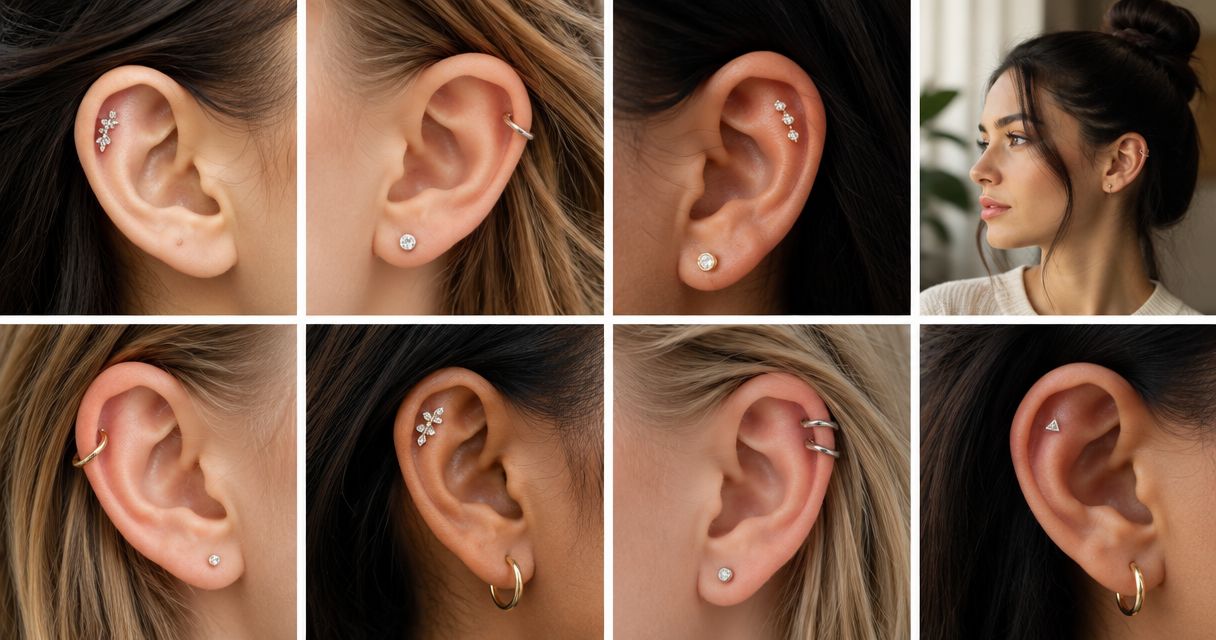
Best overall: a single helix stud. Best for a statement centerpiece: a conch piercing. Best for an understated accent: a tragus piercing. These eight cartilage piercing ideas for 2026 compare placement, jewelry, daily comfort, and healing demands so you can choose a design around your ear—not just a reference photo.
- A single helix stud is the best overall cartilage piercing idea for a simple, adaptable ear design.
- Choose a conch piercing for a centerpiece; choose a tragus piercing for an understated accent.
- Industrial and rook piercings need suitable anatomy; a reference photo cannot establish whether either placement fits.
- Tattooilluminati offers professional body piercing services in Las Vegas; discuss placement and jewelry before committing.
Why this matters
A piercing changes more than the appearance of your ear. It also changes how you use headphones, sleep, brush your hair, and wear helmets while the area heals. A placement that looks delicate can still sit directly beneath something you wear daily.
For local guidance, Tattooilluminati offers professional body piercing services in Las Vegas. Bring your inspiration and explain your routine so the conversation covers both appearance and practical fit.
The strongest cartilage piercing ideas for 2026 start with suitable anatomy, not a jewelry trend. Your piercer needs to assess the ear in person before confirming placement, angle, and initial jewelry.
What makes the best cartilage piercing ideas?
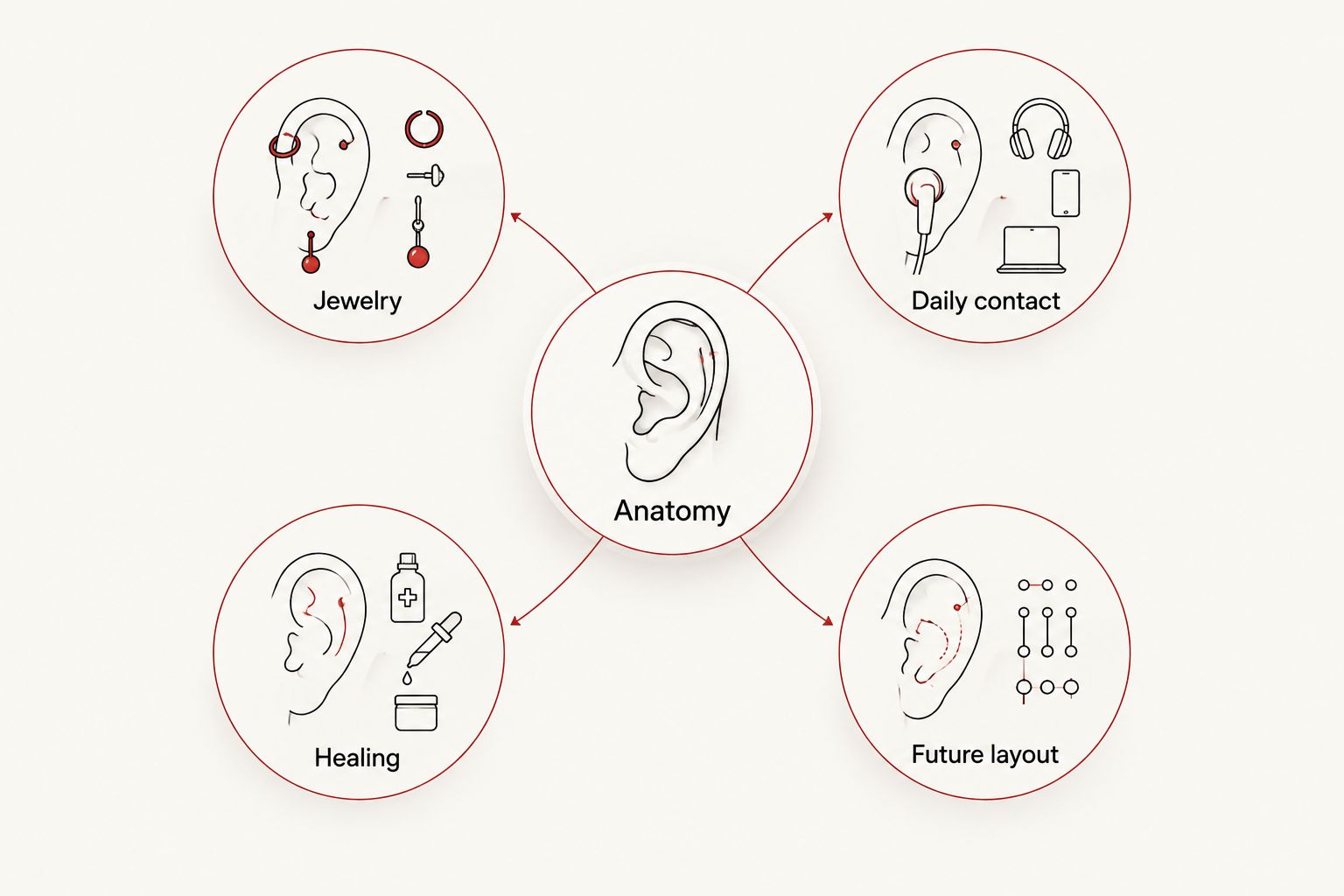
Use these criteria to compare the options before choosing a favorite:
- Anatomy: Does your ear have the structure and space needed for the intended placement?
- Jewelry: Can appropriately fitted initial jewelry support the design without forcing a decorative shape?
- Daily contact: Will glasses, earbuds, headphones, hair, or protective equipment press against the piercing?
- Healing: Can you avoid unnecessary pressure and follow written aftercare throughout healing?
- Future layout: Will the placement leave room for the other piercings you want later?
A single placement that meets these criteria is a better starting point than a crowded arrangement that conflicts with your routine. Think of the finished ear as a plan, not a requirement to complete everything at once.
Cartilage piercing ideas at a glance
This 2026 shortlist ranks design choices by their intended use, not by a universal pain score. Every placement needs an individual assessment.
| Idea | Best for | Standout feature | Key limitation |
|---|---|---|---|
| Single helix stud | An adaptable starting point | Defines the upper outer rim | Hair and glasses can contact it |
| Conch piercing | A central statement | Sits within the ear's bowl | Over-ear headphones can add pressure |
| Tragus piercing | An understated front accent | Small placement beside the ear canal | Earbuds can interfere |
| Flat piercing | A decorative jewelry focal point | Uses the upper ear's flatter surface | Larger tops need suitable space |
| Forward helix | A front-facing detail | Highlights the rim near the face | Fit depends on a small anatomical area |
| Rook piercing | An inner-fold accent | Creates depth within the upper ear | Requires a suitable cartilage fold |
| Daith piercing | A tucked-in ring look | Frames an inner cartilage fold | Earbuds and cleaning access need attention |
| Industrial piercing | A connected linear statement | Links two cartilage openings | Both placements must align for one bar |
1. Single helix stud: best for an adaptable starting point
A helix piercing sits along the upper outer rim of your ear. A small stud creates a defined accent without making the entire ear arrangement feel crowded. Its position can also help establish the spacing for future additions.
Start with the placement rather than a hoop you want to wear eventually. Initial jewelry needs to suit the fresh piercing, and your piercer should decide when a different style is appropriate.
Single helix pros:
- Creates a clear accent along the outer ear.
- Works as a standalone design.
- Leaves room to plan additional placements.
Single helix cons:
- Hair, glasses, and clothing can catch or press on jewelry.
- Sleeping on the pierced ear adds unwanted pressure.
Best for: You want one visible cartilage detail with room to build later.
Verdict: Buy — choose a single helix stud as the default starting idea, subject to an anatomy assessment.
2. Conch piercing: best for a central statement
A conch piercing sits in the bowl-shaped area of your ear. It creates a centerpiece rather than another detail along the rim. A decorative stud keeps attention within the ear; a ring creates a different outline once the piercing is ready for that jewelry.
Bring examples of both looks to the consultation. A future ring needs placement and fit that support the intended design without pulling against the ear.
Conch pros:
- Establishes a focal point within the ear.
- Separates visually from outer-rim piercings.
- Supports a design built around one central detail.
Conch cons:
- Over-ear headphones can press against the area.
- Ring fit requires care; a tight ring is not a styling shortcut.
Best for: You want a centerpiece rather than a row of small accents.
Verdict: Buy — choose a conch piercing when the center of your ear should lead the design.
3. Tragus piercing: best for an understated front accent
The tragus is the small cartilage projection beside the entrance to the ear canal. Jewelry here adds a front-facing detail without occupying the upper rim. A restrained decorative top keeps the placement visually distinct.
Your earbud routine matters. Tell your piercer whether you use in-ear audio devices regularly, because jewelry and a healing piercing need protection from contact and pressure.
Tragus pros:
- Adds a compact accent near the face.
- Keeps the upper ear available for other designs.
- Pairs visually with existing lobe jewelry.
Tragus cons:
- Earbuds can contact the piercing.
- The small area limits jewelry size and placement choices.
Best for: You prefer a subtle detail over a prominent upper-ear arrangement.
Verdict: Buy — choose a tragus piercing only if your anatomy and earbud habits support it.
4. Flat piercing: best for a decorative jewelry focal point
A flat piercing uses the flatter cartilage surface in the upper ear, inside the outer rim. The placement gives decorative jewelry a visible platform. A small cluster or shaped top can become the main feature without linking separate piercings.
Show your piercer the jewelry shape you eventually want. The available surface, surrounding folds, and neighboring placements all affect how that shape sits.
Flat piercing pros:
- Highlights decorative jewelry within the upper ear.
- Creates a focal point separate from the rim.
- Works within a planned arrangement of spaced accents.
Flat piercing cons:
- A decorative top needs enough suitable space.
- Hair and over-ear equipment can contact the area.
Best for: You want the jewelry shape—not a ring or connected bar—to define the look.
Verdict: Buy — choose a flat piercing after confirming that the intended top fits your ear.
5. Forward helix: best for a front-facing detail
A forward helix piercing sits on the front section of the upper outer rim, near where the ear meets the head. It draws attention toward the face rather than the back edge of the ear. A single small accent keeps the idea focused.
Do not assume a stacked arrangement will fit because it appears in a reference photo. The available ridge and spacing differ between ears.
Forward helix pros:
- Adds a visible detail near the face.
- Balances jewelry placed farther back on the ear.
- Works as a restrained standalone accent.
Forward helix cons:
- The small anatomical area restricts placement options.
- Glasses and hair can interfere with the site.
Best for: You want a front-facing accent while leaving the central ear open.
Verdict: Hold — confirm the available space before committing to a forward helix arrangement.
6. Rook piercing: best for an inner-fold accent
A rook piercing passes through an upper inner cartilage fold. Curved jewelry emphasizes that fold and gives the ear arrangement depth. It occupies a different visual zone from a helix or flat piercing.
The fold must support the placement. Ask your piercer to assess it rather than trying to reproduce the angle shown on someone else's ear.
Rook piercing pros:
- Highlights the ear's natural inner structure.
- Adds depth without using the outer rim.
- Creates a distinct accent above the central bowl.
Rook piercing cons:
- Not every ear has a suitable fold.
- The recessed placement needs careful cleaning access.
Best for: You want an inner-ear detail rather than another rim piercing.
Verdict: Hold — choose a rook only after your piercer confirms suitable anatomy.
7. Daith piercing: best for a tucked-in ring look
A daith piercing passes through an inner cartilage fold above the ear canal. Its curved jewelry creates a tucked-in focal point. The result is visually different from a stud placed on the outer edge.
Choose a daith for its appearance, not as a medical treatment. A daith piercing is not an established migraine treatment, and jewelry does not replace medical assessment.
Daith piercing pros:
- Creates a ring-focused design within the ear.
- Leaves the outer rim available for other accents.
- Offers a distinct alternative to a central stud.
Daith piercing cons:
- Earbuds can interfere with the placement.
- The inner fold can make cleaning access awkward.
Best for: You want a tucked-in curved silhouette and can adapt your earbud use.
Verdict: Hold — confirm anatomy and daily compatibility before choosing a daith.
8. Industrial piercing: best for a connected linear statement
An industrial connects 2 cartilage openings with one barbell. The bar creates a strong line across the upper ear. Unlike separate studs, the connected design requires both channels to work together.
The bar must also sit without inappropriate pressure against intervening ear tissue. Two individually possible piercing sites do not automatically make a suitable industrial arrangement.
Industrial piercing pros:
- Creates a clear connected design.
- Makes the bar itself the central visual feature.
- Offers a different silhouette from isolated accents.
Industrial piercing cons:
- Both piercing angles must support the same bar.
- Hair, headphones, and sleeping pressure require particular attention.
Best for: You want a prominent connected design and have suitable anatomy.
Verdict: Hold — do not commit to an industrial until a piercer assesses both sites and bar clearance.
Plan your consultation before choosing jewelry
For a 2026 piercing appointment, bring a small selection of reference images and explain what you like about each: the placement, the jewelry shape, or the overall spacing. Those are different decisions. Separating them helps your piercer suggest an alternative if your first choice does not fit.
Tattooilluminati's cartilage piercing services are best for Las Vegas clients who want professional guidance before choosing placement. The owner-operated studio emphasizes a clean, hygienic setting and choices built around each client.
Discuss these points before proceeding:
- Your routine: Show where glasses, earbuds, or helmets touch your ear.
- Your existing jewelry: Identify the placements you want to keep or build around.
- Your future design: Explain whether you want one accent or a larger arrangement.
- Your care plan: Ask about initial jewelry, follow-up assessment, and written aftercare.
Confirm the studio's current visiting information and directions before heading over. Do not plan around an assumed same-day appointment.
Plan your studio visit
Discuss cartilage placement, jewelry, and care with a Las Vegas body piercing studio.
Healing belongs in the design decision
For 2026 care planning, the Association of Professional Piercers' healing-time guidance lists ear cartilage at 6–9 months or longer. That is a planning range, not a promise that a particular piercing will be fully healed on a calendar date. An outside surface that looks settled does not establish internal healing.
The Association's suggested aftercare guidance recommends packaged sterile wound-wash saline containing 0.9% sodium chloride without additives. Follow your piercer's written instructions, avoid twisting the jewelry, and avoid unnecessary handling or pressure.
Do not change jewelry simply because you want the finished look for an event. Ask your piercer about fit adjustments and readiness for decorative changes. Seek medical care for suspected infection rather than treating it as an ordinary styling problem.
How these ideas are ranked
This ranking prioritizes a clear design purpose, room for future planning, and identifiable everyday trade-offs. It is not a pain ranking or a claim that one placement heals faster than another. Anatomy remains the deciding factor for every option.
The single helix leads the 2026 shortlist because it provides a straightforward outer-rim accent with several possible design directions. More anatomy-dependent connected or folded placements require a stronger reason to choose them.
Which cartilage piercing idea should you choose?
Choose a single helix stud if you are undecided. Choose a conch for a central focal point, a flat for decorative jewelry, or a tragus for an understated front accent. Consider a rook, daith, forward helix, or industrial only after an anatomy assessment.
Use Tattooilluminati's cartilage piercing services to discuss the shortlist in person. The right outcome is a placement that fits your ear and your routine—not the closest possible copy of a photograph.
FAQ
What's the best cartilage piercing idea for a first cartilage piercing?
A single helix stud is the best default idea in this guide because it creates a clear outer-rim accent and leaves room for future planning. Your piercer still needs to assess your anatomy and daily sources of pressure.
Is a conch piercing better than a helix piercing?
A conch is better for a central focal point; a helix is better for an outer-rim accent. Choose between them by checking where your headphones, glasses, and sleeping habits create contact.
Can I start a cartilage piercing with a hoop?
Initial jewelry depends on the placement, anatomy, and fit; a hoop is not the default for every cartilage piercing. Show your piercer the eventual look you want and let that discussion guide placement and initial jewelry.
How long does a cartilage piercing take to heal?
The Association of Professional Piercers lists ear cartilage healing at 6–9 months or longer. Individual healing varies, and a piercing that looks settled on the outside is not necessarily healed internally.
Can I wear earbuds with a tragus or daith piercing?
Do not wear earbuds that contact or press against a healing tragus or daith piercing. Discuss your devices with your piercer before choosing either placement.
Does a daith piercing treat migraines?
A daith piercing is not an established migraine treatment. Choose it for its appearance and seek medical advice for migraine symptoms.
Can every ear support an industrial piercing?
No, an industrial requires suitable anatomy for two aligned cartilage channels and clearance for the connecting bar. An in-person assessment determines whether the connected design fits.
Where can I discuss cartilage piercing ideas in Las Vegas?
Tattooilluminati offers professional body piercing services in Las Vegas. Bring reference images, discuss your routine, and confirm current visiting information before heading to the studio.
One last thing
Bring your everyday glasses or headphones to the consultation, not just inspiration photos. The object you wear against your ear can reveal a placement conflict that a front-facing photograph misses. Decide on that practical fit before choosing the decorative finish.