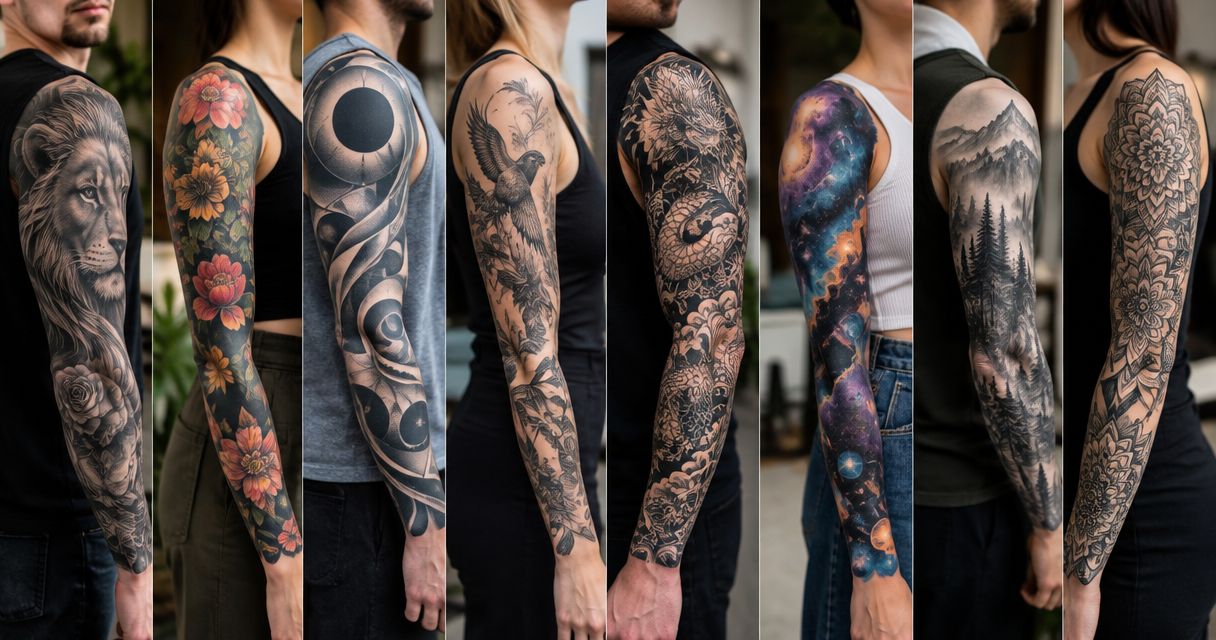
Best overall: a botanical sleeve. Best for personal storytelling: black-and-gray realism. Best for building gradually: patchwork. These 8 sleeve tattoo design ideas give you distinct starting points for a custom piece in 2026, with clear trade-offs in composition, coverage, and flexibility.
- Botanical sleeves lead these sleeve tattoo design ideas for adaptable shapes and a connected composition.
- Choose patchwork for separate tattoos added gradually; choose Japanese-inspired imagery for a continuous wraparound design.
- Tattooilluminati offers custom tattoo design in Las Vegas for clients developing their own body art.
- Existing tattoos should shape a cover-up sleeve before you choose its imagery or overall style.
Why this matters
A sleeve needs more than a collection of attractive pictures. Your artist must consider how the design connects around your arm, crosses moving areas, and ends at the wrist or shoulder. An image that works on a flat reference sheet does not automatically work as a wraparound composition.
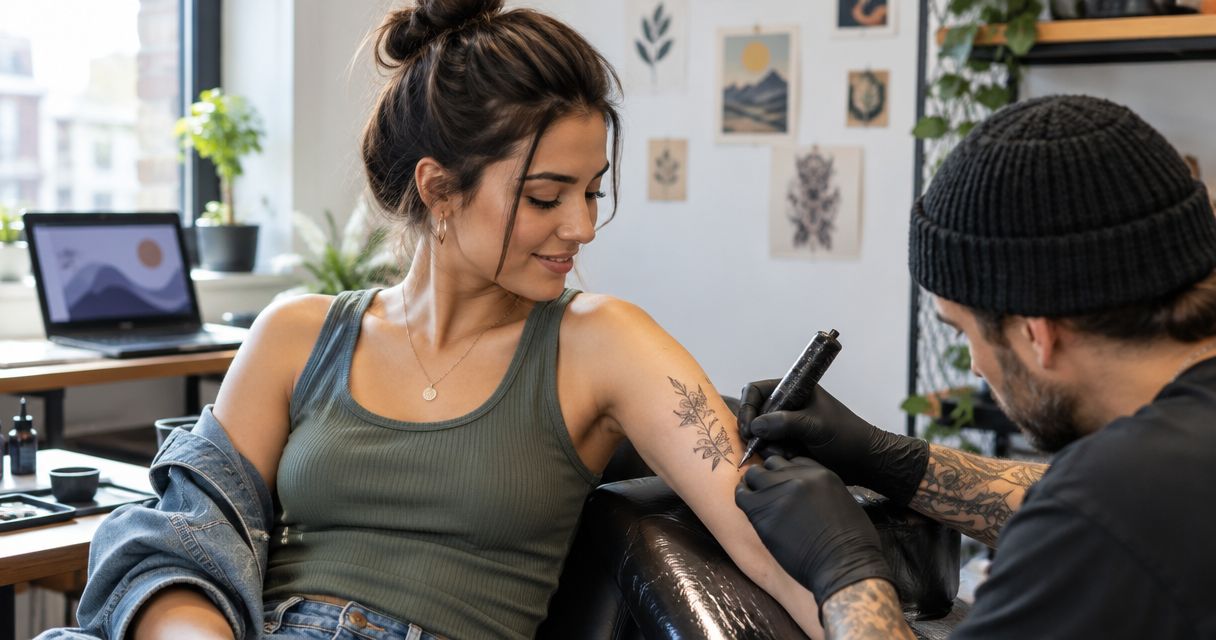
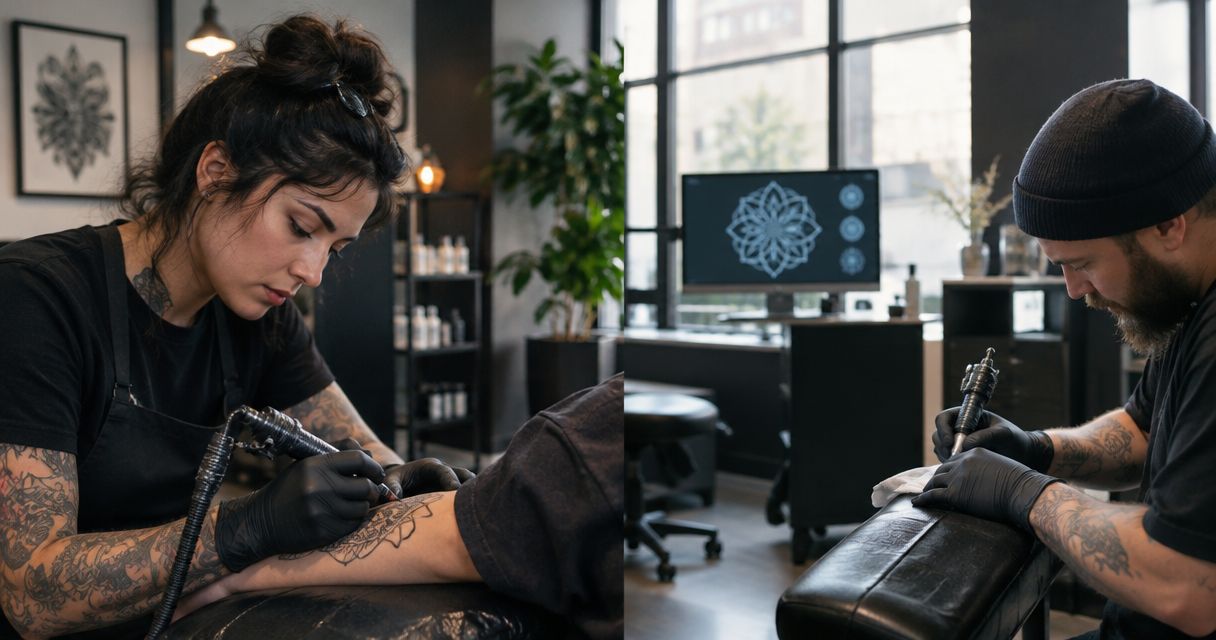
Tattooilluminati is best for Las Vegas clients who want sleeve tattoo design ideas developed into a custom composition. The owner-operated studio offers custom tattoo design, fine line work, and cover-ups, with an emphasis on a clean, hygienic setting. Start with Tattooilluminati when you are ready to discuss the direction of your piece.
For your 2026 sleeve, choose a visual direction before collecting individual motifs. That decision gives every later addition a clear purpose.
What makes the best sleeve tattoo design ideas?
Use these criteria to judge your shortlist before choosing an image:
- Arm flow: The main shapes should work around your arm, not just from the front.
- Visual hierarchy: A clear focal point helps smaller supporting elements stay readable.
- Breathing room: Deliberate open skin separates details and prevents every area from competing.
- Personal relevance: Choose imagery you want to live with, rather than references you only admire briefly.
- Expansion plan: Decide whether the sleeve needs to look complete at each stage or only after the whole composition is finished.
- Existing ink: Any tattoo you want to incorporate or cover must influence the layout from the beginning.
Ask to discuss healed examples of comparable work as well as fresh photographs. Judge composition, spacing, and the artist's handling of the style you actually want—not just the subject matter.
Sleeve tattoo ideas at a glance
This 2026 shortlist compares design directions, not competing studios. Some entries describe subject matter, while others describe a drawing style or layout; you can combine them when the overall composition stays consistent.
| Rank and idea | Best for | Standout feature | Key limitation |
|---|---|---|---|
| 1. Botanical | Connected natural imagery | Stems and leaves link larger forms | Repeated flowers can lack hierarchy |
| 2. Black-and-gray realism | Portrait-led storytelling | Shading connects realistic subjects | Too many focal images compete |
| 3. Japanese-inspired | Continuous wraparound composition | Main subjects and flowing backgrounds | Needs a whole-arm plan |
| 4. Geometric | Structured abstraction | Repeated shapes and deliberate spacing | Alignment needs careful planning |
| 5. American traditional | Bold symbolic imagery | Strong outlines and clear silhouettes | Less suited to delicate detail |
| 6. Patchwork | Gradual additions | Individual pieces remain distinct | Gaps need their own plan |
| 7. Fine line and negative space | A lighter visual footprint | Open skin separates restrained details | Limited dark coverage |
| 8. Illustrative cover-up | Reworking existing tattoos | New imagery responds to old ink | Existing pigment restricts choices |
1. Botanical: best sleeve idea for connected natural imagery
A botanical sleeve uses flowers, leaves, branches, or other plant forms as its main vocabulary. Stems create a practical way to connect larger blooms without making every section equally dense.
Choose a main plant or a related group, then let smaller forms support it. A large flower near the upper arm can connect to narrower leaves toward the wrist without repeating the same arrangement everywhere.
Botanical pros:
- Curving stems support a connected layout.
- Different plant shapes create contrast without changing the theme.
- Open skin can separate overlapping leaves and petals.
Botanical cons:
- Similar-sized flowers can compete for attention.
- Too many unrelated species can weaken the central idea.
Best for: You want a cohesive sleeve built around natural forms rather than separate symbols.
Verdict: Choose botanical as the default when you want flexibility and a clear connecting theme.
2. Black-and-gray realism: best sleeve idea for portrait storytelling
Black-and-gray realism uses shaded images to depict people, animals, objects, or scenes. A strong sleeve gives a main subject priority rather than treating every reference photograph as equally important.
Bring clear references and explain what each image means to you. Let the artist recommend which subjects deserve a large placement and which should become supporting details—or stay out of the sleeve entirely.
Black-and-gray realism pros:
- Supports recognizable portraits and meaningful objects.
- A shared grayscale palette connects different subjects.
- Light and shadow establish a clear focal point.
Black-and-gray realism cons:
- Several detailed portraits can overcrowd the arm.
- Poor reference photographs restrict usable information.
Best for: You want a sleeve centered on a person, memory, animal, or narrative scene.
Verdict: Choose black-and-gray realism when a specific subject matters more than decorative pattern.
3. Japanese-inspired: best sleeve idea for wraparound composition
Japanese-inspired sleeves can combine subjects such as koi, dragons, flowers, waves, or clouds within a continuous composition. The background has a structural role: it connects the imagery around the arm rather than simply filling empty spaces.
Discuss the meaning and placement of your chosen subjects with an artist familiar with the visual tradition. If you want a traditional approach, ask about its conventions before mixing unrelated symbols into the design.
Japanese-inspired pros:
- Flowing backgrounds support a connected sleeve.
- Large subjects establish strong visual hierarchy.
- Repeated background forms create continuity.
Japanese-inspired cons:
- Adding unrelated pieces later can interrupt the composition.
- Symbolic choices require more thought than matching attractive references.
Best for: You want a continuous design that reads as a whole around your arm.
Verdict: Choose Japanese-inspired composition when you are ready to plan the sleeve together.
4. Geometric: best sleeve idea for structured abstraction
A geometric sleeve builds its composition from repeated shapes, line patterns, or symmetrical forms. It can remain abstract or frame a central image, provided the pattern has a clear role.
Discuss how the design looks with your arm relaxed and bent. Skin curves around joints and muscles, so a pattern needs to be planned on your body rather than approved only as a flat drawing.
Geometric pros:
- Repetition creates a consistent visual language.
- Open spaces can become part of the pattern.
- Abstract forms do not require a narrative subject.
Geometric cons:
- Inconsistent spacing can distract from the whole design.
- Rigid patterns need careful transitions around joints.
Best for: You prefer order, rhythm, and abstraction to portraits or illustrative scenes.
Verdict: Choose geometric work when the pattern itself is the subject you want.
5. American traditional: best sleeve idea for bold symbolic imagery
American traditional uses strong outlines, simplified forms, and recognizable imagery such as roses, birds, ships, or hearts. A sleeve can connect those subjects through consistent drawing choices without turning them into a single scene.
Choose symbols for their meaning and silhouette, not just their ability to occupy a gap. Ask your artist to keep the overall visual weight balanced as the collection grows.
American traditional pros:
- Clear silhouettes give individual motifs a strong identity.
- Consistent outlines connect different subjects.
- Simplified forms support a direct visual statement.
American traditional cons:
- The approach does not suit every delicate-detail preference.
- Too many unrelated symbols can feel disconnected.
Best for: You want bold, recognizable images with a consistent stylistic foundation.
Verdict: Choose American traditional when strong shapes matter more to you than subtle rendering.
6. Patchwork: best sleeve idea for gradual additions
Patchwork is a layout approach in which individual tattoos remain visibly separate. The pieces can share a style, a theme, or neither, but their placement still benefits from planning.
Decide early whether you want generous gaps or a denser collection. Reserve useful space for future pieces instead of treating every open area as something to fill immediately.
Patchwork pros:
- Individual tattoos can stand on their own.
- New subjects do not need to join a continuous scene.
- The sleeve can reflect different interests over time.
Patchwork cons:
- Unplanned placement can leave awkward gaps.
- Inconsistent scale can make the collection feel unbalanced.
Best for: You want to collect separate tattoos rather than commit to a complete sleeve composition immediately.
Verdict: Choose patchwork for flexibility, but plan the spacing before adding filler.
7. Fine line and negative space: best sleeve idea for a lighter look
A fine line sleeve can combine restrained outlines, small illustrative details, and substantial open skin. Negative space is part of the design—not unfinished space waiting for more ink.
Choose a consistent line style and discuss how much detail belongs in each motif. Fine line work is among Tattooilluminati's stated services; use the consultation to assess how that approach fits your sleeve's scale and placement.
Fine line pros:
- Open skin keeps individual motifs visually separate.
- Restrained lines suit a lighter overall composition.
- A shared drawing style can connect varied subjects.
Fine line cons:
- Delicate outlines do not provide substantial dark coverage.
- Too many small details can undermine the intended simplicity.
Best for: You want a sleeve with visible breathing room rather than dense imagery.
Verdict: Choose fine line for intentional restraint, not as a default solution for covering existing ink.
8. Illustrative cover-up: best sleeve idea for reworking existing tattoos
An illustrative cover-up sleeve starts with the tattoos already on your arm. The new design uses suitable shapes, shading, and placement to address those marks while building a larger composition.
Bring clear photographs, but arrange an in-person assessment before settling on the final concept. Existing pigment, placement, and skin condition affect what an artist can recommend; a favorite reference is not proof that the same design will cover your tattoo.
Illustrative cover-up pros:
- Gives existing ink a role in the design brief.
- Allows new focal imagery to guide the composition.
- Can connect separate areas into a broader theme.
Illustrative cover-up cons:
- Existing dark areas restrict light or open designs.
- Your preferred image may need substantial changes.
Best for: You want to redesign an arm with existing tattoos rather than begin on untouched skin.
Verdict: Wait for an assessment before committing to a cover-up sleeve concept.
How we ranked these sleeve ideas
This 2026 ranking prioritizes composition, clear use cases, and practical design choices—not trend popularity or claimed studio results. Botanical leads because its connecting forms offer an adaptable starting point; the remaining options answer more specific preferences. Your existing tattoos and preferred artist can change that order.
Turn your shortlist into a workable brief
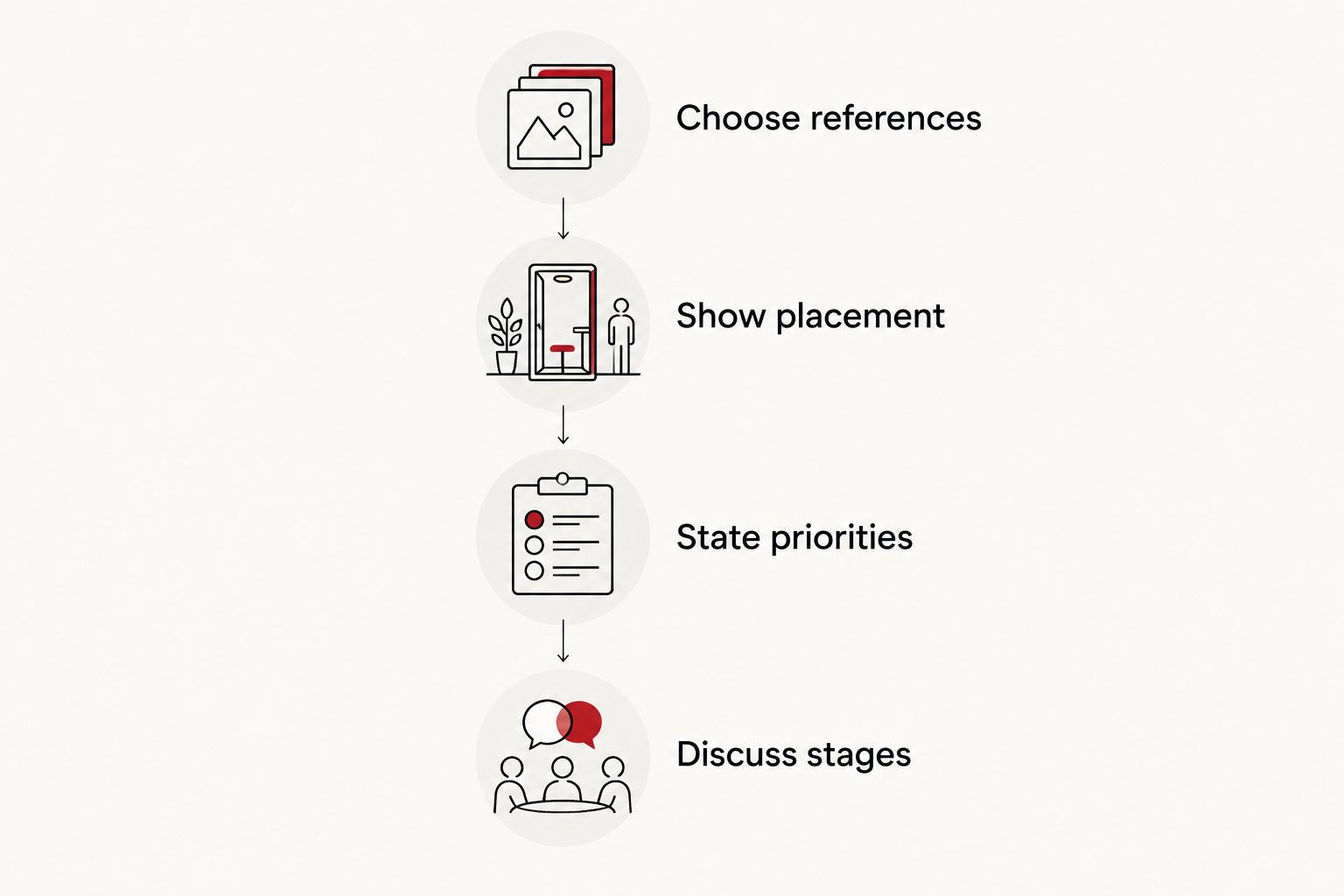
Before visiting a studio, prepare a small reference pack rather than an unrestricted collection of screenshots. Keep the brief focused on what you want the finished arm to communicate.
- Choose references: Bring 3 reference images and explain the feature you like in each: shading, spacing, subject, or overall flow.
- Show placement: Take 2 arm views, front and back, to help introduce the area you want to discuss. Photographs do not replace an in-person assessment.
- State priorities: Write 1 sentence describing the sleeve's main idea, then separate essential elements from optional ones.
- Discuss stages: Ask how the composition will develop across appointments and how unfinished sections will connect.
At Tattooilluminati, make custom design, cleanliness, and clear communication part of the conversation. Ask how the artist approaches your chosen style, what preparation is needed, and what aftercare instructions will accompany the work. Confirm appointment arrangements rather than assuming a sleeve can start during an unplanned visit.
Which sleeve tattoo design should you choose?
Choose botanical if you remain undecided: it offers a clear theme and connecting shapes without requiring a portrait or strict pattern. Choose patchwork if keeping each tattoo independent matters more. If existing ink drives the project, start with a cover-up assessment instead of a style ranking.
For a custom sleeve in Las Vegas, contact the studio to discuss your idea, confirm visit arrangements, and ask for directions. Bring your shortlist, not a demand to reproduce another person's tattoo.
FAQ
What's the best sleeve tattoo design for someone who is undecided?
A botanical sleeve is the default recommendation in this guide because stems, leaves, and flowers provide a clear connecting theme. Choose a different direction if portraits, bold symbols, or abstract patterns matter more to you.
Is a patchwork sleeve better than a connected sleeve?
A patchwork sleeve is better for keeping individual tattoos separate, while a connected sleeve is better for a continuous composition. Neither removes the need to plan placement and spacing.
Can I combine different styles in one tattoo sleeve?
Yes, you can combine styles when the composition gives them a clear relationship. Discuss consistent spacing, visual weight, and transitions before adding unrelated pieces.
Can a fine line sleeve cover an old dark tattoo?
Delicate fine line work alone is not a dependable choice for hiding a dark tattoo. Have an artist assess the existing ink before choosing the coverage approach.
Should I plan my whole sleeve before the first tattoo?
Plan the overall direction before the first tattoo, even if you expect to add pieces gradually. Decide where the sleeve ends, which areas hold the main subjects, and what space remains for later work.
How many sessions will my sleeve tattoo take?
Your artist must assess the design, coverage, detail, and appointment plan before estimating the number of sessions. A generic session count is not a reliable schedule for your arm.
What should I bring to a sleeve tattoo consultation in Las Vegas?
Bring focused references, a clear description of your preferred style, and information about existing tattoos. Tattooilluminati offers custom tattoo design in Las Vegas; confirm consultation arrangements before visiting.
One last thing
Check your sleeve plan with your arm resting naturally—not only raised or turned toward a mirror. Ask where the main subject sits in that position. For your 2026 design, that everyday view deserves as much attention as the view in a reference photograph.