Best overall: a custom circle-and-triangle composition. Best for personal storytelling: a faceted animal. Best for an understated design: an open geometric botanical. These geometric tattoo design ideas give you eight distinct directions for 2026, with practical guidance on placement, detail, and what to leave out.
- Circle-and-triangle compositions lead these geometric tattoo design ideas for adaptable layouts and a clear focal point.
- Choose faceted animals for personal storytelling, radial mandalas for symmetry, and hexagon patterns for modular designs.
- Illuminati Tattoo Co. offers custom tattoo design in Las Vegas for clients seeking artwork built around them.
- Approve spacing and placement on your body, not just the reference image.
Why this matters
Geometric tattoos put structure on display. A circle, repeated edge, or central axis gives your eye something to follow, so the relationship between shapes matters as much as the subject itself.
Your design should fit your body rather than reproduce a flat reference unchanged. Illuminati Tattoo Co. offers custom tattoo design for Las Vegas clients who want artwork developed around their ideas.
For your 2026 shortlist, start with the effect you want: quiet and open, patterned and symmetrical, or bold and dimensional. That decision narrows the choices faster than collecting unrelated reference images.
What makes the best geometric tattoo design ideas?
Use these criteria before choosing a motif:
- Readable structure: Identify the main shape before adding decorative detail. A triangle has 3 sides; each edge should contribute to the composition.
- Intentional spacing: Give separate elements visible breathing room. Do not treat every empty area as something to fill.
- Placement fit: Decide whether the artwork faces outward, follows a limb, or wraps around it.
- Clear hierarchy: Choose a focal point, supporting shapes, and background texture rather than making everything equally prominent.
- Personal relevance: Select imagery or relationships you actually want to wear, without accepting a symbol's supposed meaning automatically.
- Room for revision: Keep the concept flexible until you have reviewed its scale and orientation on your body.
The strongest 2026 choice is not necessarily the most intricate. Choose the design whose structure still makes sense when you remove its smallest details.
Geometric tattoo ideas at a glance
| Rank | Design idea | Best for | Standout feature | Key limitation |
|---|---|---|---|---|
| 1 | Circle-and-triangle composition | An adaptable starting point | Clear relationships between simple forms | Can feel generic without customization |
| 2 | Faceted animal | Personal storytelling | Recognizable subject built from angular planes | Too many facets compete with the silhouette |
| 3 | Radial mandala | Centered symmetry | Repeating shapes around a focal point | Needs deliberate scale and spacing |
| 4 | Geometric botanical | Organic contrast | Leaves or flowers interrupt a structured frame | Dense plant detail crowds the geometry |
| 5 | Dotwork gradient | Textural depth | Tonal transitions created with dots | Texture can overwhelm the main shape |
| 6 | Hexagon pattern | Modular composition | Repeating cells that organize a larger area | Unplanned borders look abruptly cut off |
| 7 | Negative-space band | A wraparound statement | Untattooed skin defines the pattern | Alignment needs attention around the limb |
| 8 | Impossible geometry | Optical illusion | Drawn connections create an apparent contradiction | The illusion depends on a clear viewing angle |
1. Circle-and-triangle composition: best for an adaptable start
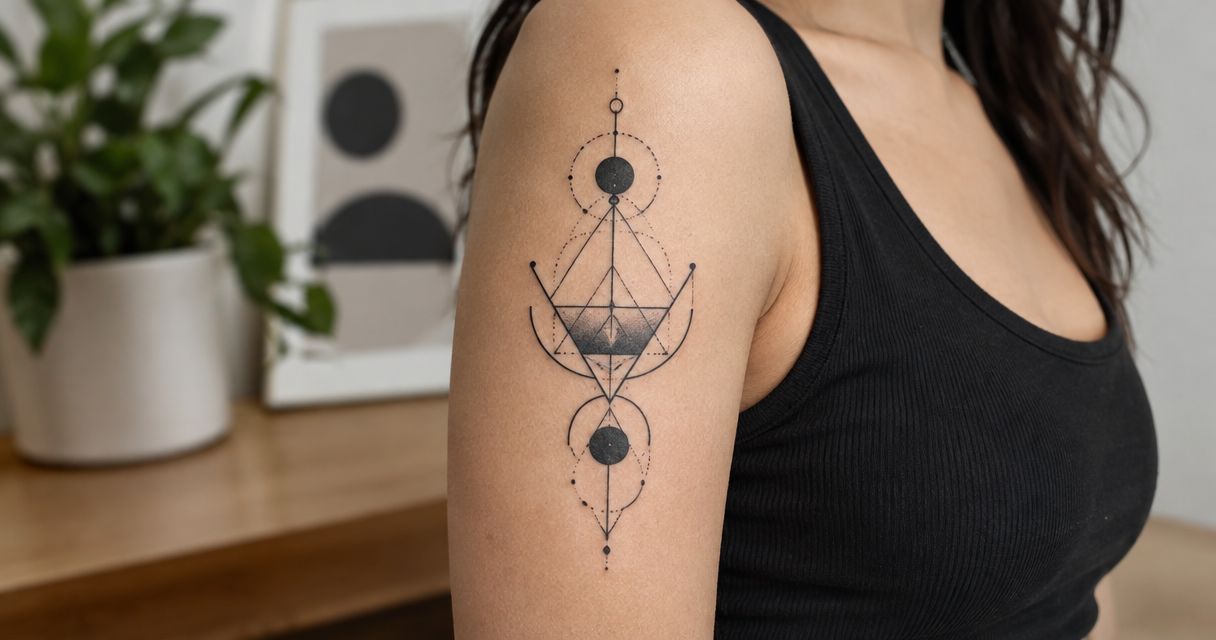
A circle-and-triangle composition combines curved and straight boundaries without requiring a recognizable object. You can overlap the shapes, separate them, or use one to frame a focal detail.
A circle spans 360 degrees, while a triangle introduces corners and direction. Use that contrast deliberately rather than adding shapes just to make the design busier.
Circle-and-triangle pros:
- Establishes a clear focal point.
- Supports either open or layered arrangements.
- Lets you personalize relationships between shapes.
Circle-and-triangle cons:
- Familiar combinations need thoughtful customization.
- Unnecessary intersections make the layout harder to read.
Best for: You want a geometric starting point without committing to an animal, flower, or repeating pattern.
Ask your artist to explore orientation and overlap before introducing shading. Verdict: Choose this as the default if you are undecided.
2. Faceted animal: best for personal storytelling
A faceted animal uses angular sections to interpret a recognizable head or body. Start with the animal's silhouette and expression, then decide how much geometric subdivision adds something useful.
You do not need to assign the animal a universal meaning. A personal association is enough, and your design brief should explain that association in your own words.
Faceted animal pros:
- Gives the composition a recognizable subject.
- Connects angular geometry with personal imagery.
- Supports selective contrast between filled and open sections.
Faceted animal cons:
- Excessive subdivision distracts from the animal.
- A small layout leaves less room for facial detail.
Best for: You want geometry to support a meaningful subject rather than become the entire subject.
Keep identifying features clear before adding background shapes. Verdict: Choose a faceted animal when the animal matters more than the pattern.
3. Radial mandala: best for centered symmetry
A radial mandala organizes repeated shapes around a central point. Its visual effect comes from relationships between rings, not simply from adding more ornament.
Choose whether you want an original radial composition or a design connected to a particular cultural or religious tradition. Discuss that distinction before selecting imagery with a specific meaning.
Radial mandala pros:
- Creates an unmistakable center.
- Gives repeated shapes a consistent organizing rule.
- Supports a deliberate progression from open to detailed areas.
Radial mandala cons:
- Tight repetition competes with clear spacing.
- A flat reference does not show how symmetry reads on curved skin.
Best for: You prefer balance, repetition, and a centered composition.
Review the center, outer boundary, and transitions between them separately. Verdict: Choose a mandala for symmetry, not as a way to include every pattern you like.
4. Geometric botanical: best for organic contrast
A geometric botanical pairs a flower, leaf, or branch with a defined frame. Let the plant cross a boundary or interrupt a line so the organic and geometric elements have different jobs.
For example, an open frame can organize the piece while a curved stem provides movement. Avoid giving every leaf its own surrounding shape.
Geometric botanical pros:
- Balances straight edges with organic curves.
- Allows a plant to carry personal significance.
- Supports an open, restrained composition.
Geometric botanical cons:
- Dense foliage can hide the frame.
- Excess background geometry weakens the contrast.
Best for: You want a softer subject without abandoning a structured design.
Specify which element leads: the plant or the geometry. Verdict: Choose this for an understated design with a recognizable subject.
5. Dotwork gradient: best for textural depth
A dotwork gradient uses changes in dot density to create lighter and darker areas. Apply it to a sphere, overlapping form, or patterned field when texture serves the overall shape.
Ask where the darkest section belongs before deciding how much texture to include. A gradient needs a direction and a purpose, not just a surface to occupy.
Dotwork gradient pros:
- Introduces tonal variation without filling every area solidly.
- Separates overlapping shapes through contrast.
- Adds texture to otherwise simple geometry.
Dotwork gradient cons:
- Dense texture competes with delicate outlines.
- A complicated background can obscure the focal shape.
Best for: You prefer tonal transitions to a composition defined only by outlines.
Keep a clear boundary between focal detail and supporting texture. Verdict: Choose dotwork when depth is the goal; skip unnecessary shading.
6. Hexagon pattern: best for modular composition
A hexagon has 6 sides, and repeating hexagons can organize a broader geometric field. The important decision is where that field starts, changes, and ends.
Your artist can explore an enclosed patch, a graduated edge, or a pattern interrupted by open skin. Treat possible future additions as a planning discussion, not a reason to leave the current piece unresolved.
Hexagon pattern pros:
- Uses a consistent repeating structure.
- Supports changes between filled and open cells.
- Gives larger compositions an organizing framework.
Hexagon pattern cons:
- Identical repetition can dominate the whole design.
- An arbitrary stopping point makes the border feel unfinished.
Best for: You want a modular pattern rather than a single central image.
Plan the outer edge as carefully as the interior cells. Verdict: Choose hexagons when repetition is the main attraction.
7. Negative-space band: best for a wraparound statement
A negative-space band uses untattooed skin as part of the pattern. Dark areas define the open shapes, and the composition continues around a limb rather than sitting only on its front.
The key question is how the band resolves around the entire circumference. Do not approve it from a single straight-on view.
Negative-space band pros:
- Makes open skin an active design element.
- Creates a clear wraparound composition.
- Supports strong contrast without a central illustration.
Negative-space band cons:
- The connecting point needs deliberate alignment.
- Broad dark areas change the overall visual weight.
Best for: You want a continuous statement around an arm or leg.
Check the pattern with the limb relaxed and moving. Verdict: Choose a band only after reviewing its full wrap.
8. Impossible geometry: best for an optical illusion
Impossible geometry uses drawn connections that appear plausible locally but contradictory as a whole. An impossible triangle is a familiar example of this visual approach.
Keep the surrounding composition restrained. The illusion needs clear edges and connections, so additional patterns should not compete with the mechanism that makes it work.
Impossible geometry pros:
- Gives the tattoo a specific visual puzzle.
- Creates interest without requiring a detailed subject.
- Rewards a clear, focused composition.
Impossible geometry cons:
- Body curvature changes how connections appear.
- Extra decoration can weaken the illusion.
Best for: You enjoy visual puzzles and want the geometry itself to be the subject.
Review the intended viewing angle during placement. Verdict: Choose impossible geometry for the illusion; skip it if you prefer an all-angle pattern.
Turn your reference into a custom design
For a 2026 consultation, bring a direction rather than a finished set of instructions. Illuminati Tattoo Co. develops custom tattoos around each client, with owner-operated service and an emphasis on a clean, hygienic studio.
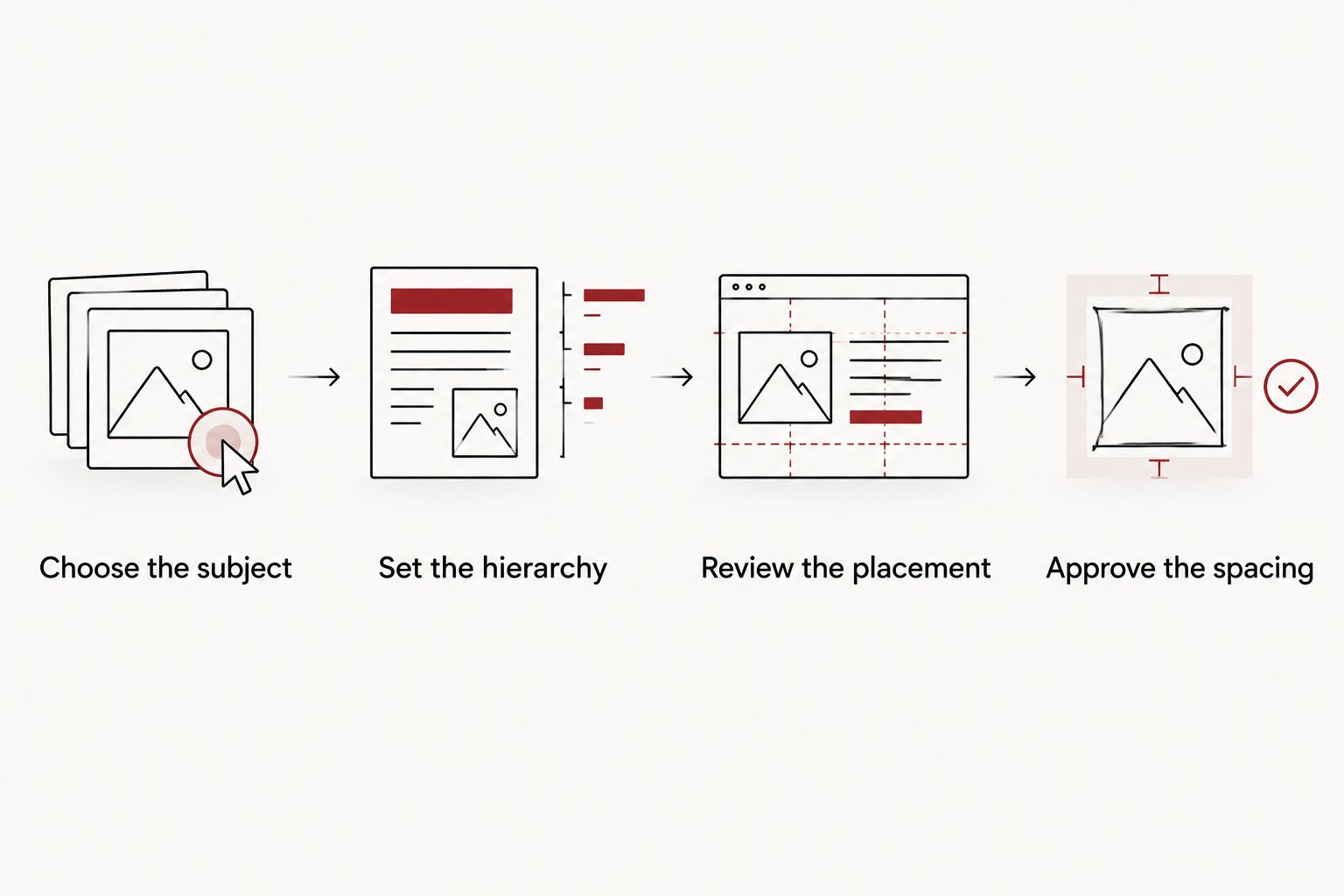
Organize your brief around these steps:
- Choose the subject: Identify the motif and explain what attracts you to it.
- Set the hierarchy: Decide what you should notice first and which details can stay secondary.
- Review the placement: Check orientation, visible boundaries, and how the design follows your body.
- Approve the spacing: Look at open areas and intersections before focusing on decorative detail.
Ask to review the stencil while standing naturally, not only while holding a pose. If a boundary disappears around your arm, decide whether that interruption supports the design or needs adjustment.
Use the contact page to request directions and discuss visiting the Las Vegas studio. Confirm arrangements directly rather than planning around an assumed same-day opening.
Discuss your geometric tattoo
Bring your references and placement ideas to a custom tattoo conversation in Las Vegas.
How these ideas were ranked
This 2026 ranking prioritizes readable structure, placement flexibility, personal relevance, and a clear role for each detail. Circle-and-triangle compositions lead because they offer a flexible starting point; the remaining options answer more specific preferences rather than represent lower-quality choices.
Which geometric tattoo should you choose?
Choose a circle-and-triangle composition if you want the clearest starting point. Choose a faceted animal for storytelling, a mandala for symmetry, or a botanical for organic contrast.
Illuminati Tattoo Co. is best for Las Vegas clients seeking custom geometric tattoo design built around their own ideas. Bring the direction you prefer, then develop its scale and placement with the artist rather than copying a reference unchanged.
FAQ
What are the best geometric tattoo design ideas for a first tattoo?
An open circle-and-triangle composition or a geometric botanical is a clear starting point. Choose a focused design and discuss its scale and placement before adding detail.
Do geometric tattoos have specific meanings?
Geometric tattoos do not share a single universal meaning. Personal compositions can carry your own associations, while specific cultural or religious symbols deserve separate research.
Are geometric tattoos always symmetrical?
No, geometric tattoos can be symmetrical or asymmetrical. A radial mandala emphasizes symmetry, while an offset botanical frame can use deliberate imbalance.
Can a geometric tattoo work as a cover-up?
A geometric cover-up needs an individual assessment of the existing tattoo. Open outlines and untattooed areas do not conceal old ink, so keep the replacement design flexible.
Should I choose fine lines or bold geometry?
Choose line weight according to the design's scale, spacing, and intended contrast. Fine lines and bold areas serve different visual purposes; neither replaces good composition.
Where should I place a geometric tattoo?
Choose placement according to whether the design faces outward, follows a limb, or wraps around it. Review the stencil from more than one angle and with your body relaxed.
How do I start a custom geometric tattoo in Las Vegas?
Contact Illuminati Tattoo Co. with your preferred motif, reference images, and placement ideas. Request directions and confirm visit arrangements directly with the studio.
One last thing
Ask what should be removed. A design discussion often focuses on additions, but eliminating a competing line or background pattern can make the central idea clearer. Before approving your 2026 tattoo, identify the detail you would miss least and consider the composition without it.