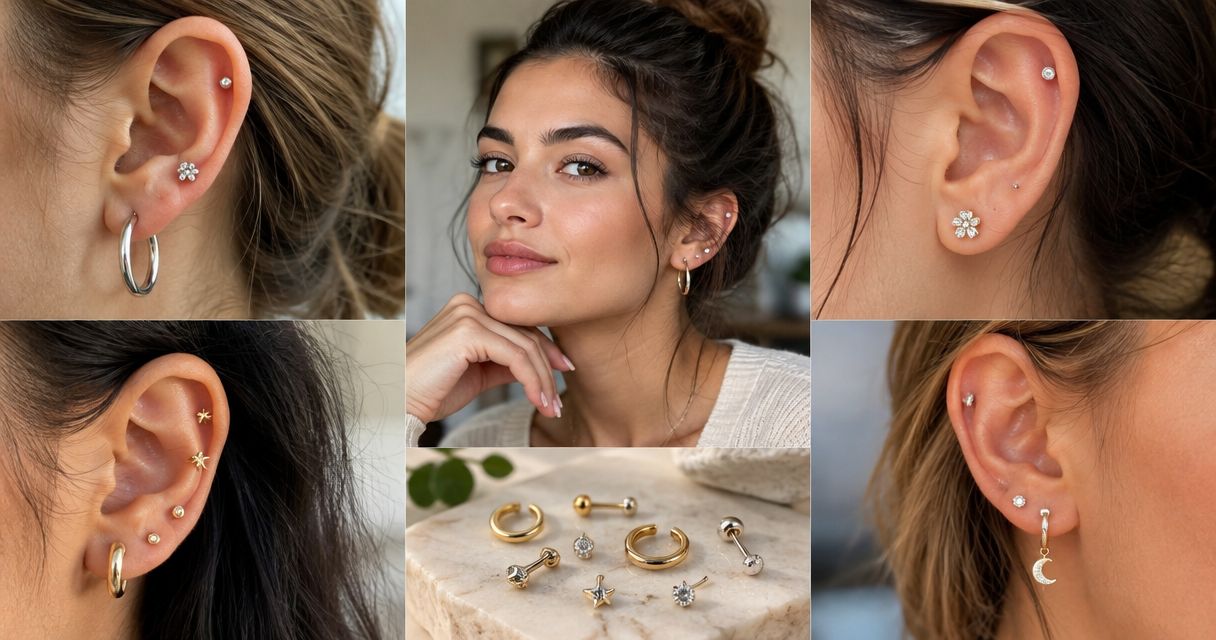
Best overall: a minimalist flat-back stud. Best for a focal point: a gemstone cluster. Best for an understated look: a plain disc. These piercing jewelry style ideas for 2026 compare ten looks by placement, proportion, and everyday practicality—not appearance alone.
- Minimalist flat-back studs lead these piercing jewelry style ideas for a clean, adaptable look.
- Gemstone clusters create a focal point; plain discs keep an ear arrangement visually quiet.
- Jewelry fit, material, and healing stage take priority over matching a reference photo.
- Tattooilluminati offers Las Vegas clients professional body piercing services and an in-person starting point for jewelry discussions.
Why this matters
A jewelry style can look right in a photograph and still be wrong for your piercing. The decorative end, wearable length, thickness, and closure all need to suit the placement and its healing stage.
For local guidance, Tattooilluminati provides professional body piercing services in Las Vegas. The owner-operated studio emphasizes clean, hygienic service and choices built around the individual—not pressure to copy someone else's arrangement.
Use this 2026 guide to identify the appearance you want before discussing the actual jewelry with a piercer. Choose the look yourself; have a professional confirm the fit.
What makes the best piercing jewelry style ideas?
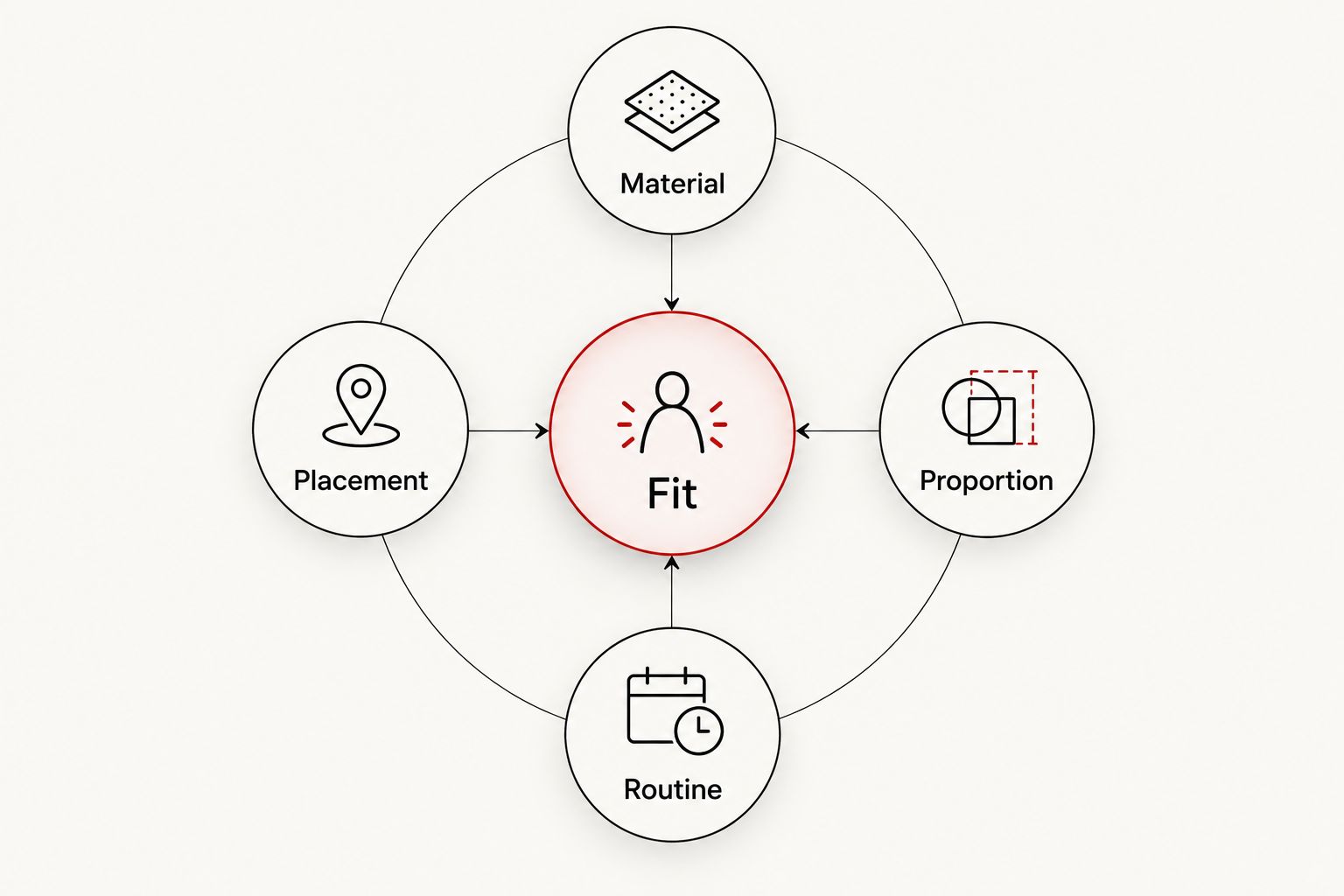
- Fit: Jewelry must suit your anatomy, piercing angle, and healing stage. A decorative preference does not determine the correct dimensions.
- Material: Ask for the exact material and relevant documentation. A silver or gold appearance does not establish what the jewelry contains.
- Placement: A lobe, nostril, helix, and septum do not use interchangeable jewelry simply because the decoration looks similar.
- Proportion: Compare the decorative end with nearby jewelry and the space around the piercing, rather than choosing from an isolated product image.
- Routine: Consider glasses, headphones, clothing, hair, and sports equipment before choosing projecting shapes or hanging details.
These criteria work together. A small end on an incorrectly fitted post is not a better choice than a larger, correctly fitted piece simply because it looks more restrained.
Piercing jewelry styles at a glance
The order below favors adaptable styling first, followed by more placement-dependent or decorative options. These are design recommendations, not a statement that every style suits a fresh piercing.
| Rank | Jewelry style | Best for | Standout feature | Key limitation |
|---|---|---|---|---|
| 1 | Minimalist flat-back stud | A versatile starting point | Small front with a flat backing | Post fit still needs assessment |
| 2 | Plain disc | An understated arrangement | Simple, uninterrupted shape | Little sparkle or visual movement |
| 3 | Bezel-set gemstone | Controlled sparkle | Metal rim frames the stone | Raised profile varies by design |
| 4 | Gemstone cluster | A single focal point | Several stones in one decorative end | Needs enough surrounding space |
| 5 | Close-fitting hoop | A continuous outline | Curved silhouette | Diameter and healing stage matter |
| 6 | Graduated lobe studs | A coordinated lobe arrangement | Deliberate size progression | Existing spacing controls the result |
| 7 | Curved decorative end | Following the ear's contour | Arc-shaped decoration | Orientation must suit the placement |
| 8 | Short jewelry chain | Linking healed piercings visually | A suspended connecting detail | Adds movement and snag exposure |
| 9 | Geometric end | A graphic accent | Defined lines and angles | Corners need careful positioning |
| 10 | Septum circular barbell | A balanced septum look | Open circular form with paired ends | Not every septum suits the same dimensions |
1. Minimalist flat-back stud: best for a versatile starting point
A minimalist flat-back stud combines a restrained decorative front with a flat disc behind the piercing. The term describes the construction, not a guarantee that a particular post suits every ear or nostril.
Start with one simple shape if you want room to develop an arrangement later. A small round end provides a clear reference for deciding whether your next piece should add color, size, or texture.
Minimalist flat-back stud pros:
- Works as a quiet supporting element.
- Keeps the decorative shape easy to read.
- Coordinates visually with several other styles.
Minimalist flat-back stud cons:
- An unsuitable post length still causes fit problems.
- A tiny end delivers limited visual impact.
Best for: A clean starting point for your 2026 jewelry plan.
Verdict: Buy after professional fitting.
2. Plain disc: best for an understated arrangement
A plain disc removes the gemstone and keeps the emphasis on shape and finish. Choose this direction when you want your piercing visible without making it the brightest detail on your face or ear.
For a coordinated arrangement, repeat the same finish rather than adding several competing decorations. Two matching discs can create repetition without requiring identical placement on both ears.
Plain disc pros:
- Creates a restrained visual effect.
- Pairs easily with a statement piece elsewhere.
- Makes a repeated-shape arrangement straightforward.
Plain disc cons:
- Offers no gemstone sparkle.
- A broad disc can conceal more surrounding skin than expected.
Best for: Subtle styling and visually quiet supporting piercings.
Verdict: Buy for simplicity, after confirming the backing and fit.
3. Bezel-set gemstone: best for controlled sparkle
A bezel setting surrounds a gemstone with a metal rim. It gives you a defined outline while keeping the stone as the main decorative feature.
Compare the side profile as well as the front view. Two round gemstone ends can look similar head-on but project differently from the skin, which matters around glasses and other daily contact points.
Bezel-set gemstone pros:
- Combines a clear outline with sparkle.
- Makes a single color easy to repeat.
- Offers a middle ground between plain and elaborate.
Bezel-set gemstone cons:
- Setting height varies between pieces.
- The metal rim changes how much stone is visible.
Best for: A polished accent without a multi-stone design.
Verdict: Buy when the complete profile suits your placement.
4. Gemstone cluster: best for a single focal point
A gemstone cluster places several stones within one decorative end. It creates a focal point without requiring several separate piercings.
Let the cluster lead the arrangement. Pairing it with quieter pieces gives the shape room to stand out, while another large cluster nearby creates a deliberately fuller look.
Gemstone cluster pros:
- Delivers detail through one jewelry end.
- Establishes a clear visual centerpiece.
- Supports coordinated color choices.
Gemstone cluster cons:
- Requires enough space around the piercing.
- Extra contours need attention during cleaning.
Best for: Readers who want one prominent accent rather than an evenly minimal arrangement.
Verdict: Buy after checking clearance and orientation in person.
5. Close-fitting hoop: best for a continuous outline
A close-fitting hoop emphasizes the curve around a piercing rather than a decorative front. The intended effect is a clean outline, not a ring that presses tightly against tissue.
For your 2026 reference collection, save photographs showing the full placement rather than cropped jewelry alone. A piercer needs to assess the relationship between the piercing channel, surrounding anatomy, and proposed diameter.
Close-fitting hoop pros:
- Creates a continuous curved silhouette.
- Provides contrast beside straight-edged decorations.
- Keeps the design visually simple.
Close-fitting hoop cons:
- An overly tight diameter creates pressure.
- Changing to a hoop requires healing-stage assessment.
Best for: A curved outline in a suitable, professionally assessed piercing.
Verdict: Hold until a piercer confirms readiness and dimensions.
6. Graduated lobe studs: best for a coordinated lobe arrangement
Graduated lobe studs use a deliberate progression in decorative size. Try planning three studs from largest to smallest, while treating that sequence as a design sketch rather than a requirement.
Your existing spacing determines whether the progression reads clearly. Do not force an oversized end into a narrow gap just to preserve the pattern.
Graduated lobe studs pros:
- Gives several piercings a shared structure.
- Works with plain or gemstone ends.
- Lets one position carry more emphasis.
Graduated lobe studs cons:
- Uneven spacing changes the visual rhythm.
- Each piercing still needs individually fitted jewelry.
Best for: Organizing an existing multi-lobe arrangement.
Verdict: Buy as a coordinated plan, not an assumed universal set.
7. Curved decorative end: best for following the ear's contour
A curved decorative end places its detail along an arc. Unlike a hoop, the visible curve belongs to the decoration rather than a ring passing around the edge of the ear.
Ask to evaluate its orientation against your actual anatomy. An attractive curve in a display image does not establish whether the ends will sit comfortably on your ear.
Curved decorative end pros:
- Introduces a directional line.
- Can echo the visible ear contour.
- Adds detail without a hanging chain.
Curved decorative end cons:
- Orientation affects the finished appearance.
- Longer ends need sufficient clearance.
Best for: A contour-led accent rather than a round focal point.
Verdict: Buy only after assessing position and surrounding space.
8. Short jewelry chain: best for linking healed piercings visually
A short jewelry chain creates a visible connection between suitable attachment points. It turns separate pieces into a connected composition and introduces movement that fixed studs do not provide.
Treat a chain as a finishing detail for an assessed, healed arrangement. Discuss attachment compatibility and your routine before deciding how much drape you want.
Short jewelry chain pros:
- Connects separate visual elements.
- Adds movement to a fixed arrangement.
- Changes the outline without another decorative stud.
Short jewelry chain cons:
- Can catch on hair or clothing.
- Requires compatible fittings and suitable attachment points.
Best for: Adding a connecting detail to established piercings.
Verdict: Hold until healing, compatibility, and snag risks are assessed.
9. Geometric end: best for a graphic accent
A geometric end uses a recognizable shape such as a triangle, square, or bar. It offers a clear alternative when you prefer lines and angles to gemstones or botanical details.
Compare the shape in its intended orientation. A horizontal bar and a vertical bar create different compositions, even when the jewelry itself is identical.
Geometric end pros:
- Creates a distinct graphic feature.
- Coordinates through repeated shapes.
- Adds contrast beside round jewelry.
Geometric end cons:
- Projecting corners need careful positioning.
- Rotation can change the intended appearance.
Best for: A structured arrangement built around shape rather than sparkle.
Verdict: Buy after checking edge clearance and orientation.
10. Septum circular barbell: best for a balanced septum look
A circular barbell has an open circular shape with an end on each side. Its paired ends create a balanced appearance beneath the nose.
Choose the dimensions around your anatomy rather than a photographed gap. This is a placement-specific option, not an interchangeable substitute for any curved piece of jewelry.
Septum circular barbell pros:
- Creates a recognizable open-circle silhouette.
- Uses paired ends for visual balance.
- Keeps the decorative structure straightforward.
Septum circular barbell cons:
- End size changes the overall appearance.
- Incorrect dimensions compromise fit.
Best for: A defined, balanced look in a suitable septum piercing.
Verdict: Buy after a professional septum assessment.
How these styles are ranked
This 2026 ranking prioritizes visual adaptability, straightforward composition, and the number of placement-specific decisions involved. It does not rank jewelry materials, manufacturers, or clinical outcomes.
Minimalist studs come first because their restrained shape makes them a useful starting point for building an arrangement. Chains and septum jewelry sit lower because their attachment or placement requirements narrow the decision—not because they are less attractive.
Plan your studio visit
Bring a small selection of reference images and identify what you like in each: the shape, color, spacing, or overall outline. Separate those preferences from assumptions about the exact jewelry required.
Before choosing, ask:
- What material is this piece, and what documentation supports it?
- Does the jewelry suit my anatomy and healing stage?
- Will the decoration interfere with glasses, headphones, or clothing?
- How should I clean around this particular shape?
At Tattooilluminati, discuss your intended look alongside practical fit questions. Use the contact page to plan your visit and get directions; confirm current arrangements before traveling.
Plan your piercing visit
Discuss your preferred jewelry style and practical fit questions before choosing your next look.
Which piercing jewelry style should you choose?
Choose a minimalist flat-back stud if you are undecided. Move toward a cluster for a focal point, a plain disc for restraint, or a professionally fitted hoop for a continuous outline.
Tattooilluminati is best for Las Vegas clients who want to discuss piercing jewelry choices in person. Bring a direction, not a fixed demand for dimensions copied from a photograph.
FAQ
What's the best piercing jewelry style for a simple look?
A plain disc is the strongest choice for an understated look. A minimalist flat-back stud is another clear starting point when its construction and dimensions suit your piercing.
Are hoops better than studs for a new piercing?
Hoops are not automatically better than studs for a new piercing. A professional piercer should select appropriate jewelry for the placement, anatomy, and expected swelling rather than choosing by appearance alone.
Can I change my piercing jewelry just because it looks healed?
No—surface appearance alone does not establish that a piercing is ready for a jewelry change. Ask a professional piercer to assess healing before replacing the jewelry yourself.
What material should I ask about for piercing jewelry?
Ask for the exact material and its supporting standard or documentation, not just a description such as hypoallergenic. Implant-certified titanium meeting ASTM F136 is one established option used for initial piercing jewelry; the complete piece must also have appropriate construction, finish, and fit.
How do I make several ear piercings look coordinated?
Repeat one visual element, such as finish, gemstone color, or shape. Graduated lobe studs provide another approach, but the size progression must respect the spacing of your existing piercings.
Can I wear a jewelry chain on a fresh piercing?
Treat a decorative chain as a later styling decision rather than a starting point for a fresh piercing. Have a piercer assess healing, compatible attachments, and the risk of catching before adding one.
Where can I discuss piercing jewelry ideas in Las Vegas?
Tattooilluminati offers professional body piercing services in Las Vegas. Bring reference images and ask about anatomy, healing stage, material, and fit before settling on your preferred style.
One last thing
For your 2026 jewelry plan, photograph the full ear or face alongside each close-up reference. The wider view reveals whether you actually prefer the individual piece or the spacing and balance around it—a useful distinction before choosing jewelry.